

A swimwear tech pack gives a manufacturer the information needed to interpret your design accurately. Without clear specifications, factories must make assumptions about fabric, fit, construction, and finishing. Those assumptions can distort quotations and create avoidable sampling revisions.1 A complete specification baseline should be established before requesting production pricing.
A swimwear tech pack should include front and back technical drawings, a bill of materials, color and print references, measurement specifications, grading expectations, construction details, labeling, packaging, quality tolerances, and revision records. Together, these details allow a manufacturer to quote, sample, produce, and inspect the garment against documented requirements rather than assumptions.
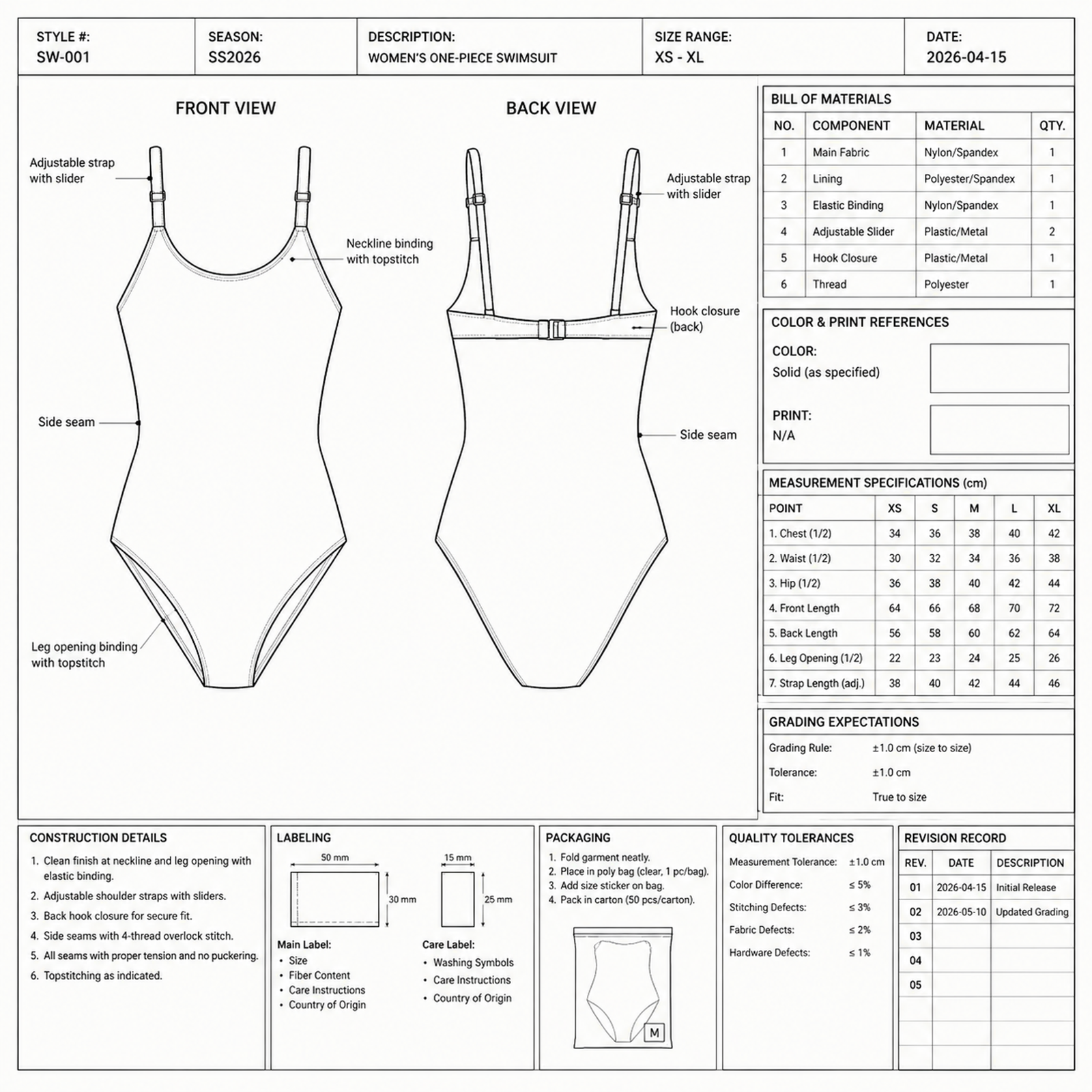
Many founders begin by asking for a unit price before providing these details. However, a useful quotation depends on much more than a design image. The following sections explain what factories need and how each field affects development.
What Design Drawings Should a Swimwear Tech Pack Include?
A beautiful inspiration image can communicate an aesthetic, but it rarely explains how a swimsuit should be assembled. If the factory interprets an unseen back, seam, strap, or closure incorrectly, the first sample may not reflect the founder’s idea. Clear technical drawings reduce that ambiguity.
Include flat front and back technical drawings with callouts for seams, panels, edges, straps, closures, hardware, trims, branding, and print placement. Additional side or interior views should show details that cannot be seen from the main flats. Each callout should describe what the manufacturer must make, not only how the design should look.
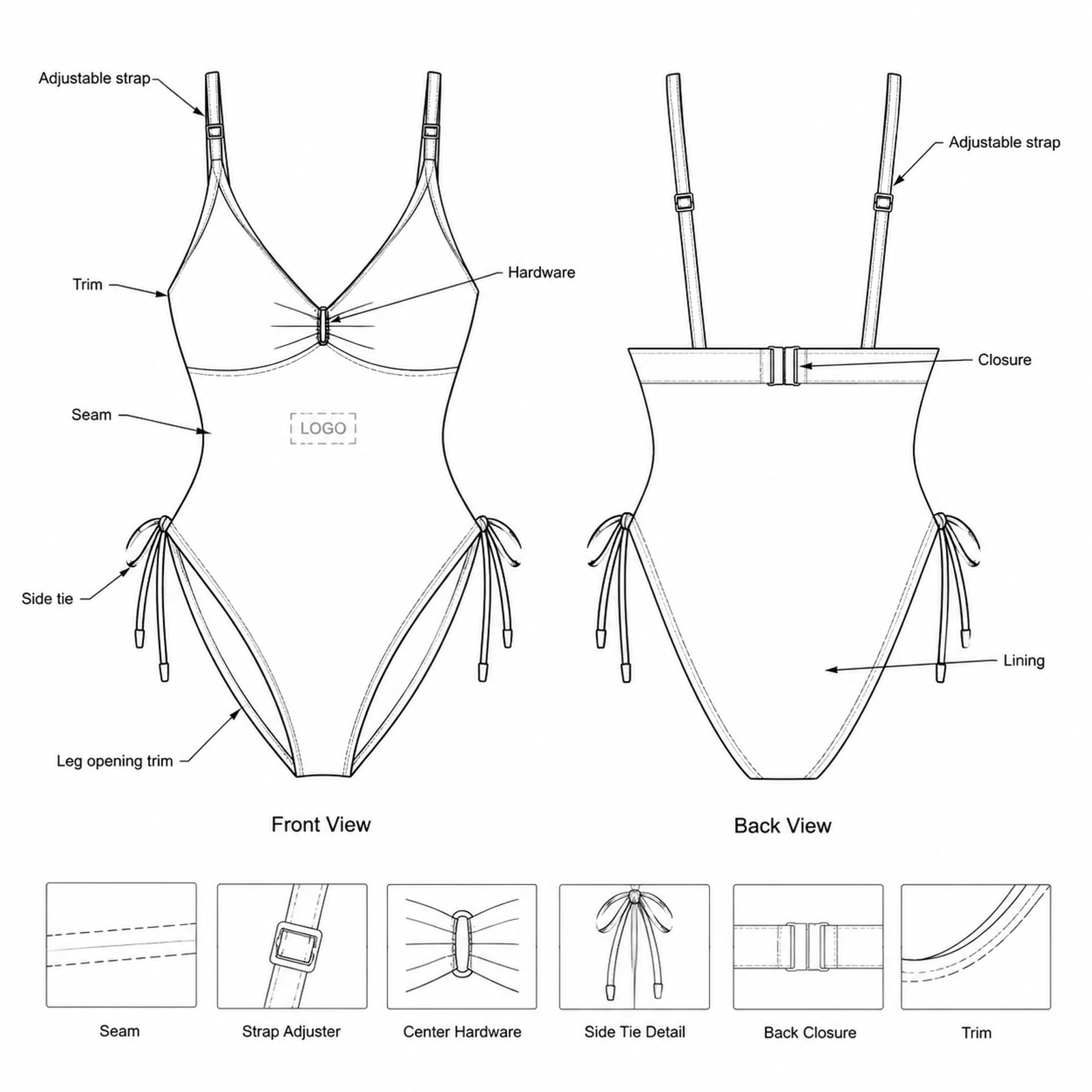
Use technical flats rather than inspiration alone
A technical flat is a simplified line drawing of the garment laid flat. It is different from a fashion illustration. A fashion illustration communicates mood and proportion, while a flat drawing communicates construction.2
At a minimum, the technical pack should include:
- Front view
- Back view
- Side view, if the side construction is unusual
- Inside view, when cups, pockets, lining, or internal elastic matter
- Close-up views for complicated straps, hardware, gathers, or closures
For example, a front image of a bikini top may not reveal whether the back uses a hook, tie, clasp, or continuous band. It may also hide removable cup openings, side boning, or strap adjusters. Those differences affect material cost, labor, sourcing, and fit.3
Call out every construction feature
Each arrow or numbered callout should identify a specific requirement. Key details include:
- Strap width and whether it is fixed or adjustable
- Neckline and armhole finishing method
- Seam position and seam type
- Elastic placement and finished tension expectations
- Cup style, cup thickness, and removable pad opening
- Hardware material, size, color, and finish
- Gathering, ruching, pleating, binding, or topstitching
- Closure type and attachment method
- Brand logo position and application technique
- Lining coverage, including partial or full lining
A note that says “gold ring” still leaves several questions. The factory may need the inner diameter, outer diameter, metal composition, finish, corrosion-resistance expectations, and approved color reference. Even a small change in ring size can alter strap construction.
Define print and branding placement
Show the position and dimensions of logos, heat transfers, embroidery, woven labels, and prints. A centered chest logo should have measurements from fixed reference points rather than an instruction such as “place near the top.”
For engineered or placement prints, the tech pack should show:
- Artwork dimensions
- Print orientation
- Repeat size, if applicable
- Placement relative to seams
- Scale on each garment size
- Acceptable placement tolerance
- Approved digital artwork file reference
In early-stage inquiries, inspiration boards are useful conversation starters. However, they are not reliable manufacturing instructions. A factory needs to know which visual elements are essential and which elements remain open to development advice.
What Measurements Should a Swimwear Tech Pack Specify?
Swimwear fit depends on controlled stretch, negative ease, coverage, and body proportion.4 A simple label such as “size medium” does not provide enough information because sizing differs across brands and markets.5 Without measurable targets, the buyer and factory may evaluate the same sample differently.
A swimwear tech pack should identify the base sample size, every point of measurement, finished garment measurements, measurement methods, allowed tolerances, intended size range, and grading rules. It should also state whether measurements are taken relaxed or stretched. These specifications create an objective basis for pattern development, fitting, and final inspection.
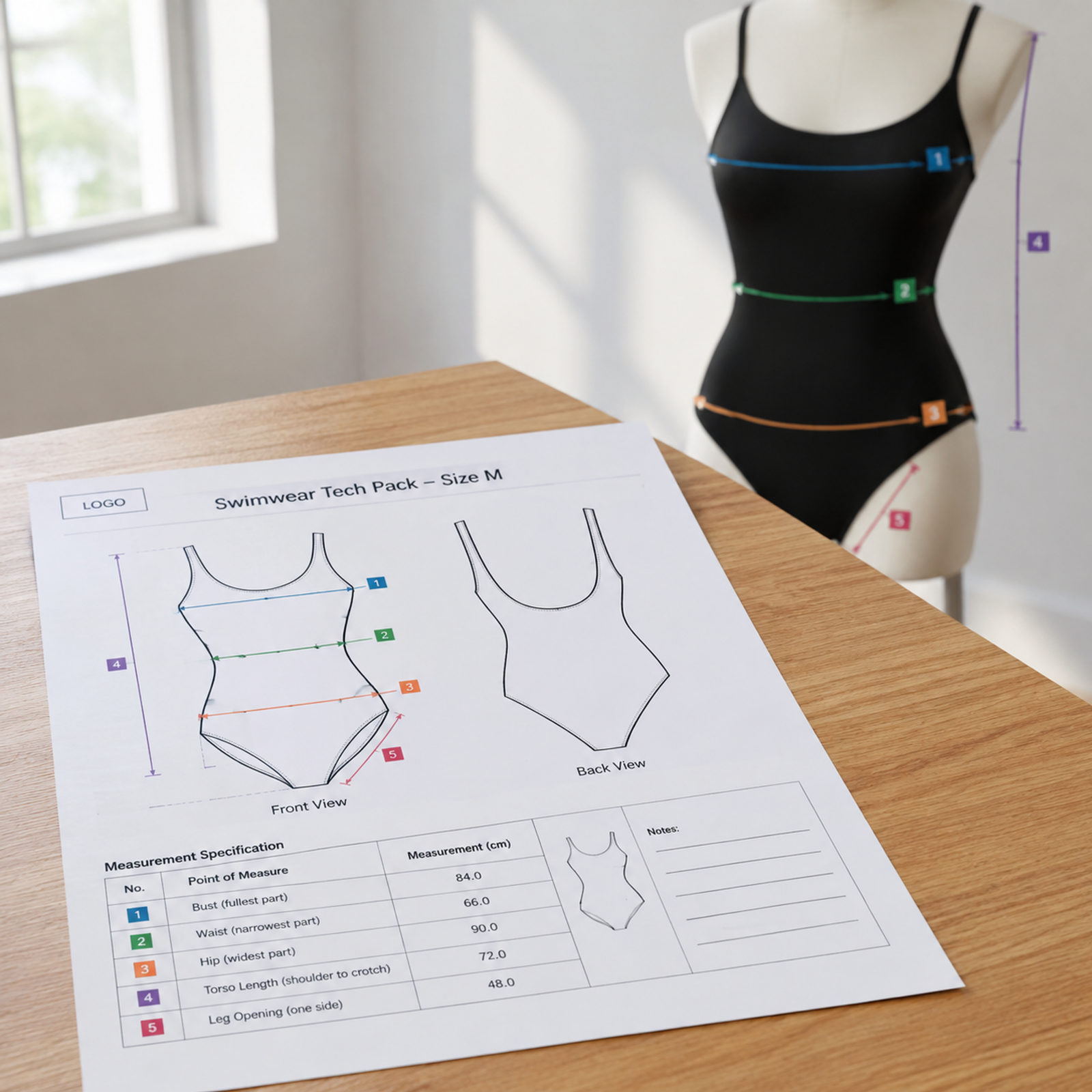
Start with a defined base size
The base size is the size used for initial pattern development and sampling. Many brands choose a central size, but the right choice depends on the customer profile and planned size range.
The specification should document:
- Base size designation
- Target body measurements
- Finished garment measurements
- Intended fit description
- Fit model measurements, if a fit model is used
- Reference block or approved existing style, if applicable
A target body chart and a garment specification chart serve different purposes. The body chart describes the intended wearer. The garment chart describes the actual product. Swimwear often uses negative ease, so the unstretched garment may measure smaller than the body.6
Define each point of measurement
Every point of measurement, often called a POM, should include a written method or numbered diagram. If two people can measure the garment in different ways, the specification needs more detail.
Common bikini-top measurements may include:
- Underbust width
- Cup width and height
- Center-front height
- Side-wing height
- Strap width
- Strap length
- Distance between cups
- Back-closure width
Common bikini-bottom measurements may include:
- Waist width
- Front rise
- Back rise
- Side-seam height
- Leg-opening length
- Front and back coverage
- Gusset width and length
One-piece measurements may also cover torso length, body width at several levels, neckline drop, armhole, leg opening, and strap positioning.
Add realistic tolerances
A tolerance defines the acceptable difference between the target measurement and the measured garment. It does not replace accurate production. Instead, it gives quality-control teams an agreed acceptance range.
| Specification field | Example format | Why it matters |
|---|---|---|
| Base size | Medium | Establishes the sample reference |
| Waist width | 34 cm relaxed | Defines the target dimension |
| Measurement method | Straight across waistband | Prevents inconsistent measuring |
| Tolerance | ±0.5 cm | Sets an inspection limit |
| Grade to next size | +2 cm | Guides size development |
| Stretch condition | Relaxed | Clarifies testing conditions |
Tolerance values should reflect the garment, material, construction, and measurement point. A single universal tolerance should not be applied to every measurement.
Explain grading expectations
Grading determines how the pattern changes between sizes. A proportional increase everywhere may not produce the desired coverage or support.7 Plus-size styles may require different strap widths, cup structures, elastics, or panel proportions rather than simple enlargement.
An experienced pattern technician should review grading against the target customer profile and intended size range. A factory can often support pattern development, but the brand should still approve the resulting fit and size set. A tech pack reduces interpretation risk, but it cannot guarantee perfect fit without physical fitting and documented approvals.
How Should Materials Be Defined in a Swimwear Tech Pack?
Material descriptions often look complete until sourcing begins. Terms such as “nylon,” “recycled fabric,” or “soft stretch material” are too broad for dependable costing. Different weights, compositions, finishes, and recovery levels can change opacity, support, hand feel, durability, and price.8
Specify the shell and lining composition, fabric weight, construction, stretch direction, color reference, finish, performance requirements, and approved supplier or swatch reference. The bill of materials should also define elastics, cups, hardware, labels, closures, threads, and decorative trims. Any acceptable substitutions should be documented before sourcing begins.
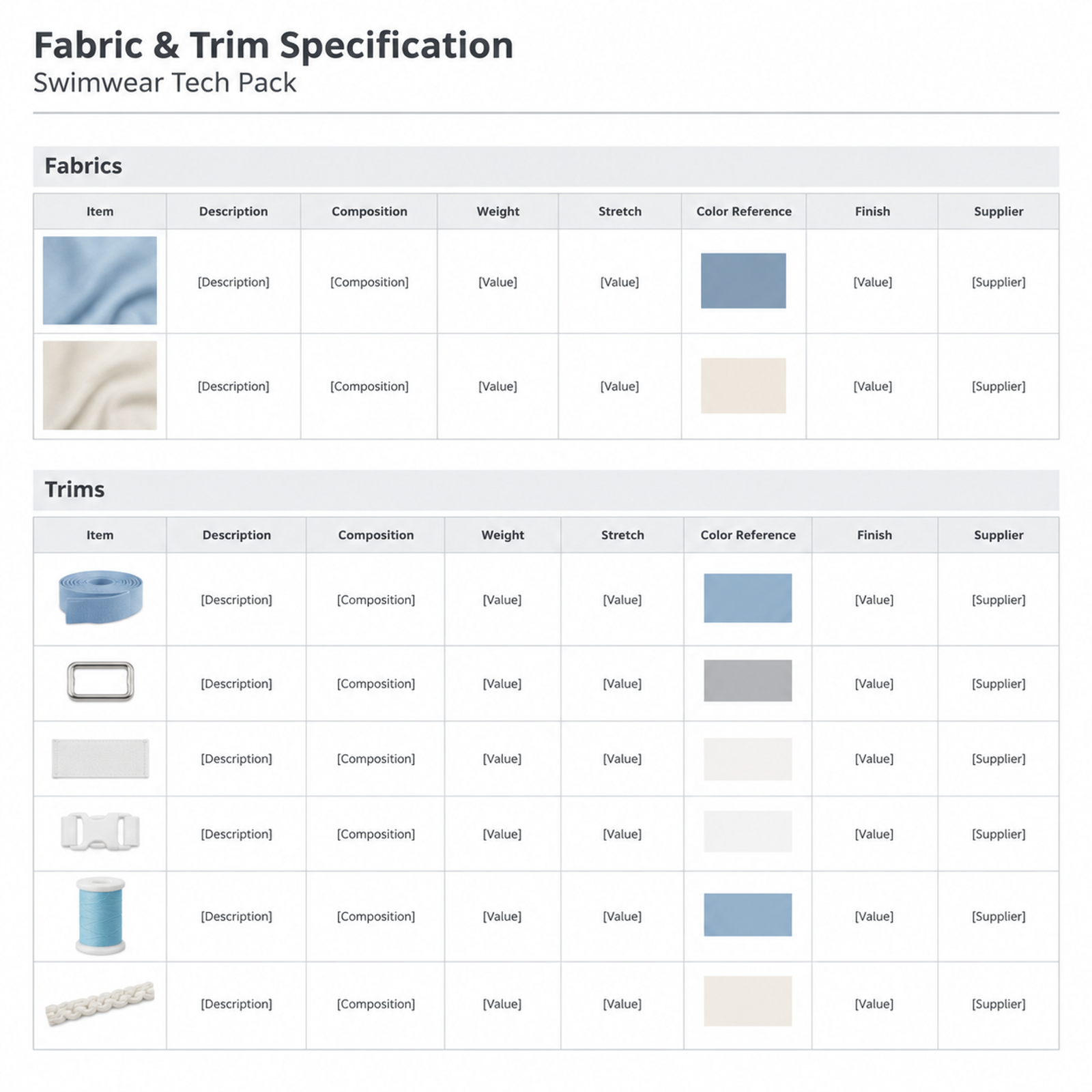
Build a precise bill of materials
The bill of materials, or BOM, lists every component required to make and pack the product. A BOM table should assign each component a reference number linked to the technical drawings.
| Component | Details to define | Cost or quality effect |
|---|---|---|
| Main fabric | Composition, weight, width, color, finish | Affects sourcing, fit, hand feel, and price |
| Lining | Composition, weight, color, coverage | Affects opacity, support, and comfort |
| Elastic | Width, type, recovery, placement | Affects fit and edge stability |
| Cups | Shape, thickness, size, removable or fixed | Affects support and construction |
| Hardware | Dimensions, material, finish, color | Affects appearance, sourcing, and durability |
| Thread | Type and color | Affects seam performance and appearance |
| Labels | Material, dimensions, artwork, placement | Affects branding and market requirements |
| Packaging | Bag, insert, barcode, carton details | Affects final costing and fulfillment |
Go beyond the fabric name
Fabric names are not standardized enough to function as full specifications. Even branded fiber terms or descriptions such as “ribbed recycled nylon” may cover many possible materials.
The fabric specification should define:
- Fiber composition percentages
- Fabric weight in grams per square meter, when available
- Knit structure or texture
- Width and usable width
- Two-way or four-way stretch
- Stretch and recovery expectations
- Matte, shiny, brushed, ribbed, or textured finish
- Chlorine, saltwater, UV, or pilling requirements, when relevant
- Main fabric and lining color
- Approved physical swatch or supplier article number
When specifying an eco-conscious material such as ECONYL® regenerated nylon, the trademarked fiber name should be treated as one part of the specification, not the complete material definition. The finished fabric still needs a defined blend, weight, knit, color, lining relationship, and performance profile. Buyers should also verify supplier documentation and any environmental claims they plan to publish.
Control color with physical and digital references
Screens display color differently, so a digital image alone can be risky.9 Use a recognized color standard where possible, and approve a physical lab dip or material swatch before bulk production.
The tech pack should distinguish among:
- Target color reference
- Submitted lab dip
- Approved lab dip
- Bulk fabric shade
- Matching requirements for lining, thread, elastic, and hardware
Color matching becomes especially important when different suppliers provide separate components. The same written color name can produce visibly different shades on fabric, elastic, plastic, and metal.
State substitution rules
Supply conditions sometimes require an alternative trim or fabric. The tech pack should not leave substitutions informal. It should state whether substitution is prohibited, allowed within defined parameters, or subject to written approval.
A substitution policy can use wording such as:
No fabric, lining, elastic, cup, or hardware substitution may enter production without buyer review and documented approval.
That process keeps the current specification clear while allowing practical sourcing discussions.
Which Construction and Quality Details Should a Swimwear Tech Pack Cover?
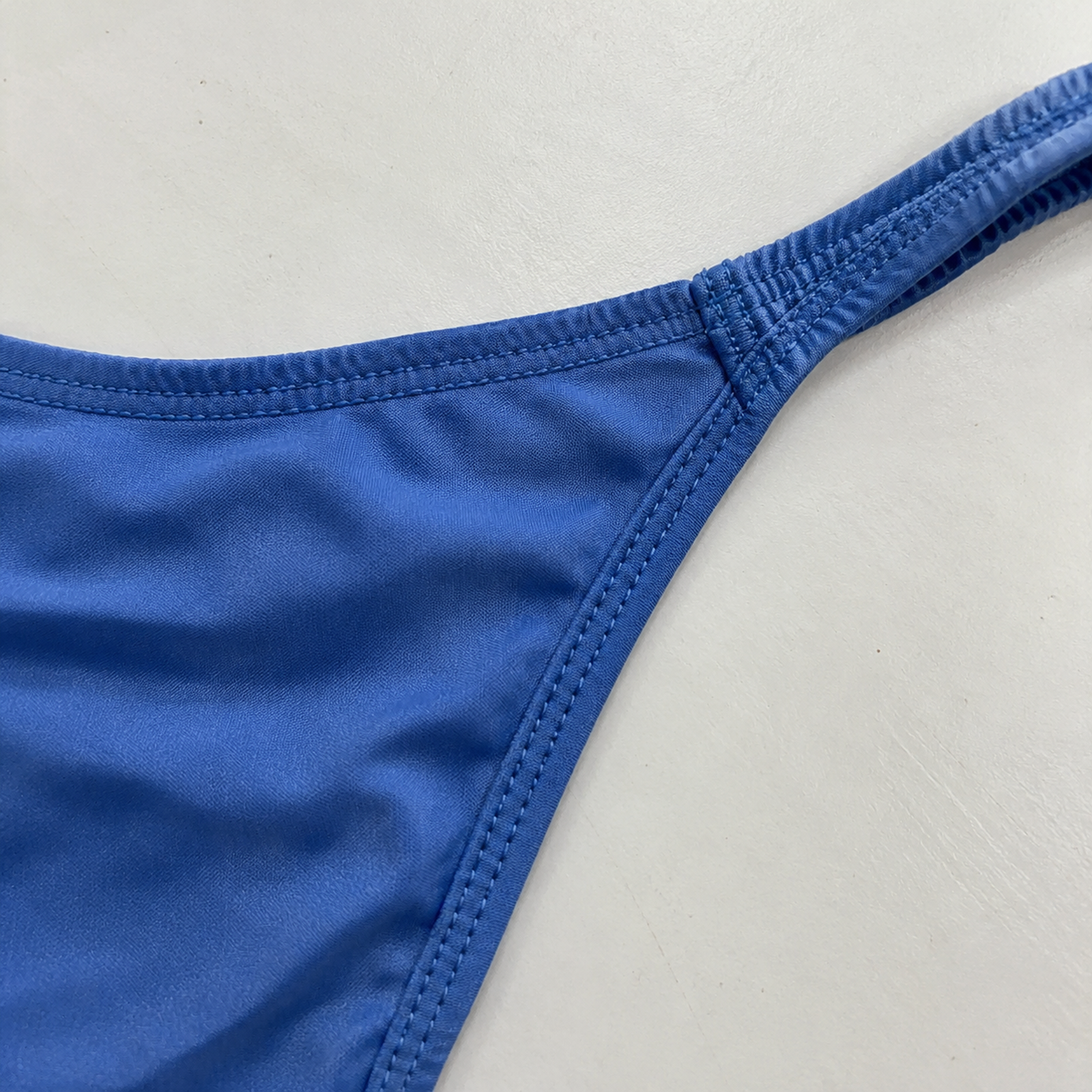
Two swimsuits can look similar in a photograph while using different seam types, elastic applications, lining methods, or reinforcement. Those choices affect labor, appearance, comfort, stretch, and costing.10 If construction remains undefined, factories may quote and sample according to different assumptions.
A swimwear tech pack should define seam types, stitch appearance, elastic application, lining method, reinforcements, edge finishes, cup construction, attachment details, and workmanship standards. It should also identify critical inspection points, measurement tolerances, color expectations, and procedures for defects or deviations that require buyer approval.
Specify the desired seam result
A founder does not always need to dictate every machine setting. However, the pack should clearly communicate the intended appearance and performance. A qualified factory technician can then recommend a suitable method based on the fabric and equipment.
Useful construction notes include:
- Seam or stitch type
- Visible or enclosed seam allowance
- Binding width
- Topstitch position
- Elastic width and application area
- Lining attachment method
- Bartack or reinforcement location
- Strap attachment and adjustment method
- Removable cup opening location
- Print alignment at seams
- Reversible construction requirements
Application-specific construction decisions should be reviewed with a qualified garment technician or pattern maker. Material behavior can change the best construction approach.
Connect quality standards to measurable criteria
Instructions such as “high quality” or “premium stitching” express an expectation, but they are not inspection criteria. Quality requirements work better when they describe an observable result.
Examples include:
- No skipped stitches in visible or load-bearing seams
- No unsecured thread ends
- Symmetrical strap placement within the agreed tolerance
- Hardware positioned according to the approved sample
- Print orientation matching the approved artwork
- No visible lining roll at specified edges
- Measurements within approved tolerances
- Main fabric, lining, and thread matching approved color references
- Labels in the specified position and orientation
The approved pre-production sample often becomes a key visual standard. However, written specifications should remain current even when an approved physical sample is available. A physical sample may not reveal why a detail was approved or which tolerance applies.
Define inspection and approval stages
A practical approval flow may include:
- Material or trim submission
- Lab-dip or print strike-off approval
- Prototype or development sample
- Fit sample
- Revised fit sample, if needed
- Size-set sample
- Pre-production sample
- Bulk production inspection
- Packing review or final random inspection
Not every project uses the same sequence. Complexity, order size, timing, and buyer requirements influence the process. The tech pack should show which stages apply and who has approval authority.
Inspection methods should be agreed upon before a bulk order is placed. At Aura Intimates Global, quality control focuses on material consistency, stitching accuracy, and color matching. Order-specific inspection criteria should be defined in advance, with independent inspection considered when appropriate.
How Should Labeling, Packaging, and Compliance Appear in a Swimwear Tech Pack?
Founders sometimes focus on the swimsuit and postpone packaging or labeling until the sample is nearly complete. That delay can affect quotations, lead times, barcode preparation, and retail readiness. Labels and packaging are production components, so these requirements should be defined early rather than treated as last-minute finishing details.
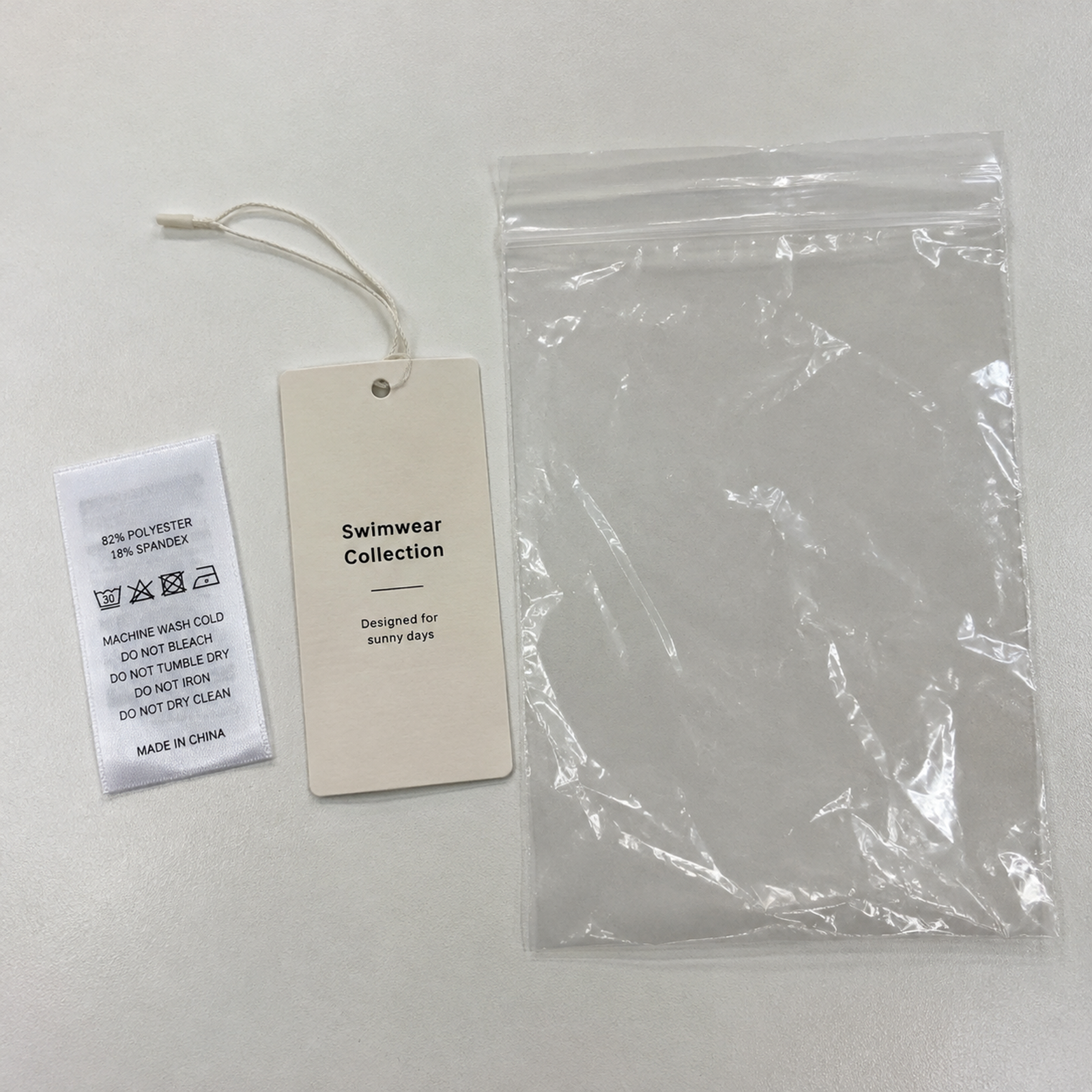
The tech pack should specify every label, care instruction, logo application, hangtag, barcode, polybag, insert, folding method, size sticker, and carton requirement. It should also identify the destination market and applicable testing or documentation needs. Buyers should verify current legal requirements with qualified professionals in each sales market.
Create a label and packaging schedule
Each packaging and labeling component should have a code, artwork reference, dimensions, material, color, and placement.
The schedule may include:
- Main brand label
- Size label
- Fiber-content label
- Country-of-origin marking
- Care label
- Hygiene liner or sticker
- Hangtag
- Barcode or SKU label
- Individual polybag or alternative packaging
- Tissue paper or product insert
- Assortment instructions
- Inner and outer carton markings
For each item, the pack should identify whether the factory will source it or the buyer will supply it. Buyer-supplied components need delivery deadlines and quantity allowances.
Show exact placement
A label that is technically correct can still be uncomfortable or visually disruptive if its placement is unclear. Use diagrams that specify distances from fixed seams or edges to define label placement accurately.
Packaging instructions should also show the intended fold. A one-piece swimsuit with molded cups may need a different packing method from an unstructured bikini. The pack should identify whether hardware needs protective wrapping and whether sets must be attached or packed separately.
Treat compliance as market-specific
Requirements vary by destination, product, sales channel, and claim.11 A single universal swimwear compliance checklist may be misleading because requirements vary by destination market, product, sales channel, and claim.
Instead, document:
- Intended countries of sale
- Required label languages
- Fiber-content and origin-marking instructions
- Restricted-substance requirements
- Retailer-specific testing protocols
- Children’s product requirements, if applicable
- Packaging or waste rules
- Documentation needed for customs or import processes
- Any performance or environmental claims planned for marketing
A supplier may provide test reports, audit records, or certificates where relevant. Buyers should verify the issuing body, scope, product coverage, facility name, and validity period. A certificate should be treated as a document to examine, not as a substitute for product-specific due diligence.
For each target market, buyers should confirm local labeling, language, import, and customs requirements with an experienced compliance adviser or importer. Requirements can differ across countries, even within the same region.
Why Does a Swimwear Tech Pack Matter Before Requesting a Quote?
A price-first inquiry is understandable, especially when a founder is building a business plan. However, a factory cannot calculate a dependable price without knowing what it must source, sew, test, label, and pack. An early number based on assumptions may not be comparable with another supplier’s quote.
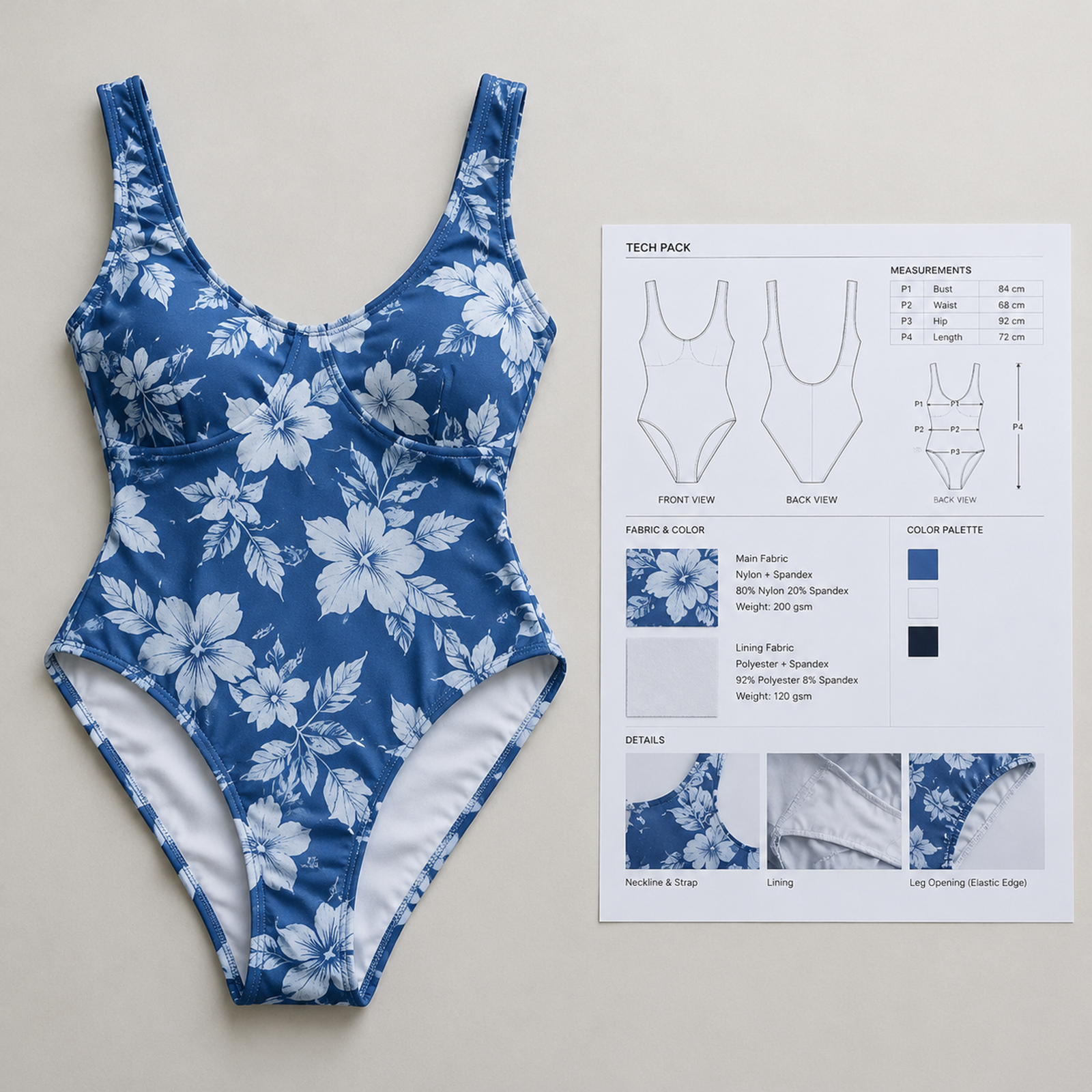
A swimwear tech pack supports accurate quotation because unit cost depends on fabric composition and weight, lining, construction complexity, trims, print method, size range, order quantity, compliance, labeling, and packaging. Without those inputs, a manufacturer can provide only a provisional estimate based on assumptions that may change during product development.
Understand the main cost drivers
Before a quotation can be considered reliable, several variables must be clarified.
| Cost driver | Questions the factory must answer |
|---|---|
| Main material | What composition, weight, texture, and finish are required? |
| Lining | Is the garment fully, partially, or doubly lined? |
| Construction | Which seams, bindings, cups, reinforcements, and closures apply? |
| Is the design solid dyed, all-over printed, or placement printed? | |
| Trims | Does the garment use custom hardware, elastics, rings, or sliders? |
| Sizing | What size range and grading approach are required? |
| Quantity | How many units are needed per style, color, and size? |
| Compliance | Which destination-market tests or documents apply? |
| Packaging | What labels, barcodes, bags, inserts, and cartons are required? |
Order quantity is particularly important.12 A request for 1,000 units can mean 1,000 units of one color or 1,000 units divided among ten colorways and a broad size range. Those scenarios create different material minimums, cutting plans, trim quantities, and handling needs.
Ask for assumptions in provisional estimates
A founder may need a budget range before every detail is final. An indicative estimate can support early budgeting while the product specifications are still being finalized. In that case, request an indicative estimate with clearly documented assumptions.
For example, the estimate might assume:
- One solid color
- A specified standard fabric range
- Full lining
- No custom metal hardware
- A defined quantity per color
- Standard factory packaging
- A limited size range
- No special testing beyond normal quality controls
This approach makes an early estimate more useful. It also allows the buyer to compare suppliers on a similar basis.
Compare scope, not only unit price
A lower quote may exclude items included in another quote. Before comparing prices, confirm:
- Whether fabric and lining are included
- Whether sampling fees are separate
- Whether custom print development is included
- Whether labels and packaging are included
- Whether freight, duties, or taxes are excluded
- Whether testing or inspection costs are included
- Whether the quote uses the same order quantity
- How long the quote remains valid
For example, a reference image may show textured fabric, custom hardware, and shaped cups, while the written inquiry asks only for “a nylon bikini price.” In this situation, clarifying the product specifications is more useful than providing a price based on assumptions.
How Should I Manage Swimwear Tech Pack Revisions and Sample Comments?
Even a detailed pack can change during fitting and sourcing. The risk arises when comments remain scattered across emails, messaging apps, and outdated files. A factory may then follow an old measurement or overlook an approval. One controlled version keeps the development team aligned.
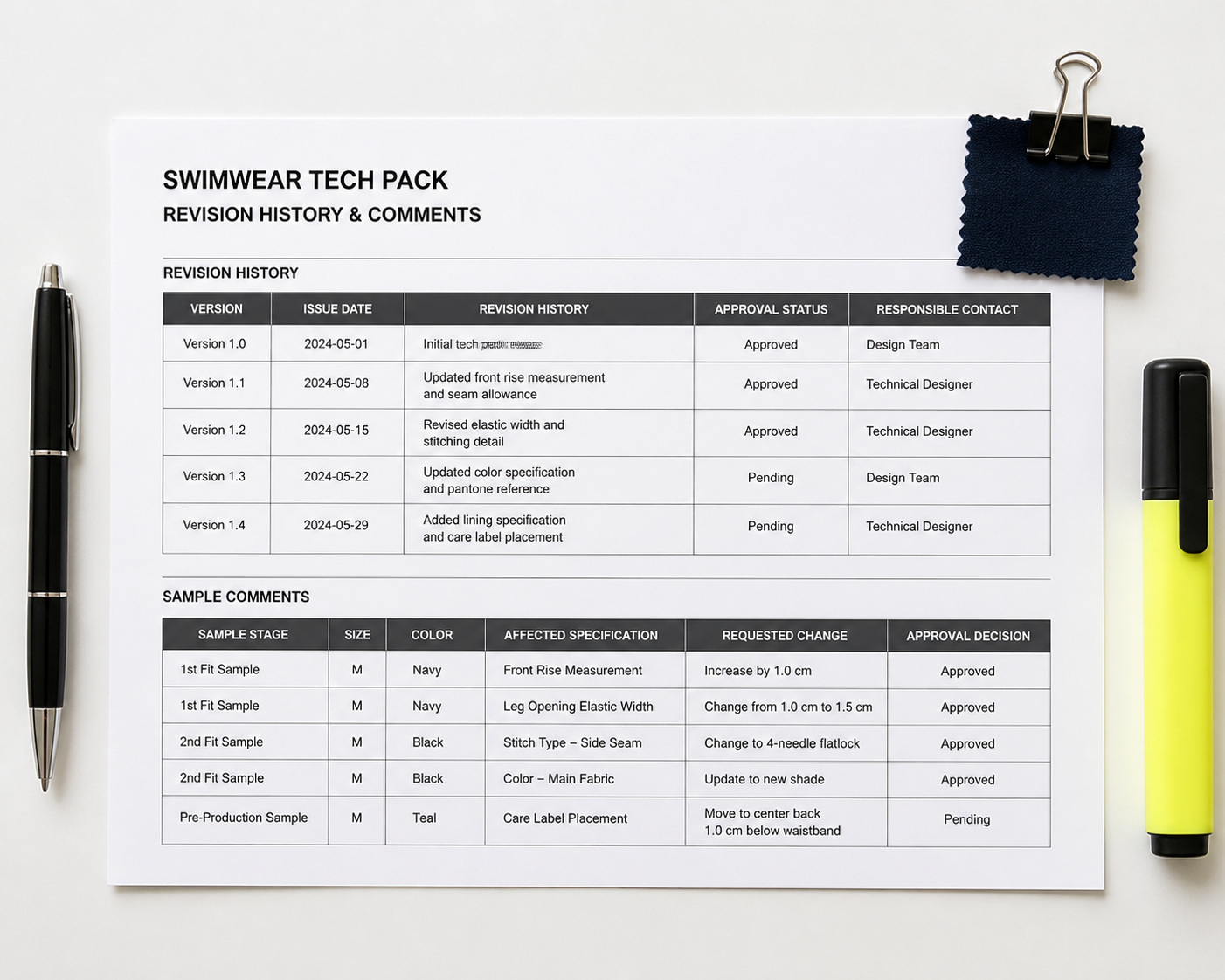
Maintain one controlled swimwear tech pack with a version number, issue date, revision history, approval status, and responsible contact. Every sample comment should identify the sample stage, size, color, affected specification, requested change, and approval decision. Superseded files should be archived clearly and removed from active production use.
Record every meaningful change
A revision table does not need to be complicated. It should make the latest instructions easy to identify.
| Version | Date | Change | Status |
|---|---|---|---|
| V1.0 | 10 January | Initial specification issued | Superseded |
| V1.1 | 24 January | Strap widened and cup position adjusted | Superseded |
| V1.2 | 8 February | Fit approved; lining color updated | Current |
| V1.3 | 15 February | Packaging artwork added | Current for production |
The brand and factory should agree on whether the complete file or only changed pages will be reissued. Reissuing the complete current file can reduce the risk of combining pages from different versions.
Make sample comments objective
Comments such as “fit feels wrong” or “make it more flattering” can begin a discussion, but they do not provide production instructions. Pair visual feedback with a measurable or clearly observable request.
A useful comment can include:
- Photograph with marked area
- Current result
- Desired result
- Measurement change
- Pattern or construction change to evaluate
- Responsible party
- Deadline
- Approval status
For example: “Increase the front rise by 1 cm at center front while keeping the side-seam height unchanged” gives the pattern team clearer direction than “add more coverage.”
Freeze production specifications
Before bulk cutting begins, the parties should confirm the approved:
- Technical drawings
- Measurement chart and tolerances
- Graded size specifications
- Main fabric and lining
- Colors or print strike-offs
- Trims and hardware
- Construction details
- Labels and artwork
- Packaging method
- Pre-production sample
- Order quantities and assortment
Document this stage as a production release or final approval. Changes after approval may affect materials, lead times, or cost, so they should go through a formal review rather than an informal message.
A controlled tech pack does not remove every production risk. Fabric can behave differently at scale, and human processes still require supervision. However, version control greatly reduces avoidable ambiguity and gives quality teams a clear inspection reference.
Frequently Asked Questions About Swimwear Tech Packs
Can I send a reference photo instead of a tech pack?
A reference photo can communicate style direction, but it usually cannot define measurements, internal construction, fabric weight, lining, trims, tolerances, or packaging. Use photos as supporting references alongside technical drawings and written specifications for quotation and sampling.
Do I need a completed tech pack before contacting a manufacturer?
You do not always need a completely finalized file for an initial conversation. However, the manufacturer needs enough information to state meaningful assumptions. At minimum, provide drawings, intended materials, measurements or fit references, quantity, size range, colors, construction features, target market, and packaging expectations.
Can a swimwear manufacturer help create the tech pack?
Many OEM/ODM manufacturers can support specification development, pattern work, and material selection. The service scope varies, so confirm fees, ownership of technical files, revision limits, and approval responsibilities before development begins. The brand should review and approve the final specifications before production.
Does a detailed tech pack guarantee perfect swimsuit fit?
No. A detailed pack reduces ambiguity, but fit still requires skilled pattern development, appropriate fabric, physical samples, fitting, and documented corrections. Test the garment on suitable fit models and review grading with a qualified technician before bulk production.
How often should I update my swimwear technical specifications?
Update the controlled file whenever an approved change affects materials, dimensions, construction, artwork, labeling, packaging, or quality requirements. The current version should display its date and approval status. The factory should not need to search through emails to determine which instruction is valid.
Conclusion
A complete swimwear tech pack gives your manufacturer a reliable baseline for pricing, sampling, production, and inspection. Define the design, measurements, materials, construction, tolerances, labels, packaging, market requirements, and revision status before approving production. The file cannot eliminate every risk, but it can reduce assumptions and avoidable human error.
If you are preparing a new collection, contact Aura Intimates Global to review your specifications and discuss an OEM or ODM development plan, material options, practical MOQs, and quotation requirements.
"ABSTRACT GHAANI FARASHAHI, BEHNOOSH. Perceptions ...", https://repository.lib.ncsu.edu/server/api/core/bitstreams/2a291a7a-537f-4991-b790-cb8e9bf141a0/content. Research on apparel product development indicates that incomplete technical specifications can increase interpretation errors and require additional clarification or sampling, although the number of revisions depends on the product and supplier relationship. Evidence role: general_support; source type: paper. Supports: Research on apparel product development should show that incomplete or ambiguous specifications increase communication errors, costing uncertainty, or sample iterations.. Scope note: This evidence supports the general relationship between specification completeness and development efficiency, not a guaranteed outcome for every quotation. ↩
"Fashion Flats and Technical Drawing: - with STUDIO", https://www.bloomsbury.com/us/fashion-flats-and-technical-drawing-9781501317521/. Apparel-design references distinguish fashion illustration, which presents the visual concept on a figure, from the technical flat, which records garment shape, proportions, seams, and construction details for development. Evidence role: definition; source type: education. Supports: An apparel-design educational source should distinguish expressive fashion illustrations from technical flats used to communicate garment details and construction.. ↩
"The Ultimate Guide to Garment Costing", https://www.netsuite.com/portal/resource/articles/accounting/apparel-costing.shtml. Apparel-costing studies identify material consumption, trims, and sewing operation time as principal cost inputs, so changes to closures, boning, cup access, or strap hardware can alter both sourcing and assembly requirements. Evidence role: mechanism; source type: paper. Supports: Apparel-costing research should explain how added components and construction operations alter material consumption, operation time, sourcing requirements, and garment performance.. Scope note: General apparel-costing evidence does not quantify the effect of any particular swimwear feature. ↩
"(PDF) Designing with stretch fabrics", https://www.academia.edu/68247631/Designing_with_stretch_fabrics. Studies of close-fitting stretch garments show that fit is governed by the interaction of body dimensions, garment dimensions, fabric extension and recovery, and the amount of negative ease applied. Evidence role: mechanism; source type: paper. Supports: Research should explain how fabric extension and recovery, garment ease, and anthropometric dimensions interact in the fit of close-fitting garments.. Scope note: Evidence from stretch garments generally may not address every swimwear style, support structure, or coverage preference. ↩
"Why clothing sizes still don't mean the same thing from one ...", https://themtnear.com/premium/stacker/stories/why-clothing-sizes-still-don039t-mean-the-same-thing-from-one-brand-to-another,110469. Apparel-sizing research has documented substantial variation in the body dimensions assigned to the same nominal size across brands and sizing systems, making a label such as “medium” an unreliable standalone specification. Evidence role: general_support; source type: paper. Supports: Sizing research should document inconsistencies in nominal apparel sizes among brands, sizing systems, or national markets.. Scope note: The degree of variation depends on garment category, brand, consumer population, and market. ↩
"𝗪𝗵𝗮𝘁 𝗶𝘀 𝗡𝗘𝗚𝗔𝗧𝗜𝗩𝗘 𝗘𝗔𝗦𝗘? 𝘞𝘩𝘺 𝘸𝘦 𝘶𝘴𝘦 𝘪𝘵 𝘰𝘯 ...", https://bikinidesignclub.com/blogs/bikinidesignclub/what-is-negative-ease. Patternmaking references define negative ease as a condition in which a garment is cut smaller than the corresponding body measurement so that the fabric stretches to fit the wearer, a method commonly applied to close-fitting stretch garments. Evidence role: definition; source type: education. Supports: A patternmaking or apparel-design source should define negative ease and explain its use in stretch garments.. Scope note: The appropriate amount of negative ease varies with fabric stretch, recovery, construction, and intended fit. ↩
"Towards more inclusivity in pattern making", https://readytosew.fr/en/journal/sharing-my-research-and-methods-towards-more-inclusivity-in-pattern-making-b124.html?rewrite=sharing-my-research-and-methods-towards-more-inclusivity-in-pattern-making&id=124&module=leoblog. Anthropometric and apparel-grading research shows that body dimensions and shape do not increase at a single uniform rate across sizes; consequently, proportional enlargement alone may not preserve fit, coverage, or support. Evidence role: mechanism; source type: paper. Supports: Anthropometric or pattern-grading research should show that body measurements and shape do not scale uniformly across size ranges.. Scope note: The required grading adjustments are specific to the target population, garment category, and design. ↩
"Performance Properties in Fibers and Fabrics", https://d24-h.tamu.edu/files/2023/02/D2D-Performance-Properties-in-Fibers-and-Fabrics-Copy.pdf. Textile studies show that fiber composition, fabric mass and structure, finishing treatments, and elastic recovery influence properties including extensibility, opacity, tactile response, support, and durability. Evidence role: mechanism; source type: paper. Supports: Textile research should connect fiber composition, fabric mass, structure, finishing, and recovery with mechanical, visual, tactile, and durability properties.. Scope note: Technical-property research does not by itself establish price, which also varies with supplier, volume, certification, and market conditions. ↩
"How Does Color Management Work? | Seena Burns", https://seenaburns.com/how-does-color-management-work/. Color-management authorities describe display color as device-dependent: calibration, color gamut, brightness, viewing conditions, and software settings can cause the same digital values to appear different on separate screens. Evidence role: mechanism; source type: institution. Supports: A color-science source should explain that display color is device-dependent and affected by calibration, gamut, viewing conditions, and rendering settings.. Scope note: Managed and calibrated workflows can reduce, but not entirely eliminate, discrepancies between displays and physical materials. ↩
"Seam Performance of Garments", https://www.intechopen.com/chapters/67275. Apparel-engineering studies report that seam and stitch configuration affects seam strength, extensibility, thickness, appearance, and assembly time, linking construction choices to both garment performance and manufacturing cost. Evidence role: mechanism; source type: paper. Supports: Research should show that seam and stitch selection affects extensibility, strength, thickness, appearance, comfort, and sewing time.. Scope note: Measured effects depend on the specific fabric, thread, machinery, seam geometry, and operating conditions. ↩
"Regulation - 1007/2011 - EN - EUR-Lex - European Union", https://eur-lex.europa.eu/eli/reg/2011/1007/oj/eng. Official textile guidance in major markets imposes jurisdiction-specific rules concerning fiber disclosure, care information, origin marking, product safety, and consumer claims, confirming that compliance cannot be reduced to a single universal checklist. Evidence role: general_support; source type: government. Supports: Official regulatory guidance should show that textile labeling and product obligations differ by jurisdiction, product type, and the representations made to consumers.. Scope note: The applicable obligations must still be determined for the particular product, age group, destination, sales channel, and claim. ↩
"What Is the Minimum Order Quantity for Custom Apparel?", https://orangeboxasia.com/minimum-order-quantity-for-custom-apparel/. Production-planning research shows that order size and assortment fragmentation influence purchasing economies, setup frequency, cutting efficiency, inventory, and handling, so equal total quantities can have different unit costs when divided among more colors or sizes. Evidence role: mechanism; source type: paper. Supports: Manufacturing research should explain how lot size and assortment complexity affect setup, procurement, cutting, inventory, and handling costs.. Scope note: The cost effect varies with factory capacity, supplier minimums, production technology, and the style's material requirements. ↩