
What MOQ Should a New Swimwear Brand Expect?
The MOQ for a new swimwear brand can turn an exciting launch into a costly inventory decision. A low minimum may look attractive, but it can hide additional requirements for styles, colors, sizes, fabrics, and customization. Understanding how MOQ works helps founders plan a more realistic first collection without committing too much capital upfront.
A new swimwear brand should expect its MOQ to depend on the production route, assortment size, material requirements, and level of customization. The right MOQ is the smallest commercially workable order that supports consistent production, acceptable unit costs, and manageable inventory risk.
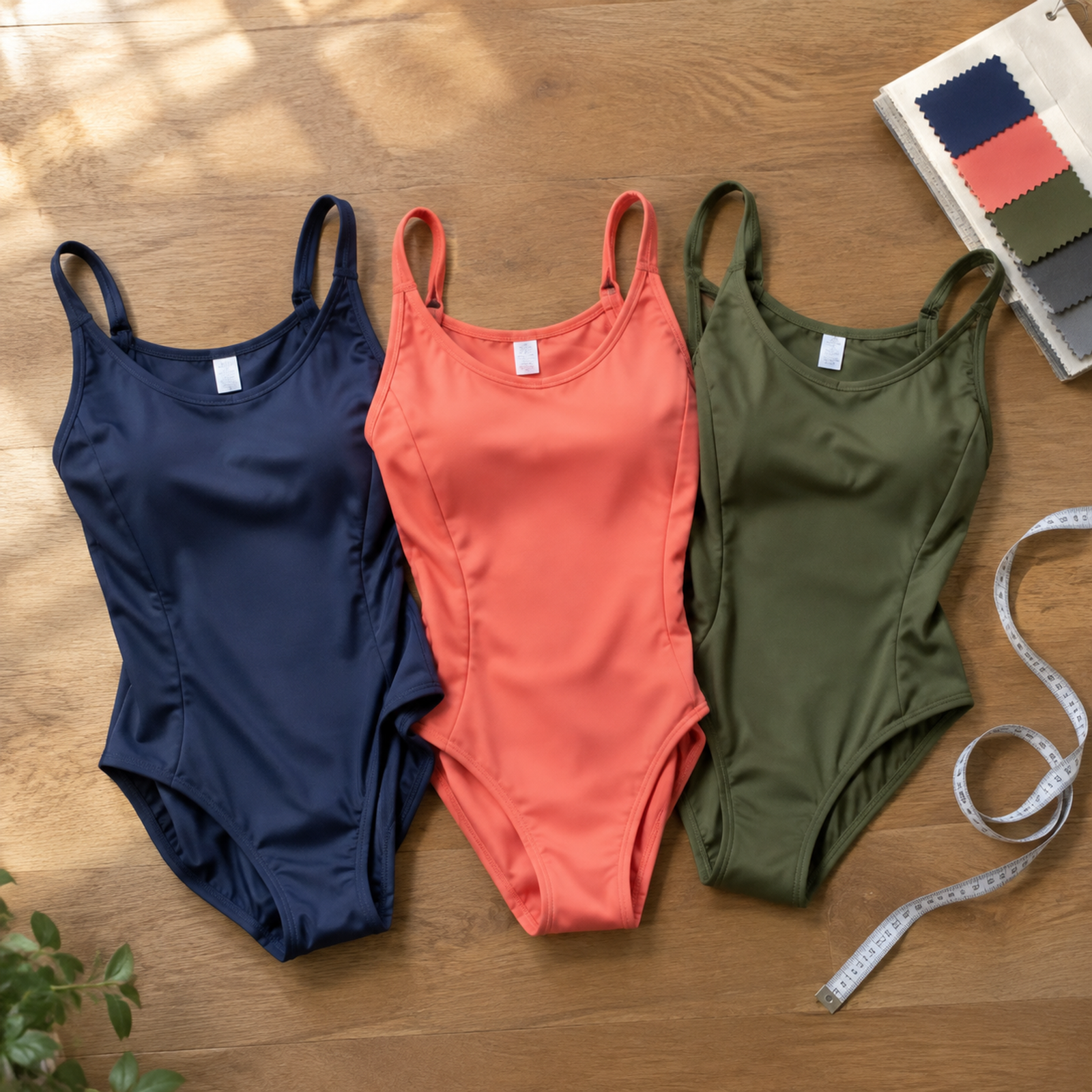
Before comparing suppliers, founders should map out their proposed styles, colors, and sizes, then compare the quantities against their launch budget, target retail prices, and expected demand.
What Does MOQ for a New Swimwear Brand Actually Mean?
MOQ stands for Minimum Order Quantity.1 However, a supplier's stated minimum does not always apply to the entire purchase order.
MOQ for a new swimwear brand is the minimum order quantity required for a particular product or production configuration. Depending on the supplier and materials, it may apply per order, style, color, fabric, or style-color combination.2
One Total Quantity Can Hide Several Production Groups
Consider a hypothetical order of 240 pieces. This example illustrates how quickly quantities can be divided; it is not a recommended factory minimum.
| Assortment level | Hypothetical breakdown | Quantity |
|---|---|---|
| Total order | Entire purchase order | 240 pieces |
| Three styles | 240 ÷ 3 | 80 per style |
| Two colors per style | 80 ÷ 2 | 40 per style-color |
| Four sizes | Distributed within each style-color | Varies by size |
If each style-color combination contains 40 pieces, an uneven size ratio could result in only four pieces in one size and six in another.
Although the total order is 240 pieces, individual production groups may be too small for certain cutting, printing, dyeing, or assembly requirements.
What Can Affect the MOQ?
Before confirming an order, ask whether the minimum applies to:
- Each swimwear style
- Each color or printed pattern
- Each style-color combination
- Each fabric quality or custom-dyed material
- Labels, trims, and retail packaging
- The total purchase order
Custom prints, exclusive fabrics, molded cups, branded hardware, and special packaging may have separate minimum requirements.
A useful question to ask a supplier is:
“How does your MOQ apply to my styles, colors, sizes, fabrics, and customization requirements?”
This helps clarify the actual order commitment before you pay for sampling or bulk production.
How Does the Production Route Change the MOQ for a New Swimwear Brand?
The production route has a direct impact on development work, material commitments, and order quantities.3 A ready-to-brand swimsuit is different from a modified design or a completely new product developed from a technical pack.
For new swimwear brands, the main options are ODM private label, custom development, and full-custom OEM manufacturing. Each route has different MOQ requirements depending on the existing design, requested changes, and materials involved.
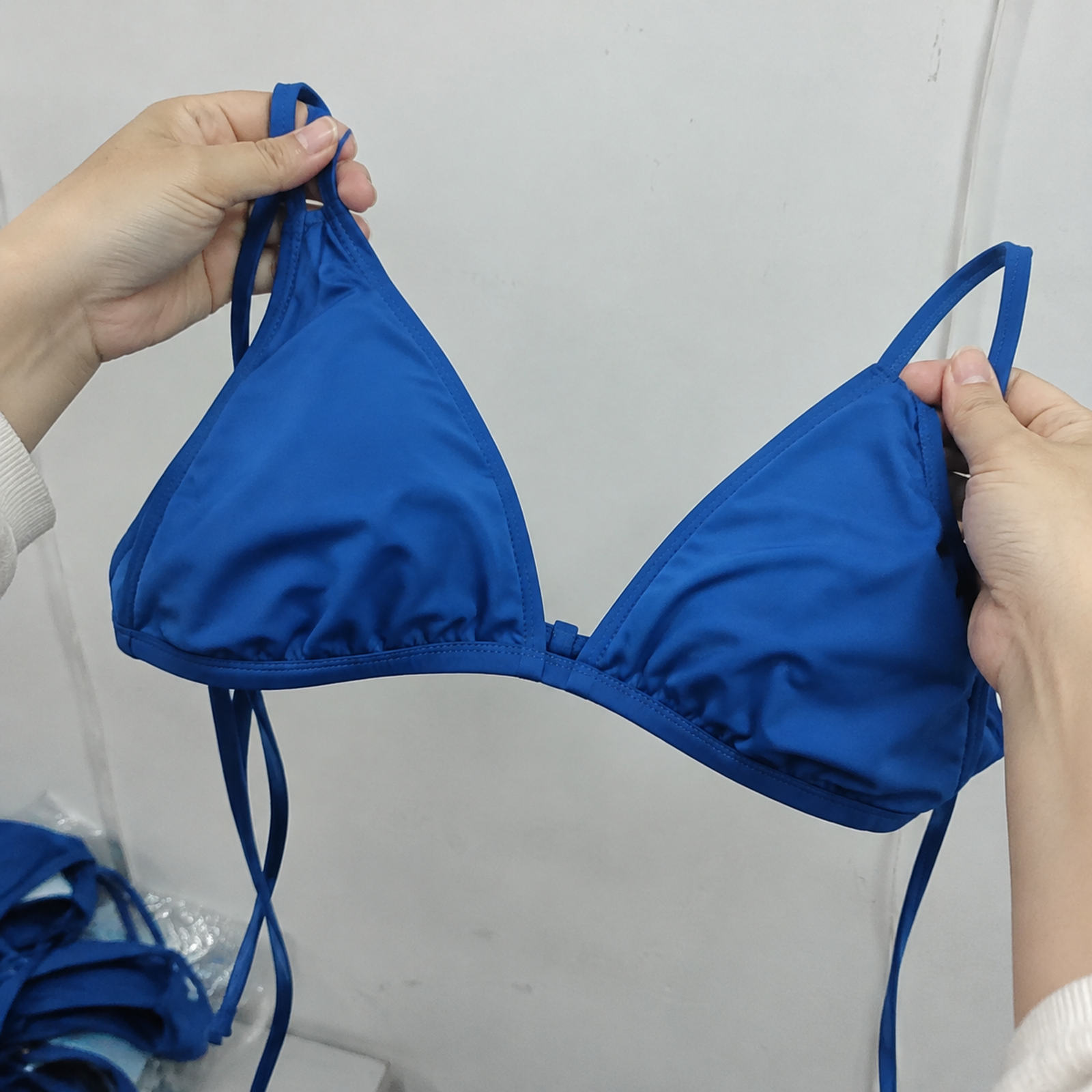
1. ODM · Private Label
ODM is often a practical starting point for brands that want to launch using existing designs rather than develop every detail from scratch.
Depending on the available collection, customization may include:
- Brand and size labels
- Care labels and hangtags
- Packaging
- Available colors or prints
- Selected design details, where supported
Because the product design and construction are already developed, this route can reduce development complexity.4 However, buyers should confirm fabric availability and any separate requirements for labels or packaging.
Aura's typical MOQ: 300 pieces per style.
2. Custom Development · Semi-Custom
Custom Development is suitable for brands that want to adapt an established design rather than start entirely from scratch.
Possible changes include:
- Neckline or strap design
- Back coverage and leg opening
- Padding or support features
- Selected fabrics, trims, and hardware
- Fit and sizing adjustments
Even relatively small changes may require new patterns, samples, fit reviews, or additional material sourcing.5
Aura's typical MOQ: 500 pieces per style.
3. OEM Manufacturing · Full Custom
Full-custom OEM is designed for brands that have their own concepts, sketches, reference samples, or technical packs.
Depending on the project, development may involve:
- Original pattern development
- Custom measurements and grading
- Fabric and lining selection
- Specialized construction
- Custom prints or branded components
- Sample development and approval
The MOQ depends on the complexity of the design and the minimum commitments required for fabrics, trims, and other components.
Aura's MOQ starts from 1,000 pieces per style.
How Aura's Swimwear MOQ Options Compare
| Production route | Typical development scope | Aura's MOQ |
|---|---|---|
| ODM · Private Label | Existing designs with brand customization | 300 pcs/style |
| Custom Development · Semi-Custom | Adapted designs and selected modifications | 500 pcs/style |
| OEM Manufacturing · Full Custom | Original designs and custom development | Starting from 1,000 pcs/style |
These are Aura's standard starting quantities, not universal industry minimums. Final requirements depend on the product specification, color arrangement, material availability, and customization scope.
For more details, explore our ODM Swimwear and OEM Manufacturing services.
A Practical Hybrid Strategy
A brand does not need to customize every product component to create a distinctive collection.
For example, you could use an established pattern and standard lining while differentiating the product through a signature silhouette, selected colors, or branded details.
This approach may reduce the number of custom materials and development steps required. It does not guarantee a lower MOQ, but it can help allocate your budget to the features that matter most to your customers.
How Do Styles, Colors, and Sizes Affect Swimwear MOQ?
A broad collection may look appealing during planning, but every additional style or color divides the available order quantity into smaller groups.
The more styles, colors, and sizes a brand offers, the more carefully it needs to plan quantities at the SKU level.6 A focused assortment can make an opening order easier to manage, provided it still meets the target customer's needs.
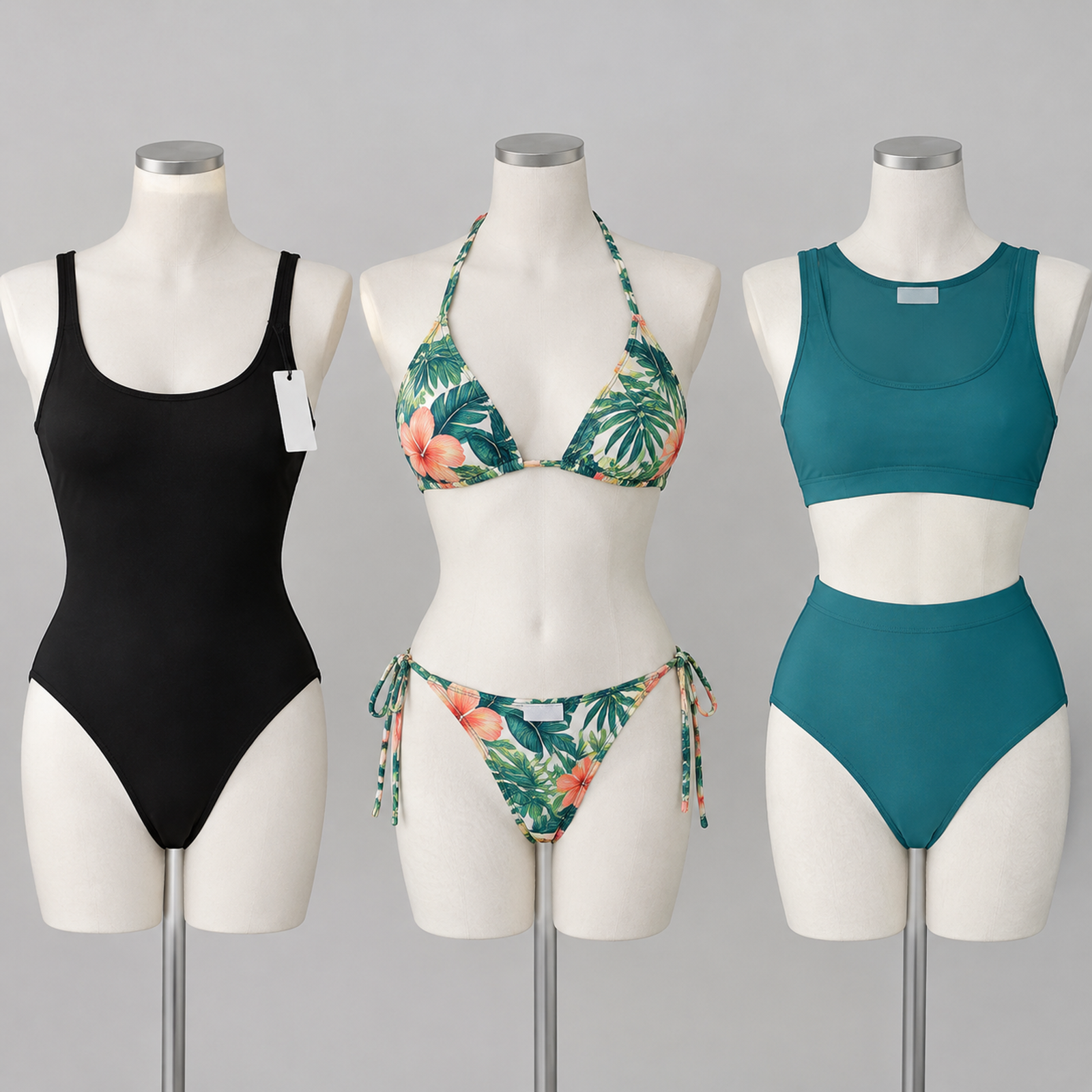
Calculate the Number of SKUs
A simple starting formula is:
Number of styles × colors per style × sizes = number of style-color-size combinations
For example, a collection with four styles, three colors per style, and five sizes creates:
4 × 3 × 5 = 60 style-color-size combinations
If bikini tops and bottoms are sold separately, the number of sellable SKUs can increase further.
This calculation does not determine whether production is feasible. It helps reveal how widely your order is divided.
Plan Size Ratios Around Your Target Customer
Equal quantities in every size may be easy to calculate, but they do not necessarily reflect actual demand.7
When planning your first size ratio, consider:
- Pre-launch surveys and wait-list data
- Comparable product sales
- Feedback from retail partners
- Customer fit-testing results
- Pre-orders, if available
If you do not have sales history, treat your initial size ratio as a working hypothesis. Review the results after launch and use real customer data to guide replenishment.
Limit Unnecessary Color Variations
Each additional color may require separate material purchasing, thread matching, lining coordination, or color approval.8 Custom-dyed and printed fabrics can introduce additional development steps.
For a first collection, consider:
- One or two signature silhouettes
- A focused core color palette
- A clear size allocation
- Shared materials across compatible products
- A replenishment plan for your strongest sellers
The goal is not necessarily to launch fewer products. It is to ensure that your assortment matches your budget, production requirements, and expected demand.
How Should a Founder Balance Swimwear MOQ, Unit Cost, and Inventory Risk?
A smaller order can reduce the amount of money tied up in inventory, but it may result in a higher unit cost or fewer customization options.9 A larger order may improve pricing while increasing cash-flow pressure and the risk of unsold stock.
The best MOQ balances landed cost, gross margin, launch budget, expected sell-through, and replenishment lead time. The lowest minimum is not automatically the most profitable option.10

Calculate Landed Cost, Not Just the Product Price
The quoted garment price is only one part of your total cost.11 Depending on the order, landed cost may include:
- Product manufacturing cost
- Sampling and development
- Labels and packaging
- Inspection costs
- International freight and insurance
- Import duties and taxes
- Customs clearance and local delivery
- Payment and currency-conversion charges
A basic gross margin calculation is:
Gross margin percentage = (Retail price − landed unit cost) ÷ retail price × 100
This calculation does not include all operating expenses. Marketing, payment processing, returns, warehousing, and markdowns can also affect profitability.
Compare Different Order Scenarios
Instead of asking for one MOQ figure, request quotations for realistic assortment options using consistent product specifications.
| Scenario | Assortment approach | Main advantage | Main risk |
|---|---|---|---|
| Focused launch | Fewer styles and colors | More depth in selected products | Less variety |
| Broad test | More styles with smaller quantities | More opportunities to test demand | Thin quantities per SKU |
| Higher-volume order | More units per combination | Potentially lower unit cost | Greater inventory exposure |
| Existing-design route | Established designs and components | Less development complexity | Less design exclusivity |
Compare the total financial commitment, not just the quoted unit price.
Match Your Order to Your Sales Plan
Before confirming an opening order, estimate:
- Expected website traffic
- Conversion-rate assumptions
- Average units per customer order
- Wholesale or retail partner commitments
- Planned marketing activity
- Seasonal selling window
- Expected replenishment lead time
These estimates will not be perfect, especially for a new brand. However, they provide a more useful basis for planning than choosing an MOQ based on price alone.
Keep a contingency reserve for sampling revisions, freight changes, inspections, marketing, and potential replenishment. Spending the entire launch budget on the initial order can leave too little flexibility to respond to customer demand.
How Should Buyers Evaluate an MOQ Quote from a Swimwear Supplier?
A supplier's headline MOQ does not tell you everything about product quality, customization, delivery, or additional costs.
Before accepting a swimwear MOQ quote, confirm exactly what the minimum includes, how the price changes with quantity, which materials are available, and how samples and quality checks will be handled.

Ask for a Written MOQ Breakdown
A useful quotation should clarify:
- Style references and quantities
- Quantity per color and size
- Fabric and lining specifications
- Included trims and components
- Customization requirements
- Label and packaging arrangements
- Sample charges
- Unit price and payment terms
- Estimated production lead time
- Shipping terms and quotation validity
- Conditions that could change the MOQ or price
If the quotation assumes stock materials, ask the supplier to reconfirm availability before placing the bulk order.
Review the Supplier's Quality Control Process
MOQ should be evaluated alongside quality consistency and the supplier's ability to meet the agreed specifications.
Ask how the project will address:
- Material inspection
- Measurement tolerances
- Stitching and seam quality
- Color consistency
- In-line and final inspection
- Sample approval
- Packaging and labeling checks
- Defect handling and third-party inspection, if required
Certificates and test reports should be verified for their issuing body, validity, and relevance to the specific product or material.12 Do not assume that every supplier or product automatically meets every market's compliance requirements.
At Aura Intimates Global, we review MOQ requirements in relation to style selection, colors, sizing, customization, and budget. With over 10 years of experience supporting OEM and ODM swimwear projects, we help brands assess their requirements and identify a suitable development route.
Every project requires an individual review because material availability, design complexity, and customization can affect the final order terms.
Watch for These Warning Signs
Before committing funds, be cautious if a supplier offers:
- One MOQ figure without explaining how it applies
- A firm production commitment before reviewing the specifications
- Unclear fabric or trim details
- No defined sample-approval process
- Significant unexplained price changes
- Unverifiable certification claims
- Payment terms that differ from the written quotation
- Unrealistic delivery promises that ignore material and sampling lead times
A low MOQ cannot compensate for unclear specifications, unreliable communication, or weak quality controls.
Frequently Asked Questions
Can a New Swimwear Brand Negotiate the MOQ?
Sometimes. You can ask whether the supplier can simplify the assortment, use available materials, reduce custom components, or adjust packaging requirements. Any revised MOQ should be confirmed in writing, along with its effect on pricing, lead time, and specifications.
Is a Low Swimwear MOQ Always Better for a First Collection?
No. A lower MOQ can reduce initial inventory exposure but may increase unit cost or limit customization. Compare total cash requirements, landed cost, expected margins, and inventory risk before deciding.
Does Every Size Need the Same Order Quantity?
Not necessarily. Uneven size ratios may be possible, depending on the supplier's production requirements. Plan your size allocation around your target customers and confirm the permitted ratio before placing the order.
Can Different Swimwear Styles Share One MOQ?
Sometimes, but do not assume that quantities can be combined across all styles. The answer depends on the supplier's rules, materials, colors, and construction requirements. Ask for a written breakdown showing whether MOQ applies per order, style, color, or style-color combination.
What Information Should I Provide Before Requesting an MOQ?
Prepare your style references or technical packs, planned quantities, colors, size range, customization requirements, fabric preferences, target retail price, budget, destination, and required delivery date. The more clearly you define your project, the easier it is for a supplier to assess feasibility and provide a meaningful quotation.
Conclusion
The right MOQ for a new swimwear brand depends on the production route, style-color-size allocation, material requirements, landed cost, and available launch budget. Rather than choosing a supplier based on the lowest advertised minimum, compare realistic order scenarios and confirm the materials, quality procedures, and delivery terms before committing funds.
Aura Intimates Global supports ODM private-label, custom development, and OEM swimwear projects with different starting MOQs to suit different development requirements.
Ready to plan your first swimwear collection?
Share your proposed styles, colors, size range, target quantities, and customization requirements with our team. We'll review your project and help you understand the applicable MOQ and production options.
"Minimum Order Quantity (MOQ) – Formula, Benefits & Tips", https://www.slimstock.com/blog/minimum-order-quantity/. Procurement references define minimum order quantity as the smallest quantity of a product that a supplier is willing to sell or produce under specified ordering conditions. Evidence role: definition; source type: education. Supports: A procurement or supply-chain reference should define MOQ as the smallest quantity a supplier will accept or produce in an order.. ↩
"Discover MOQ Minimum Order Quantity: Meaning, Types & ...", https://china.docshipper.com/en/sourcing/moq-minimum-order-quantity-meaning-types-negociation/. Supply-chain research treats minimum order and batch constraints as potentially product-specific, meaning that separate variants or material configurations may be subject to distinct quantity requirements. Evidence role: general_support; source type: paper. Supports: Supply-chain evidence should show that order minimums and batch constraints can apply to specific SKUs, variants, materials, or production runs.. Scope note: General supply-chain evidence establishes the principle but may not document every swimwear-specific category listed in the article. ↩
"apparel sample maker Los Angeles", https://euphoriccolors.com/sample-development. Manufacturing research links higher customization with additional design, sourcing, setup, and coordination work, all of which can affect the economically feasible production quantity. Evidence role: mechanism; source type: paper. Supports: Research should explain how greater product customization introduces design, tooling, sourcing, setup, or sampling work that can alter production economics and batch requirements.. Scope note: The relationship is general to manufacturing and apparel development; it does not establish a universal MOQ for any particular swimwear production route. ↩
"What is Design Reuse in Engineering? - Lifecycle Insights", https://www.lifecycleinsights.com/design-reuse/. Studies of design reuse and product platforms find that reusing established designs can reduce new development work and shorten parts of the product-development process. Evidence role: mechanism; source type: paper. Supports: Product-development research should show that design reuse or established product platforms can reduce the amount of new engineering and development work.. Scope note: Design reuse does not eliminate supplier-specific sampling, compliance, fit, or material-verification requirements. ↩
"Body data-driven garment pattern construction in digital ...", https://journals.sagepub.com/doi/10.1177/00405175251352800. Apparel product-development literature describes patternmaking, sample construction, fit evaluation, and material selection as iterative activities that may need to be repeated when design specifications change. Evidence role: mechanism; source type: education. Supports: An apparel-development source should describe patternmaking, sample production, fitting, and material sourcing as iterative stages affected by design changes.. Scope note: Whether a particular alteration requires every listed step depends on its technical scope and the supplier's existing patterns and materials. ↩
"What is Assortment Planning in Retail? 9 Ways to Optimize", https://www.oracle.com/retail/assortment-planning/. Operations research on product-variety proliferation shows that expanding assortments increases the number of stock-keeping units and distributes inventory and demand across more individual variants. Evidence role: general_support; source type: paper. Supports: Retail or operations research should show that greater product variety creates more stock-keeping units and can fragment demand and inventory across variants.. Scope note: The operational effect varies with demand, replenishment capability, and whether products share materials or production processes. ↩
"Elevating Retail, Apparel, and Footwear Industries with ...", https://o9solutions.com/articles/advanced-size-curve-analysis. Apparel assortment research models demand separately by size because customer purchases are not generally distributed evenly across all offered sizes. Evidence role: general_support; source type: paper. Supports: Apparel inventory research should demonstrate that demand differs by size and that size-level allocations are commonly estimated from observed demand or historical sales.. Scope note: Published size distributions from one market or product category should not be assumed to represent a new swimwear brand's own customers. ↩
"Comparing Lab Dips vs. Bulk Fabric for Color Consistency", https://www.tradeaiders.com/lab-color-matching-comparing-lab-dips-vs-bulk-fabric-for-color-consistency.html. Textile production guidance describes color development as involving shade specification, matching, component coordination, and approval, so additional colorways can create distinct material and quality-control tasks. Evidence role: mechanism; source type: education. Supports: A textile-production source should explain that colorways may require separate dyeing or printing specifications, shade matching, component coordination, and approval.. Scope note: The amount of added work depends on whether the color is already stocked and whether fabrics, linings, and threads are purchased or processed together. ↩
"Efficient production - the art of batch size optimization", https://www.valantic.com/en/blog/efficient-production-batch-size-optimization/. Inventory models identify a trade-off between order size and cost: smaller orders reduce average inventory exposure, while fixed ordering or setup costs and quantity discounts can make their unit economics less favorable. Evidence role: mechanism; source type: paper. Supports: Inventory and production research should support the trade-off between lower inventory exposure at small order quantities and higher per-unit costs caused by setup costs or lost volume discounts.. Scope note: These models do not prove that every supplier will charge more or restrict customization at a specific lower quantity. ↩
"What Is Inventory Optimization? Benefits and Techniques", https://www.netsuite.com/portal/resource/articles/inventory-management/inventory-optimization.shtml. Inventory-optimization research evaluates order quantities by balancing purchasing and setup costs with the expected costs of overstocking and understocking, rather than treating the smallest permissible order as inherently optimal. Evidence role: expert_consensus; source type: paper. Supports: Inventory theory should show that an optimal order quantity balances procurement economics against the costs of excess stock and insufficient stock rather than minimizing quantity alone.. Scope note: The profit-maximizing quantity depends on uncertain demand, selling price, salvage value, lead time, and the cost structure of the individual business. ↩
"Determine Total Export Price", https://www.trade.gov/determine-total-export-price. Government import guidance explains that the cost of imported merchandise can extend beyond its purchase price to include transportation, insurance, duties, taxes, customs processing, and domestic delivery charges. Evidence role: definition; source type: government. Supports: Government trade guidance should define landed cost or explain the import expenses that arise in addition to the merchandise purchase price.. Scope note: The precise components and valuation rules vary by destination country, shipping terms, product classification, and contractual allocation of costs. ↩
"General Use Products: Certification and Testing", https://www.cpsc.gov/Business--Manufacturing/Testing-Certification/General-Use-Products-Certification-and-Testing. Conformity-assessment guidance emphasizes verifying the competence and accreditation status of the issuing body, the report's scope and validity, and the connection between the tested sample and the product placed on the market. Evidence role: general_support; source type: institution. Supports: Accreditation or regulatory guidance should support checking the issuing body's competence, the report's scope and date, and whether the tested item corresponds to the relevant product.. Scope note: A valid certificate or accredited test report covers only the standards, samples, sites, and dates within its stated scope; it does not by itself establish compliance in every market. ↩