

Swimwear manufacturing costs vary according to the design, fabric, construction, order quantity, sampling requirements, and delivery terms. Two swimsuits that look similar in a photo can require very different materials and production processes.
There is no reliable price that applies to every style. To estimate your budget, define the product specifications and compare quotations based on the same requirements—not just the unit price.
What Determines Swimwear Manufacturing Cost?
Most swimwear quotations depend on six main factors: design complexity, fabric and lining, trims, special techniques, order quantity, and delivery requirements. Development, testing, packaging, inspection, and freight may add to the total project cost.
1. Design and Construction
A simple triangle bikini usually requires fewer production operations than a structured swimsuit with underwire, molded cups, adjustable straps, boning, and a back clasp.1
Details that can affect cost include:
- Reversible or double-layer construction
- Removable, fixed, or molded cups
- Underwire channels and side boning
- Adjustable straps, sliders, and clasps
- Binding, piping, ruching, or gathering
- Multiple panels or contrast inserts
- High-compression lining and plus-size support features
- Specialized elastic application or reinforced seams
A design with many straps or connection points may use little fabric but require more precise sewing and inspection. Less fabric does not automatically mean a lower production cost.
2. Fabric and Lining
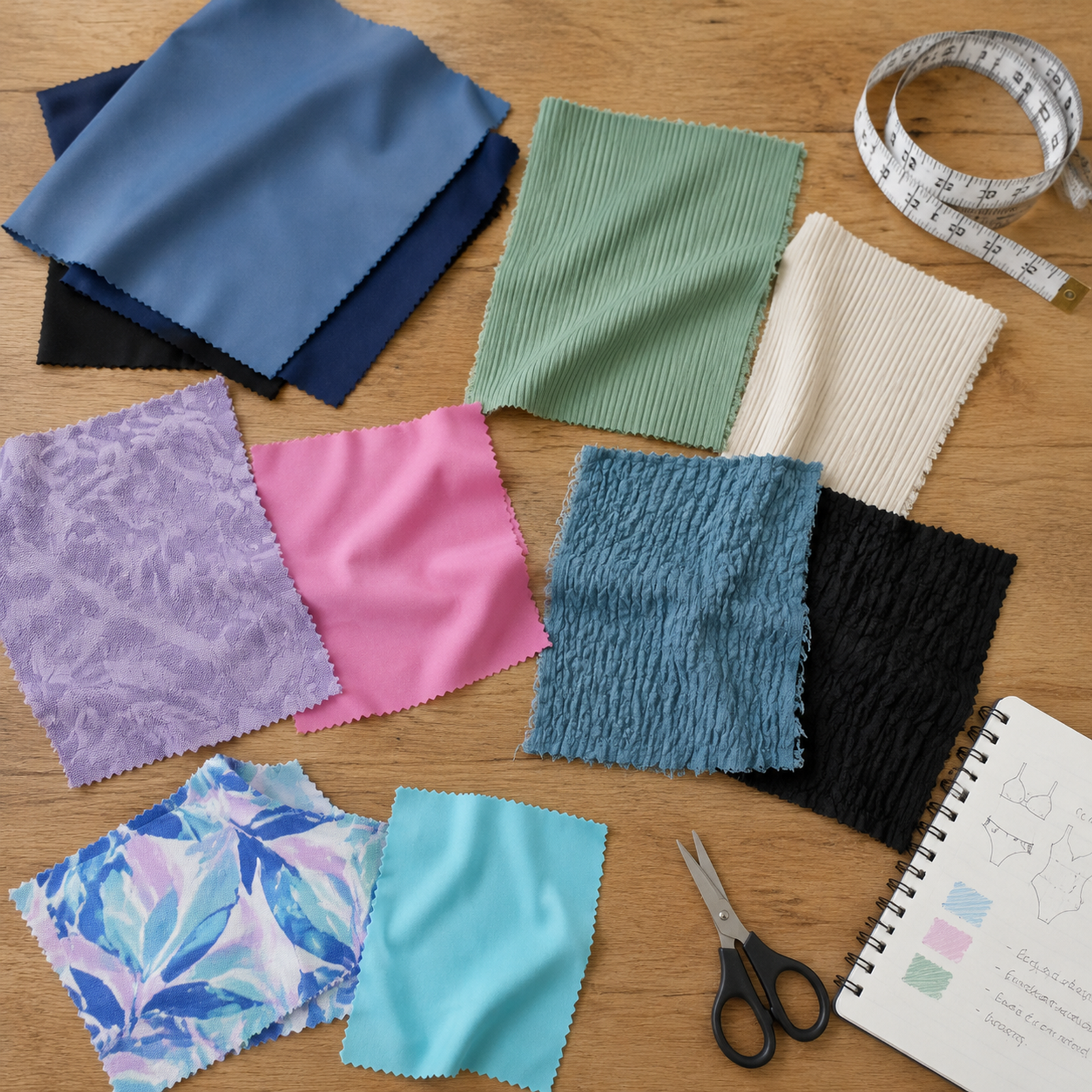
Fabric affects material cost, production handling, fit, and performance.2 Before requesting a quote, clarify the composition, weight, stretch, recovery, texture, color, and performance requirements.
Common considerations include:
- Nylon-spandex or polyester-spandex fabric
- Recycled fibers or specified sustainability certifications
- Ribbed, jacquard, crinkle, or bubble-gauze textures
- Chlorine-resistant or UV-performance requirements
- Solid-dyed, custom-dyed, digital-print, or sublimation-print fabric
- Full lining, partial lining, or power mesh
- Custom colors versus available stock colors
If certification or performance claims are important to your market, specify the required standards and documentation. Some claims may require verification by an accredited laboratory or qualified professional.3
3. Trims and Special Techniques
Small components and decorative details can add material, setup, and labor costs. These may include elastic, cups, underwire, rings, sliders, clasps, labels, hygiene stickers, and custom hardware.
| Cost factor | What to confirm | Why it matters |
|---|---|---|
| Custom print | Artwork, placement, repeat, and color count | Setup and print matching affect cost and timing |
| Embroidery | Motif size, stitch coverage, and placement | Dense designs require more machine time4 |
| Hardware | Standard or custom finish, engraving, or branding | Custom components may have setup fees and minimums |
| Custom color | Pantone reference or approved swatch | Lab dips and color approval add development steps |
| Branded trims | Labels, clasps, sliders, and hangtags | Separate suppliers may have their own minimums |
| Packaging | Standard, branded, recyclable, or retail-ready | Materials and packing labor affect the project total |
4. Order Quantity by Style, Color, and Size
The total quantity alone does not tell the whole story. A quote should specify how many units are required for each style, color, and size.
For example, 1,000 pieces in one style and one color may be easier to plan than 1,000 pieces divided among many styles and colors. More variations can require additional material allocation, cutting plans, setup, inspection, and packing work.5
Larger orders can spread setup costs across more units, but the lowest unit price is not always the best choice for a new brand.6 Excess inventory can tie up cash and lead to markdowns.7 Balance unit cost with demand, reorder flexibility, and inventory risk.
5. Sampling and Product Development
Sample costs are usually higher per piece than bulk production because development work is concentrated in one or a few garments.8 Depending on the project, sampling may involve:
- Reviewing the design, measurements, and construction notes
- Creating or adjusting the pattern
- Sourcing fabric, lining, elastic, cups, and hardware
- Cutting and sewing the prototype
- Reviewing fit, coverage, measurements, and workmanship
- Making agreed revisions
- Confirming the production-ready sample when needed
An existing ODM design may require fewer development steps than a fully custom style. Ask whether the sample fee includes pattern development, how many revision rounds are included, whether freight is separate, and whether any fee can be credited toward a bulk order.
Sample materials should also be clarified. A prototype made with substitute fabric may not behave exactly like the final material in stretch, recovery, color, compression, or fit.9 If those properties are important, confirm the garment in production-intent materials before bulk approval.
6. Packaging, Testing, and Delivery
A factory unit price may not include every cost associated with getting products to your destination. Confirm whether the quotation includes:
- Labels, hangtags, hygiene stickers, and packaging
- Product testing or third-party inspection
- Export documentation and customs clearance
- Freight and insurance
- Import duties and taxes
- The applicable Incoterm and named destination
An EXW price, for example, should not be compared directly with a quotation that includes shipping to a named destination.10 Compare like-for-like terms to understand the real landed cost.
A useful budget framework is:
Development and sampling + bulk production + packaging and testing + inspection + freight and insurance + import duties and taxes + contingency
How to Request an Accurate Swimwear Manufacturing Quote
A product photo helps communicate the design direction, but it does not specify every detail needed for a reliable quotation. A tech pack or reference sample, supported by clear requirements, can reduce assumptions and avoid unexpected changes later.11
Use this RFQ checklist when contacting suppliers:
| Information | What to provide |
|---|---|
| Product | Bikini, one-piece, tankini, rash guard, or another style |
| Design | Tech pack, sketches, measurement chart, or reference sample |
| Fabric | Composition, weight, texture, color, stretch, and recovery |
| Lining and construction | Lining coverage, cups, underwire, seams, elastic, and support details |
| Decoration | Printing, embroidery, appliqué, or branded hardware |
| Quantity | Units by style, color, and size |
| Sizing | Size range, grading requirements, and target market |
| Branding | Labels, hangtags, hygiene stickers, and packaging |
| Quality | Inspection criteria, tolerances, and testing requirements |
| Timing | Sample deadline, approval schedule, and required delivery date |
| Logistics | Destination, shipping method, and requested Incoterm |
Before accepting a quote, clarify whether the requested quantity means individual garments or complete sets. Also confirm whether the delivery date refers to factory completion or arrival at the destination.
How to Compare Swimwear Factory Quotes
The lowest quotation may not offer the lowest overall cost. First, make sure each supplier has quoted the same product specifications, quantities, packaging, quality requirements, delivery schedule, and trade terms.
Use a comparison sheet to confirm:
- The same fabric, lining, cups, and hardware are included
- Quantity by style, color, and size is accepted
- Sample and revision rounds are defined
- Inspection procedures and measurement tolerances are stated
- The delivery date and quote validity period are clear
- Freight, insurance, duties, and taxes are identified as included or excluded
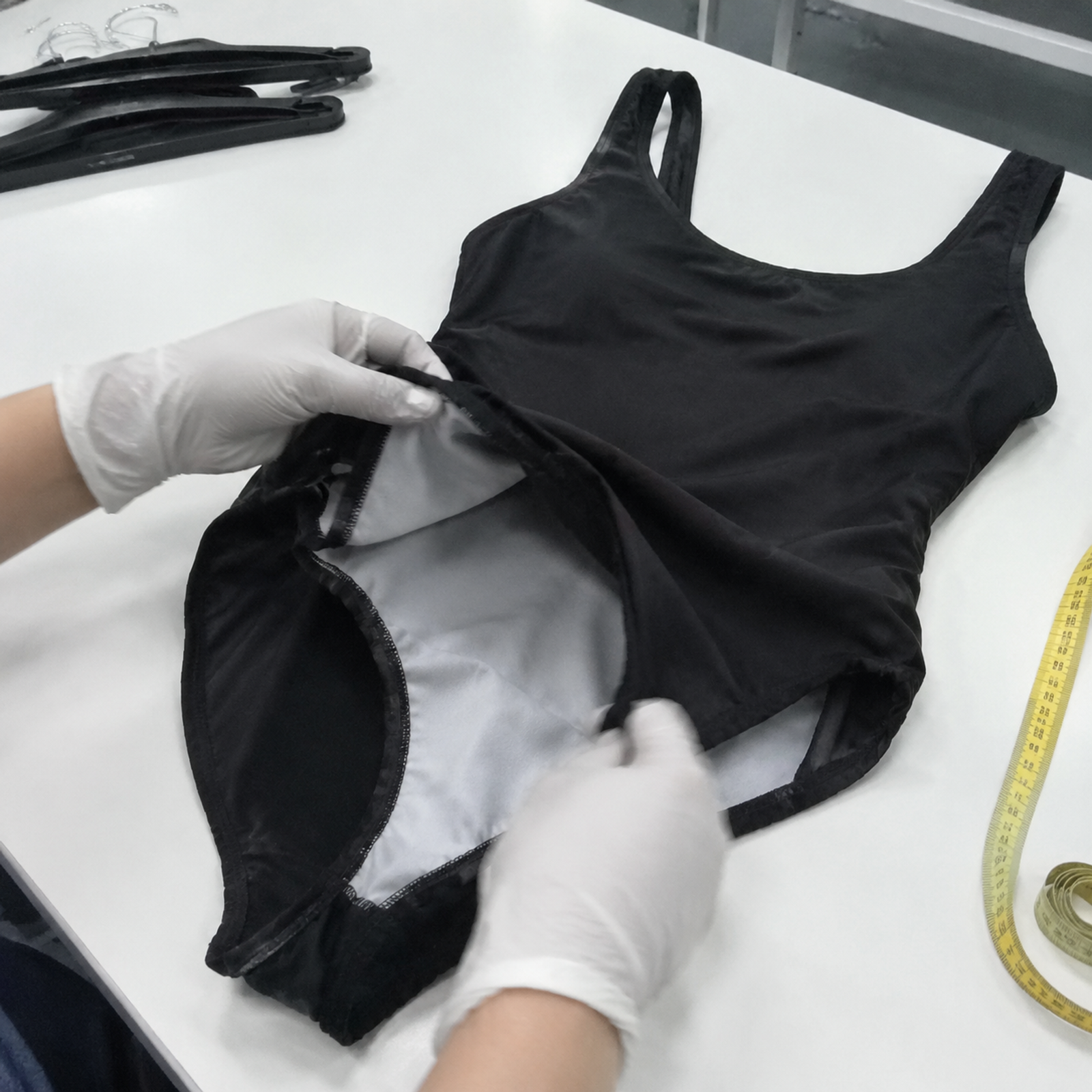
Ask suppliers how they check incoming materials, shade consistency, stitching, measurements, print placement, and packed quantities. You may also arrange a third-party pre-shipment inspection when appropriate. Any certificates provided should be checked for issuer, scope, validity, facility name, and relevance to the order.
Consider Quality and Delay Risks
A lower unit price can be offset by defects, rework, replacement shipments, additional inspection, or a missed selling season.12 Compare the commercial risk as well as the quoted amount.
For example, a supplier with a lower price may still cost more if a significant share of the order is unsellable. Defect rates, replacement arrangements, and responsibility for rework should be discussed before production.
Balance MOQ and Cash Flow
For an emerging brand, a focused launch can sometimes be more practical than spreading a small order across too many styles and colors.
- Launching with fewer colors or silhouettes
- Using compatible fabrics across several styles
- Choosing standard hardware for the first order
- Planning repeat orders around sales data
- Considering ready-to-brand ODM styles to reduce development work
The right order quantity depends on demand, margins, lead times, storage costs, and how easily successful styles can be reordered.
Frequently Asked Questions
Can I Get a Swimwear Quote From a Photo?
A photo can communicate the general design, but a reliable quote also requires details about fabric, lining, construction, trims, sizing, quantity, packaging, delivery, and trade terms. A tech pack or physical sample can improve accuracy.
Does a Larger Order Always Reduce Manufacturing Cost?
A larger order may spread setup costs across more units, but it can also increase inventory and cash-flow risk. Quantity by style, color, and size matters, so consider expected demand and reorder options as well as unit price.
What Is Usually Excluded From a Factory Unit Price?
It depends on the quotation. Confirm whether sampling, labels, packaging, testing, inspection, freight, insurance, duties, and taxes are included. Always identify the Incoterm and named destination.
How Can I Reduce Costs Without Lowering Quality?
Simplify avoidable complexity before compromising fabric or performance. You may be able to consolidate fabrics, reduce initial color options, use standard hardware, simplify decorative details, improve the tech pack, or focus quantities on proven styles. Review changes through sampling to ensure fit and performance remain acceptable.
Get a Swimwear Manufacturing Quote
Swimwear manufacturing cost depends on the product specifications, quantity, development needs, quality requirements, and delivery terms. A clear brief helps suppliers prepare more accurate and comparable quotations.
If you are developing a bikini, one-piece swimsuit, tankini, or plus-size collection, contact Aura Intimates Global with your tech pack or reference sample, quantity breakdown, and target delivery date to discuss your OEM or ODM project.
"Automated Cutting and Sewing for Industry 4.0 at ITMA 2019", https://jtatm.textiles.ncsu.edu/index.php/JTATM/article/download/16453/7266/59551. Apparel-production research associates greater component and construction complexity with additional assembly operations and labor time; this supports the general comparison, although the exact operation count depends on the factory's methods and equipment. Evidence role: mechanism; source type: paper. Supports: Garments with more components, seams, attachments, and structured features generally require additional sewing and assembly operations.. Scope note: The evidence establishes a general apparel-manufacturing mechanism rather than a universal operation count for these specific swimsuit designs. ↩
"Date thesis is presented August ll, 1966 gingham fabrics, ( ...", https://ir.library.oregonstate.edu/downloads/9s1618272?locale=pt-BR. Textile-science sources identify fiber composition and fabric structure as determinants of properties such as stretch, recovery, drape, handling, and garment performance; material cost itself remains dependent on supplier and market conditions. Evidence role: mechanism; source type: education. Supports: Textile composition and structure affect stretch, recovery, drape, handling, fit, and end-use performance.. Scope note: The source can establish the technical effects of fabric selection but not a specific cost impact for every supplier or order. ↩
"Guides for the Use of Environmental Marketing Claims", https://www.federalregister.gov/documents/2010/10/15/2010-25000/guides-for-the-use-of-environmental-marketing-claims. Government guidance generally requires objective product claims to be adequately substantiated, and ISO/IEC 17025 provides the recognized competence framework for testing laboratories; whether accredited testing is legally mandatory depends on the claim, standard, and jurisdiction. Evidence role: expert_consensus; source type: government. Supports: Product claims should be substantiated with appropriate evidence, while ISO/IEC 17025 accreditation demonstrates laboratory competence for defined testing activities.. Scope note: Accreditation is not universally required for every textile claim, so the applicable rule must be determined for the relevant market and claim. ↩
"Embroidery Stitch Count Explained: What It Means for Your ...", https://www.frenchpresscustom.com/blog/embroidery-stitch-count-explained-what-it-means-for-your-order. Research on computerized embroidery treats stitch count and machine speed as primary determinants of machine run time, with trims and color changes adding further time; stitch coverage is therefore an indirect proxy rather than a complete predictor. Evidence role: mechanism; source type: paper. Supports: Embroidery run time is substantially influenced by stitch count, machine speed, trims, and color changes.. Scope note: Actual production time also varies with machine settings, thread breaks, color changes, and design digitization. ↩
"CIRP Annals - Manufacturing Technology - personal.umich.edu", https://www-personal.umich.edu/~ykoren/uploads/Product_variety_and_manufacturing_complexity_in_assembly_lines.pdf. Operations-management research links greater product variety to additional planning, setup, scheduling, and material-handling complexity; the size of that effect varies with production technology and the manufacturer's ability to combine similar variants. Evidence role: mechanism; source type: paper. Supports: Greater product variety increases planning, setup, scheduling, material-handling, and coordination requirements in manufacturing.. Scope note: The literature supports the general complexity mechanism but does not quantify the added work for a particular swimwear order. ↩
"Economies of Scale: Definition, Types, and Strategies", https://online.hbs.edu/blog/post/economies-of-scale. Standard operations models show that increasing lot size spreads fixed ordering or setup costs across more units, while total-cost analysis also accounts for inventory holding and related risks; these models do not determine the optimal quantity without business-specific demand and cost data. Evidence role: mechanism; source type: education. Supports: Fixed setup costs are allocated over more units at larger volumes, but purchasing decisions also involve inventory-holding and other total costs.. Scope note: The general model does not prove which order size is best for an individual brand. ↩
"Strategic Management of Distressed Inventory", https://business.columbia.edu/sites/default/files-efs/pubfiles/4123/SPDI_paper_vfinal4.pdf. Retail inventory research identifies capital tied up in unsold stock and end-of-season markdowns as material consequences of demand uncertainty and overstocking; the severity depends on product seasonality, storage costs, and resale options. Evidence role: general_support; source type: paper. Supports: Unsold inventory commits working capital and may require price reductions when demand is below forecast.. Scope note: The evidence is general to retail inventory and does not estimate markdown rates for swimwear specifically. ↩
"What does it cost to prototype a bag or clothing line?", https://fashion-incubator.com/what-does-it-cost-to-prototype-a-bag-or-clothing-line/. Apparel product-development sources describe sampling as a sequence of pattern, sourcing, construction, fitting, and revision activities performed before bulk production, supporting the concentration of development effort in a small number of garments; actual sample pricing remains supplier-specific. Evidence role: mechanism; source type: education. Supports: Apparel sampling includes pattern development, material sourcing, prototype construction, fitting, and revisions before bulk production.. Scope note: The source supports the process and cost mechanism but not a universal sample-to-bulk price ratio. ↩
"Compression Garments for Medical Therapy and Sports - PMC", https://pmc.ncbi.nlm.nih.gov/articles/PMC6404358/. Textile and clothing-fit studies show that fabric elasticity, recovery, thickness, and related mechanical properties influence garment deformation, pressure, and fit, so a substitute material cannot be assumed to reproduce the behavior of production fabric. Evidence role: mechanism; source type: paper. Supports: Differences in fabric elasticity, recovery, thickness, and mechanical behavior can change garment pressure, dimensions, and fit.. ↩
"Incoterms® 2020 - ICC", https://iccwbo.org/business-solutions/incoterms-rules/incoterms-2020/. Under Incoterms 2020, EXW generally places the principal transport obligations and costs on the buyer once the goods are made available at the named place, whereas destination-based terms may allocate some or all carriage to the seller. Evidence role: definition; source type: institution. Supports: Under EXW, the seller's delivery obligation is generally fulfilled by placing goods at the buyer's disposal at the named place, leaving most transport obligations and costs to the buyer.. ↩
"(PDF) Effectiveness of Technical Packages for the Apparel ...", https://www.academia.edu/56373178/Effectiveness_of_Technical_Packages_for_the_Apparel_Production_Process_in_the_Global_Apparel_Industry. Apparel product-development literature describes the technical package as a principal means of communicating measurements, materials, construction details, and quality requirements to production partners, thereby reducing ambiguity; it cannot eliminate changes caused by testing, fit review, or material availability. Evidence role: general_support; source type: education. Supports: Technical packages communicate measurements, materials, construction, and quality requirements between designers and manufacturers.. Scope note: Clear documentation reduces communication uncertainty but does not guarantee an unchanged specification or error-free production. ↩
"Cost of Poor Quality (COPQ)", https://sixsigmastudyguide.com/cost-of-poor-quality/. Quality-management research classifies rework, replacement, additional inspection, returns, and lost sales as costs of poor quality, while supply-chain studies show that delivery delays can be particularly damaging for seasonal products; the net cost in any order depends on defect severity, contract terms, and the selling calendar. Evidence role: general_support; source type: research. Supports: Poor quality generates internal and external failure costs, including inspection, rework, replacement, returns, and lost sales, while delays are especially consequential for seasonal goods.. Scope note: The evidence supports the categories of risk but does not establish that every lower-priced supplier will incur them. ↩