

Swimwear fabric can make an attractive design fail once it becomes wet, stretched, or exposed to pool chemicals and sunlight. These failures can lead to returns, delayed launches, and damaged margins. The practical solution is to match the material system with the garment’s intended use, support level, price position, and production requirements.
The right swimwear fabric provides the required stretch, recovery, coverage, support, comfort, and appearance for a specific design and use environment. Buyers should evaluate fiber content, fabric weight, knit construction, finishes, color performance, and pattern interaction together. Sampling and bulk-quality controls should then confirm that the chosen material performs consistently.
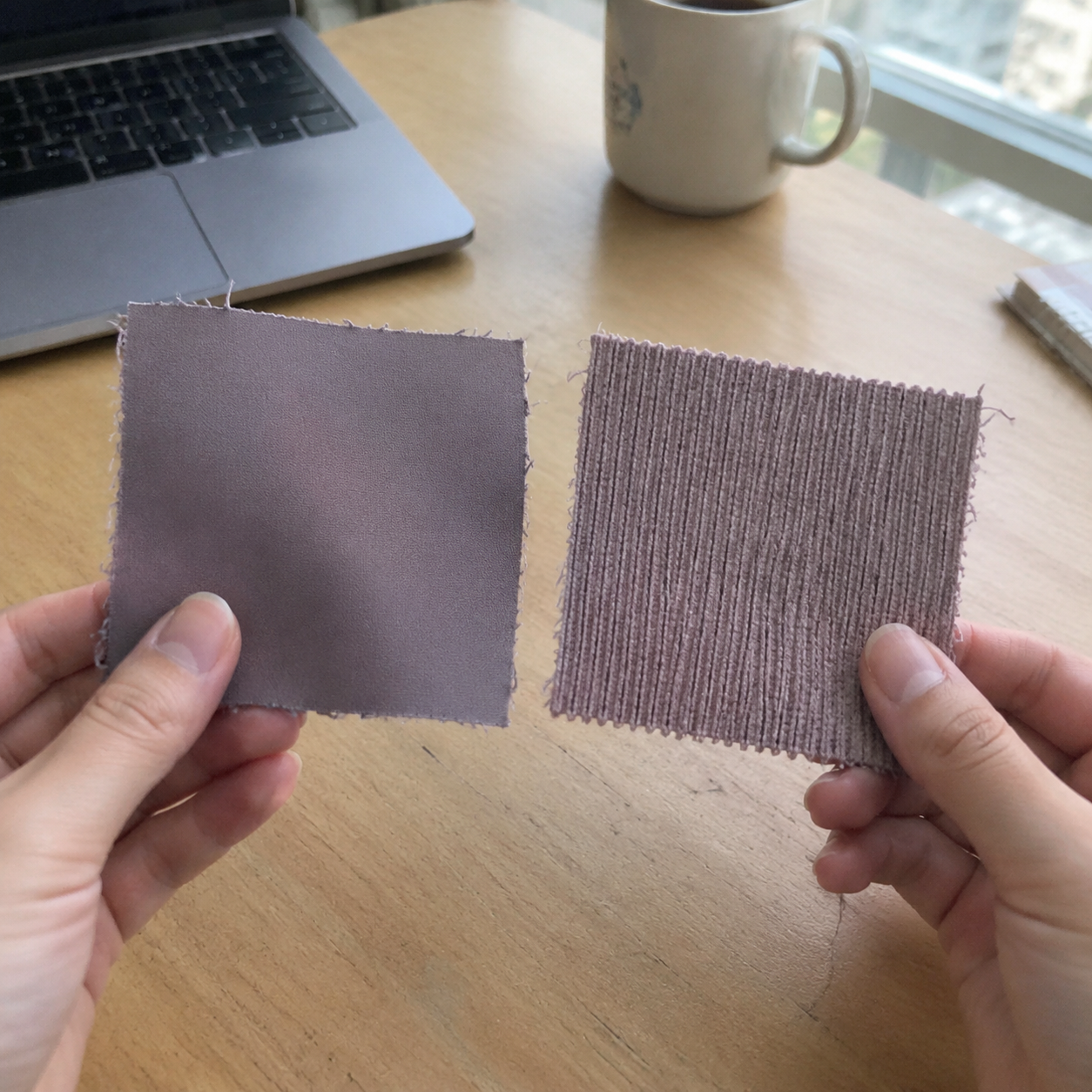
No single fabric is best for every bikini, one-piece swimsuit, tankini, or performance style. A successful choice depends on several trade-offs. The following framework helps buyers compare those trade-offs before committing to samples or bulk production.
How Should Buyers Begin Choosing Swimwear Fabric?
Choosing swimwear fabric from a supplier’s swatch card can feel simple, but color and hand feel reveal only part of the story. A fabric that suits a leisure bikini may not provide enough support for a structured one-piece. Buyers can reduce this risk by defining the product before comparing materials.
The selection process should begin with three questions: Where will the garment be worn? What support, shaping, and coverage must it provide? What retail price and material cost can the brand sustain? These answers help designers, manufacturers, and fabric suppliers assess suitable options.

1. Where will the swimsuit be used?
The intended environment affects material priorities. Buyers should distinguish among several use cases:
- Leisure and resort wear: Soft hand feel, color, texture, drape, and visual appeal often receive greater emphasis.
- Regular pool use: Resistance to chlorinated water and repeated washing becomes more important.1
- Beach use: Coverage, color stability, sand interaction, and exposure to salt water and sunlight need consideration.
- Water sports: Secure fit, recovery, support, and resistance to movement-related distortion become priorities.
- Fashion-led or occasional wear: Surface texture and silhouette may matter more than long-term intensive use.
These categories can overlap. A premium resort swimsuit, for example, may still need reliable recovery and wet-state coverage even if it is not intended for competitive swimming.
2. What must the garment structure accomplish?
Fabric works with the pattern, lining, elastic, seams, cups, underbands, and other components. It does not function alone.
A bandeau top and a high-support bikini top have different mechanical needs. The same applies to a minimally covered bottom and a shaping one-piece. Buyers should define:
- Required bust support
- Compression or shaping level
- Desired coverage
- Lining requirements
- Removable or fixed cup construction
- Strap width and adjustability
- Leg-opening and neckline tension
- Size range, including plus-size grading
- Intended fit, from relaxed to close compression
A textured fabric may suit a simple leisure bikini but require additional lining or construction adjustments in a structured one-piece. The better choice depends on the fabric-pattern combination, not the material’s appearance alone.
3. What cost can the collection support?
Fabric cost should be assessed within the total garment cost rather than in isolation. A lower-priced outer material may require a more substantial lining or additional construction. A premium material may create sourcing risks if its minimum order quantity exceeds the planned launch volume.
The cost review should include:
| Cost factor | Procurement question |
|---|---|
| Fabric price | Is pricing based on kilograms, yards, or meters? |
| Fabric width | How much usable width remains after edge losses? |
| Consumption | How much material does each size and style require? |
| Lining | Does the garment need full or partial lining? |
| Color minimum | What is the MOQ for each custom color? |
| Waste allowance | Does pattern placement or texture increase cutting waste? |
| Testing | Which inspections or third-party tests are required? |
| Reorders | Can the supplier reproduce the shade and construction later? |
A clear commercial target prevents the design team from approving a material that cannot support the planned retail margin or order volume.
Which Types of Swimwear Fabric Should Buyers Compare?
Fabric names can create misleading shortcuts. Nylon-rich, polyester-rich, recycled, ribbed, and textured materials all have potential advantages, but none guarantees a particular finished-garment result. Buyers need to compare the complete fabric specification and verify its suitability through samples and relevant tests.
Common swimwear fabric options include nylon-elastane and polyester-elastane blends, recycled versions, ribs, jacquards, and tactile textures. The right option depends on softness, print method, recovery, support, appearance, exposure conditions, availability, and cost—not on a context-free ranking of fiber types.
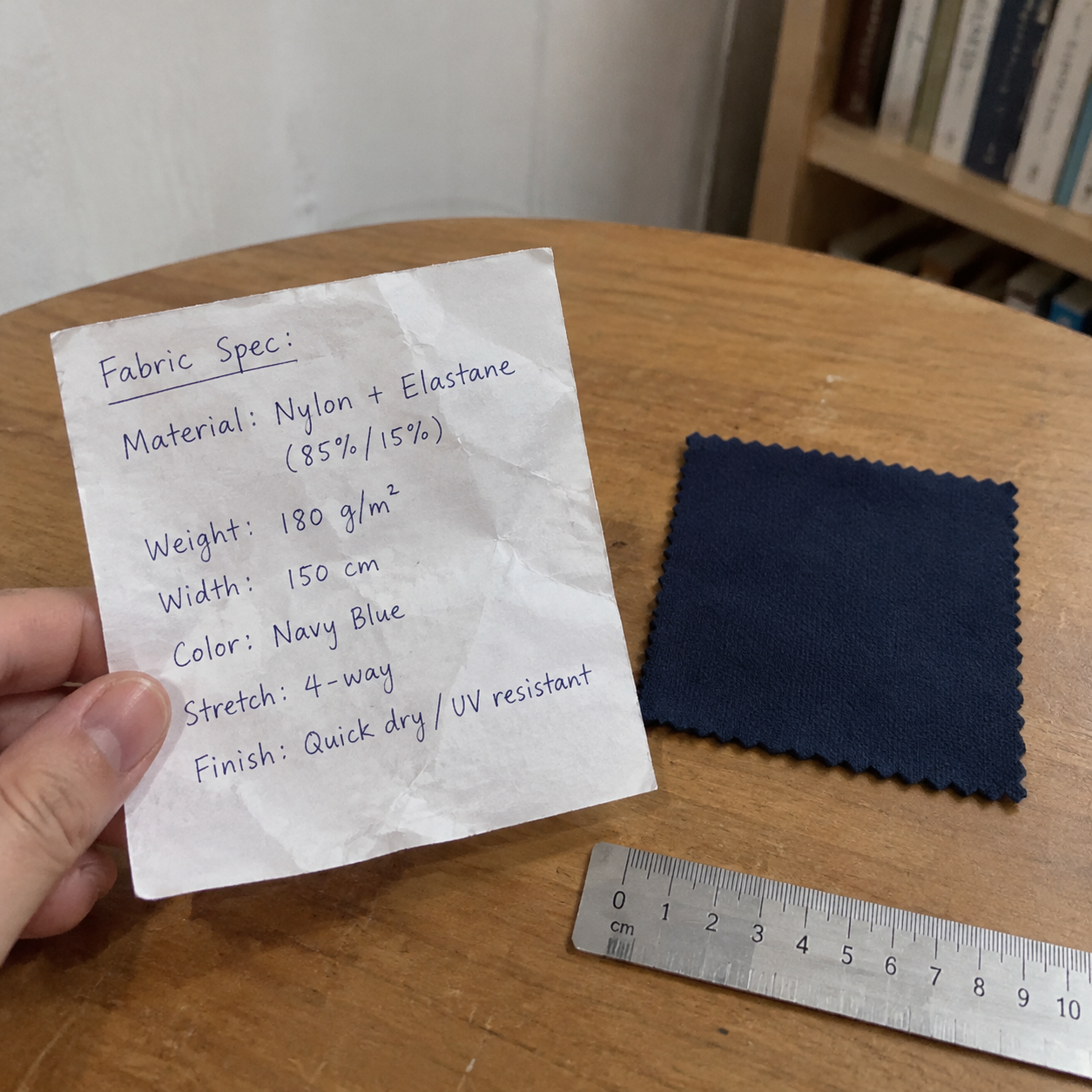
Nylon-elastane blends
Nylon-elastane fabrics are often considered when buyers want a smooth surface and soft hand feel. They can suit fashion-led bikinis, resort styles, and close-fitting one-pieces. However, the word “nylon” does not establish colorfastness, recovery, or durability.
Buyers should still verify:
- Finished fabric weight
- Stretch in both directions
- Recovery after extension
- Wet-state appearance
- Color behavior under intended exposure
- Pilling or surface sensitivity
- Compatibility with printing and finishing
- Shade consistency across rolls
Polyester-elastane blends
Polyester-elastane options may be evaluated for printed collections, pool-oriented products, and performance designs. Their suitability still depends on the exact knit, dye or print process, finish, and elastane system.
Buyers should not assume that every polyester-rich material will withstand the same conditions. The finished garment also includes thread, elastic, lining, pads, hardware, and printed or transferred color. Failure in any component can affect the product.
Recycled swimwear fabrics
Recycled nylon and recycled polyester can support a brand’s material strategy, but sourcing claims require documentation. Buyers should ask what is certified, who issued the document, which facility or transaction it covers, and whether the document remains valid.
Documents associated with standards such as the Global Recycled Standard (GRS) or Recycled Claim Standard (RCS) should be verified with the issuing body or relevant database.2 A fabric marketing name alone does not prove recycled content or chain of custody.
Claims about lower environmental impact also need care. Fiber origin represents only one part of a product’s broader impact.3 Dyeing, finishing, production waste, transportation, care, and useful garment life may also matter. Precise environmental comparisons should rely on credible, applicable evidence rather than general assumptions.
Ribbed, jacquard, and textured fabrics
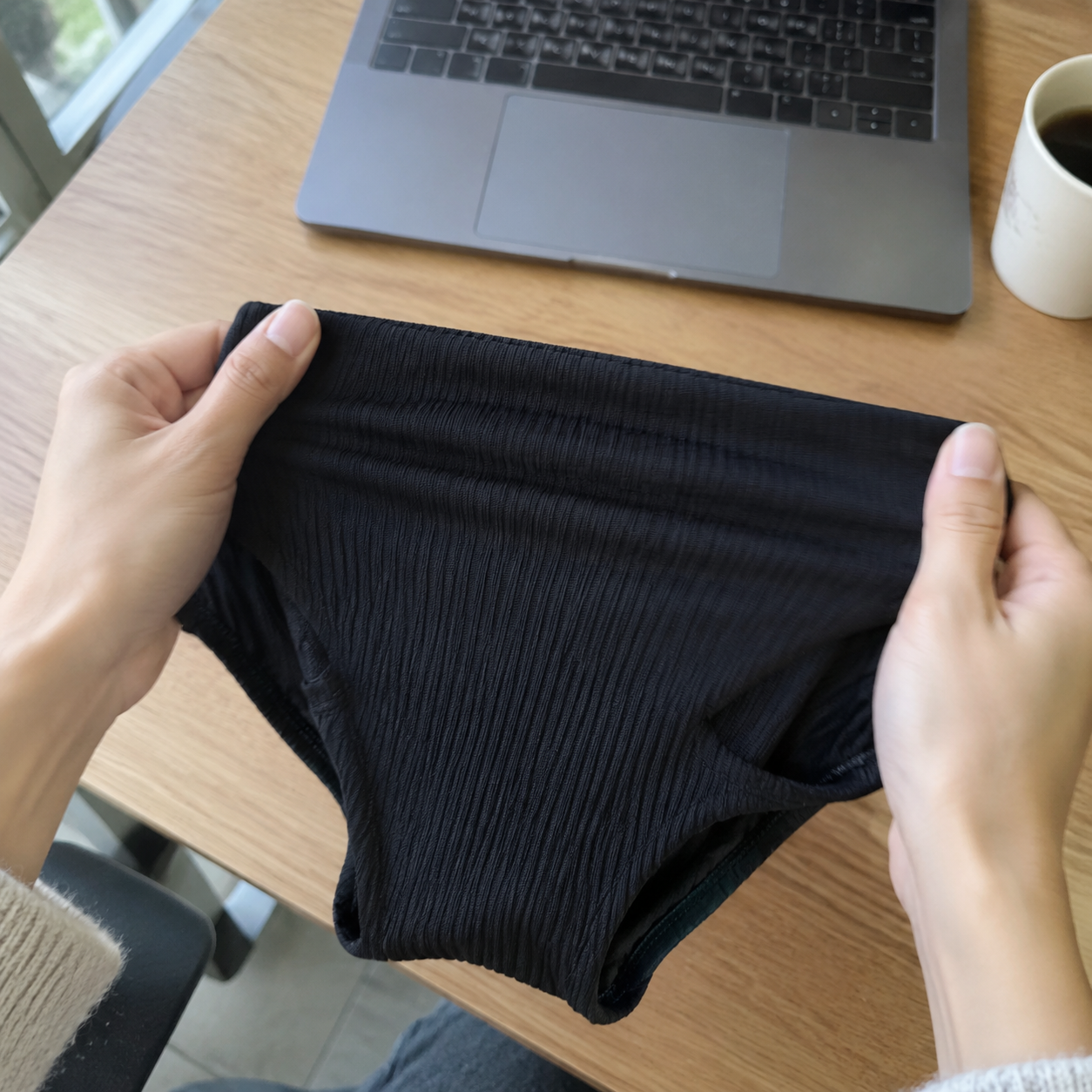
Textured materials can create strong visual differentiation. Examples include ribs, puckered surfaces, jacquards, and bubble-like textures. However, they can behave differently during cutting, sewing, stretching, and lining.
Key questions include:
- Does the texture flatten significantly under tension?
- Does the surface become more transparent when stretched?
- Will the fabric feed evenly during sewing?
- Does the pattern need adjustments for contraction or distortion?
- Can the supplier reproduce the texture between batches?
- Does the texture feel comfortable against the skin and at seam edges?
A texture that looks premium on a hanger may change when stretched over the body. That change should be reviewed on the intended garment rather than on a loose swatch alone.
What Swimwear Fabric Specifications Matter Beyond Fiber Content?
Fiber percentages are easy to compare, so buyers often give them too much authority. Two fabrics with similar composition labels can produce different coverage, compression, drape, and recovery.4 This uncertainty can lead to incorrect costing, poor fit, or an unsuitable production decision.
A complete swimwear fabric review should cover composition, weight, usable width, knit construction, stretch direction, recovery, opacity, surface finish, color method, and lot consistency. Buyers should then evaluate how those properties interact with the pattern, lining, elastic, seams, and intended size range.
Fabric weight and construction
Fabric weight is commonly stated in grams per square meter, or GSM. It helps buyers compare materials, but GSM does not independently determine support or quality.5
Commercial swimsuit fabrics vary in weight according to product category and supplier. A lighter material may work for a lined fashion bikini, while a denser option may be considered for greater coverage or a structured silhouette. Buyers should treat any suggested GSM range as a starting point rather than a universal pass-or-fail rule.
Knit construction is equally important. It affects:
- Surface appearance
- Stretch direction
- Edge curling
- Dimensional behavior
- Recovery
- Breathability
- Coverage under strain
- Ease of cutting and sewing
The supplier should provide the construction description when available. The garment manufacturer should also assess how the material behaves during production.
Stretch and recovery
Stretch describes how far a material extends. Recovery describes how effectively it returns toward its original dimensions. A material can offer generous stretch but weak recovery, which may result in bagging, loose openings, or reduced support after wear.6
Buyers should request data for both directions because warp and weft performance may differ. Test methods, specimen dimensions, applied force, extension level, and rest time can affect reported values. Comparable results require an agreed method.
A stretch percentage without a documented method provides limited procurement value.
The garment pattern must also reflect the fabric’s behavior. A pattern developed for one base material may not transfer directly to another, even when the composition labels look similar.7
Width and yield
Usable fabric width affects consumption and unit cost. The stated total width may include edges that cannot be cut. Buyers should confirm whether the quotation refers to full width or usable width.
Fabric yield can also change because of:
- Directional prints
- One-way ribs or motifs
- Placement graphics
- Shade variation across the width
- Surface defects
- Pattern matching
- Relaxation before cutting
A material with a low price per kilogram may not produce the lowest garment cost if it has limited usable width or high cutting waste.
Finishes and functional claims
Some suppliers offer finishes or claims related to UV protection, chlorine exposure, quick drying, or shape retention. Buyers should ask for the relevant test report, test method, sample description, date, and issuing laboratory.
For example, UV-protection claims may be assessed under standards such as AS/NZS 4399 or through methods such as AATCC TM1838, depending on the market and claim. The applicable requirement should be confirmed by a qualified laboratory or compliance professional. Buyers should also establish whether the result applies to the fabric alone or the finished garment in its marketed condition.
How Can Buyers Prevent Common Swimwear Fabric Failures?
Material problems often appear only after a swimsuit is stretched, wet, washed, or exposed to its real use environment. If evaluation focuses only on dry appearance, a brand may discover transparency, color change, weak recovery, or discomfort after production has already begun.
Buyers can reduce these risks by assessing wet-state opacity, support, recovery, appearance, color performance, and skin contact before bulk approval. The review should use the intended color, lining, pattern, trims, and construction because each element can change the finished result.
Wet-state transparency
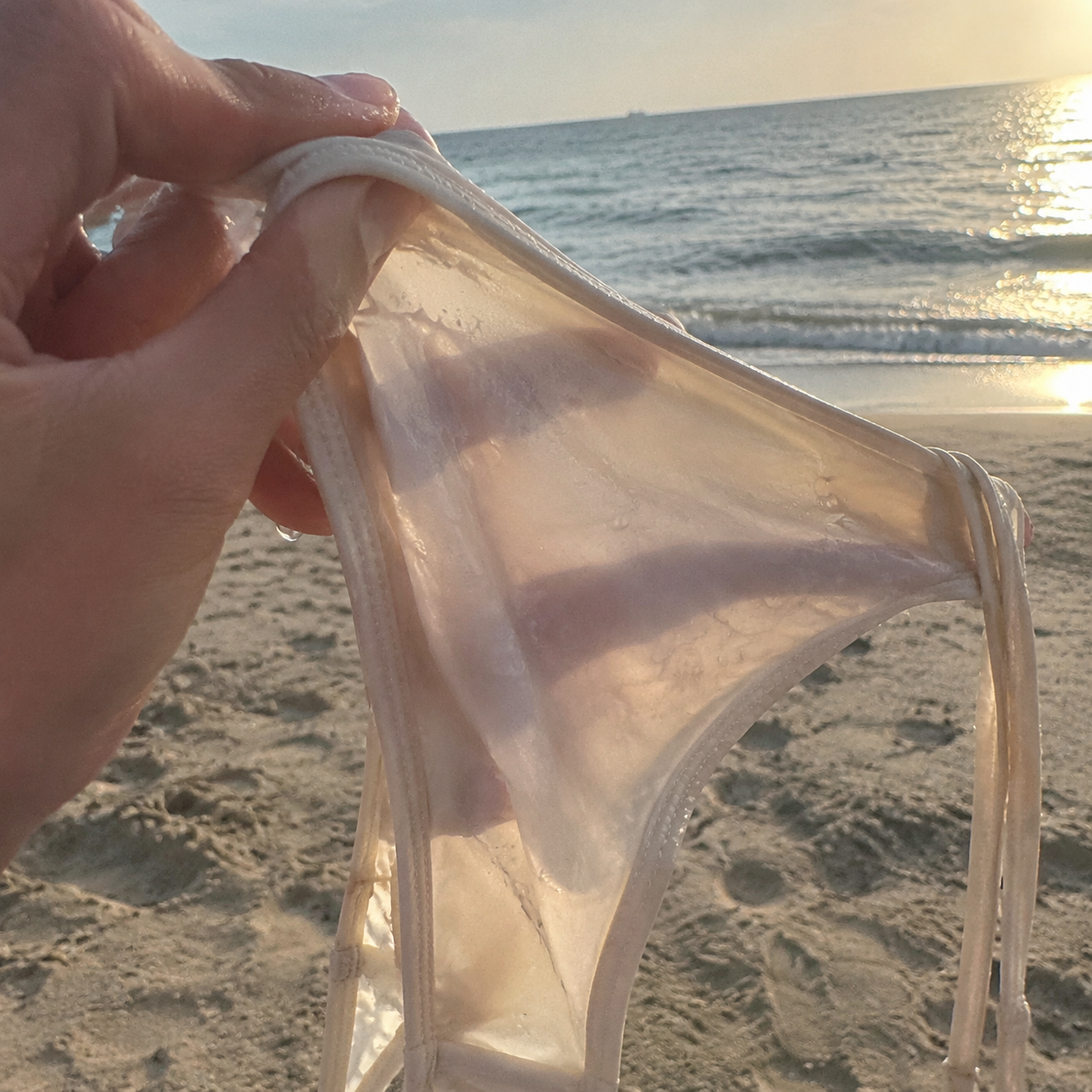
A fabric that appears opaque when dry may become visibly transparent when wet or stretched.9 Pale colors can create a higher risk, but color alone does not predict the outcome. Fabric density, construction, finish, stretch, lining, and wearer contrast all play a role.
A practical development review can include:
- Inspecting the dry fabric over contrasting backgrounds.
- Stretching it to a realistic garment extension.
- Repeating the review in a controlled wet state.
- Checking the outer fabric with the intended lining.
- Assessing the sewn sample on an appropriate fit form or fit model.
This practical review does not replace standardized laboratory evaluation where a formal claim or specification is required. It helps the product team identify visible risks early.
Inadequate support and loss of recovery
Support does not come from elastane percentage alone.10 A garment’s support depends on the combined behavior of the outer material, lining, elastic, straps, cups, seams, pattern shape, and fit tension.
A high-support style may require:
- Stable power mesh or supportive lining
- Wider underbust elastic
- Reinforced straps
- Cup structure
- Strategic seams
- Suitable negative ease
- Size-specific grading adjustments
Weak recovery may lead to loose leg openings, stretched straps, seat bagging, or a general loss of fit. Buyers should inspect both fabric and garment recovery, paying particular attention to high-stress seams, leg and arm openings, underbust areas, straps, ties, and seat coverage.
Repeated extension or wear simulation may provide more useful information than a single hand pull. A qualified laboratory can help define a suitable method where measurable acceptance criteria are needed.
Color and surface deterioration
Color can change because of dye selection, printing, finishing, washing, sunlight, salt water, chlorinated water, perspiration, or interaction with other materials.11 Surface changes may include pilling, snagging, abrasion, or loss of texture.
Depending on the product and market, buyers may discuss relevant methods from standards families such as ISO 105 for specific colorfastness exposures. The exact method and acceptance level should be set with a qualified testing or compliance professional. No single test represents every real-world condition.
Hardware also matters. Rings, sliders, hooks, decorative coatings, and printed logos should be reviewed alongside the material because staining, corrosion, or color transfer can damage an otherwise acceptable garment.
Why Should Swimwear Fabric Sampling and Bulk Production Be Separate Gates?
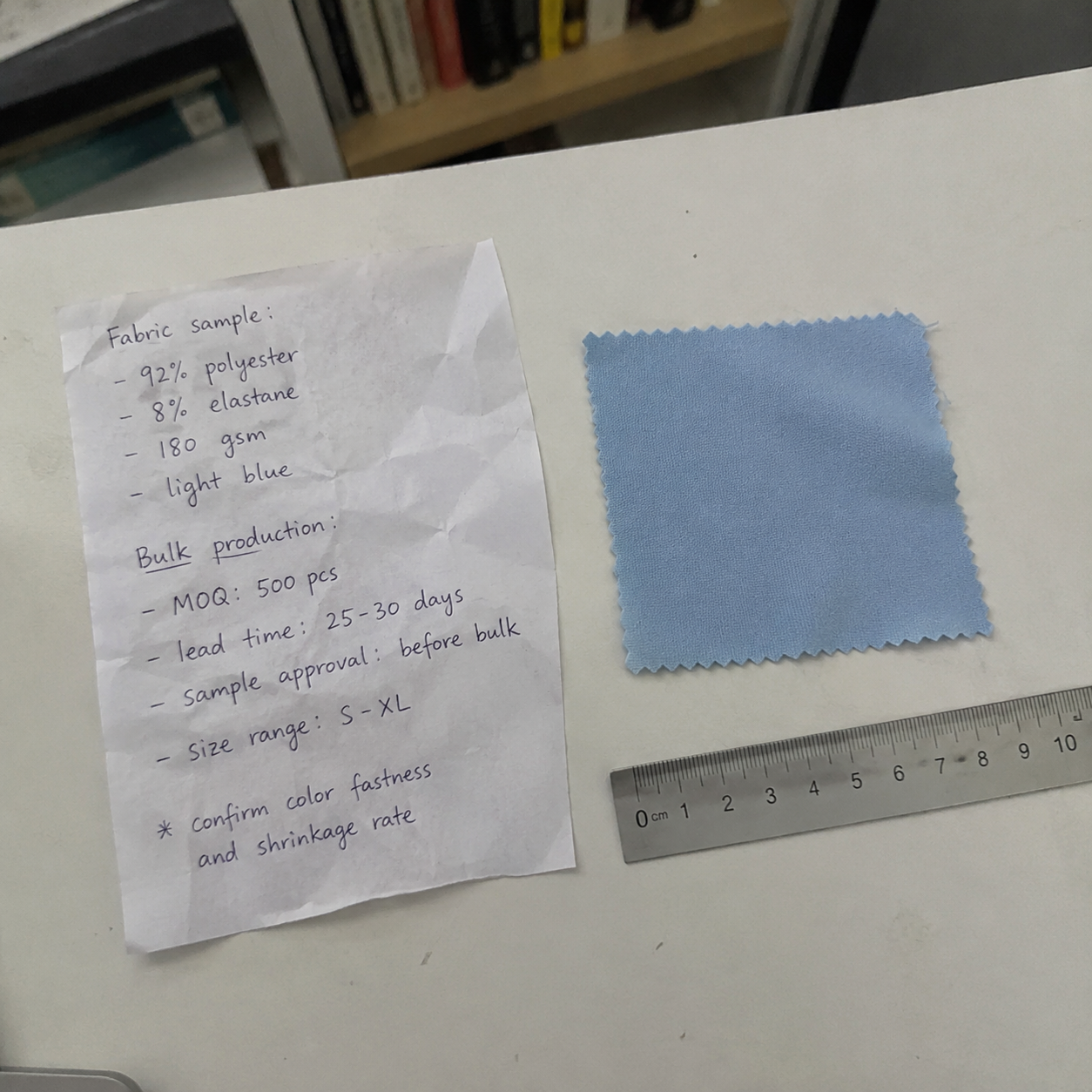
A strong sample can create false confidence. It may be made from a small material cut, handled by a sample specialist, or produced before the final bulk lot is available. If buyers treat sample approval as complete production approval, batch variation can remain undetected.
Sampling should confirm design, fit, construction, and preliminary material suitability. Bulk approval should separately confirm the production fabric’s shade, weight, width, construction, appearance, and agreed performance requirements. Both gates need documented standards because an approved sample does not automatically guarantee consistent bulk goods.
What sampling should establish
The sampling stage should answer product-development questions such as:
- Does the silhouette match the design intent?
- Does the material provide the expected coverage?
- Does the pattern create the required support?
- Does the lining work with the outer fabric?
- Do the seams lie correctly?
- Do openings remain secure?
- Does the texture distort?
- Does the color match the approved visual direction?
- Is the garment comfortable during realistic movement?
A fit sample should be assessed in the intended base size and then reviewed through the planned size range. A material that behaves well in a smaller sample may require construction or grading adjustments in extended sizes.
What bulk approval should establish
Bulk fabric can vary from the development yardage.12 Procurement teams should therefore establish acceptance procedures for the production lot.
| Control point | What the buyer should verify |
|---|---|
| Roll identification | Lot numbers and roll traceability |
| Shade | Agreement with the approved standard and between rolls |
| Weight | Compliance with the agreed tolerance and method |
| Width | Minimum usable cutting width |
| Surface | Holes, marks, streaks, snags, or texture inconsistency |
| Construction | Agreement with the approved material specification |
| Stretch and recovery | Results under the agreed evaluation method |
| Color performance | Relevant reports or agreed lot checks |
| Quantity | Delivered amount after applicable inspection |
Tolerances should be written into the purchase specification. Statements such as “same as sample” can be too vague for resolving a dispute.
Keep an approved reference and control changes
Buyers, garment manufacturers, and material suppliers should retain clearly identified references when practical. These may include:
- Approved fabric swatch
- Approved color standard
- Sealed pre-production sample
- Lab-dip or strike-off approval
- Inspection report
- Test report
- Material specification sheet
- Trim and lining references
Each document should include a date, version, color code, and product reference. This reduces confusion when multiple styles, revisions, and colorways move through development at the same time.
Any material substitution should trigger a review. A replacement with the same stated fiber percentages may still differ in weight, construction, finish, recovery, or shade. The brand should require written approval before changes to the fabric supplier, yarn or fiber source, knit construction, weight, finish, dye or print route, lining, elastic, or major trims.
How Should Buyers Evaluate a Swimwear Fabric Supplier?
Even a well-selected material can create problems if the supplier cannot maintain consistency, communicate changes, or support repeat orders. Buyers need more than an attractive swatch book. They need evidence that the material and manufacturing partners can manage specifications from development through shipment.
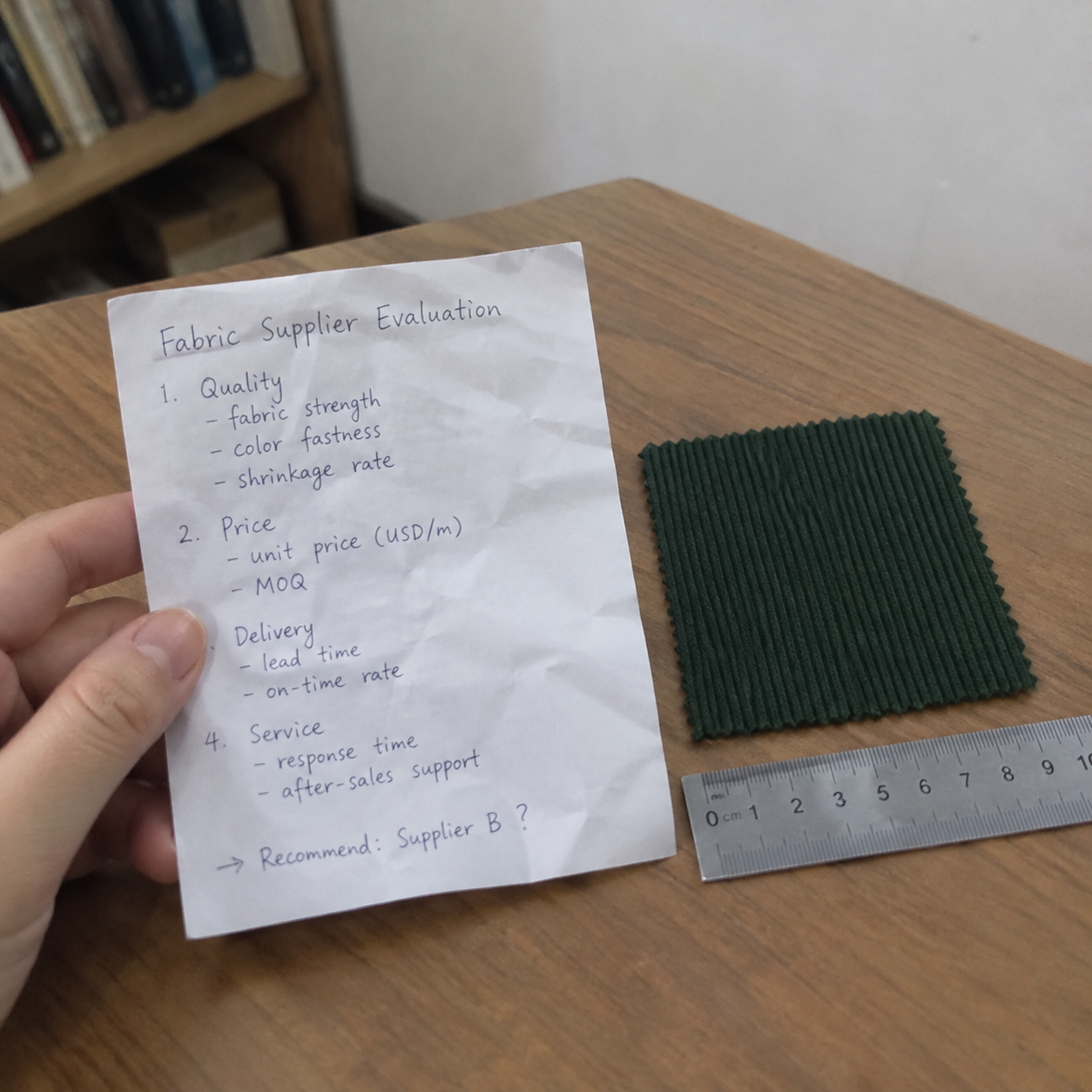
A swimwear fabric supplier should be evaluated for technical documentation, lot consistency, color control, order flexibility, traceability, lead times, and issue resolution. The garment manufacturer should also demonstrate suitable material inspection, controlled cutting, sewing capability, and documented final-quality checks.
Ask for complete documentation
The material specification should include as much relevant information as possible:
- Fiber composition
- Finished weight and tolerance
- Usable width and tolerance
- Knit construction
- Color or print reference
- Stretch direction
- Available test reports
- Care instructions
- Country of origin where required
- Minimum order quantity
- Lead time
- Color minimum
- Lot and roll identification process
If a certification supports a sourcing claim, buyers should verify its scope. A valid certificate held by one facility does not necessarily cover every product, transaction, subcontractor, or stage of production.
Review production compatibility
The garment manufacturer should evaluate whether the fabric can be spread, cut, sewn, and finished reliably. Highly elastic or textured materials may need controlled relaxation, suitable needles, differential feeding, adjusted seam construction, or specialized operator handling.
At Aura Intimates Global, material selection is linked to the intended garment, approved specifications, and production requirements. The company’s OEM and ODM workflow covers bikinis, one-piece swimsuits, tankinis, and plus-size collections. Quality checks focus on material condition, stitching accuracy, color consistency, and alignment with the approved sample. Inspection arrangements are defined according to the product and order requirements.
Application-specific performance claims still require appropriate evidence. Buyers should use qualified laboratories, compliance specialists, or textile professionals when formal testing and market-specific requirements apply.
Compare suppliers with a scorecard
A simple scorecard helps procurement teams avoid making decisions on price alone.
| Evaluation category | Suggested questions |
|---|---|
| Material suitability | Does the fabric meet the garment’s use and support needs? |
| Documentation | Are specifications and reports complete and current? |
| Consistency | How are shade, weight, width, and defects controlled? |
| MOQ flexibility | Can the order volume support a test launch? |
| Lead time | Does the schedule fit the seasonal launch window? |
| Repeatability | Can future orders match the approved standard? |
| Communication | Are risks and changes reported before production? |
| Traceability | Can rolls, lots, and production orders be identified? |
| Issue resolution | Is there a documented process for nonconforming goods? |
| Export support | Can documentation meet the destination market’s needs? |
For seasonal swimwear launches, production timing should be planned backward from the intended launch date. The schedule needs to include development, material booking, color approval, sampling, bulk production, inspection, transport, customs clearance, and local distribution. A short material lead time has limited value if shade approval or export documentation delays the overall order.
Frequently Asked Questions
What is the best fabric composition for swimwear?
No single composition is best for every swimsuit. Nylon-elastane and polyester-elastane blends are common, but buyers should also compare weight, knit construction, recovery, opacity, finish, lining, and intended exposure. The complete material and garment system provides more useful information than fiber percentages alone.
How much elastane should swimwear fabric contain?
Elastane content varies by material and intended use. A higher percentage does not automatically provide better support or recovery. Yarn quality, fabric construction, finishing, and pattern tension can materially change performance. Buyers should evaluate an actual sample and request test information produced under a defined method.
Should all swimwear be lined?
Not every design requires the same lining approach. Lining decisions depend on opacity, support, color, construction, comfort, coverage, and price. Pale colors or structured styles may need full lining, while some designs may use partial or specialized lining. Wet-state assessment should inform the decision.
Is recycled swimwear fabric always more sustainable?
Recycled content can support a responsible material strategy, but it does not establish the product’s complete environmental impact. Buyers should verify recycled-content documentation and avoid unsupported comparisons. Dyeing, finishing, waste, transport, garment care, and useful life can also affect a broader sustainability assessment.
How can a buyer confirm swimwear fabric quality before ordering?
A buyer should review the specification, inspect swatches, develop a garment sample, assess fit and wet-state coverage, and agree on relevant performance checks. Before cutting bulk goods, the buyer or manufacturer should verify the production lot’s shade, weight, width, surface condition, construction, and traceability.
Conclusion
The right swimwear fabric is not a universal blend. It is the material system that matches the swimsuit’s use environment, support, coverage, price, construction, and acceptable production risk. Buyers should compare more than composition, test the intended garment, document measurable specifications, and treat sample and bulk approvals as separate quality gates.
Aura Intimates Global supports brands with OEM and ODM development, material selection, sampling, and scalable swimwear production. Contact our team to review your design brief, target price, order volume, and fabric requirements before starting your next collection.
"Functional clothing, an overlooked source of persistent textile ...", https://link.springer.com/article/10.1007/s10311-024-01796-2. Textile studies report that repeated chlorine and laundering exposure can degrade elastomeric fibers and affect the color, strength, or elastic recovery of swimwear fabrics. Evidence role: mechanism; source type: paper. Supports: Repeated exposure to chlorinated water and laundering can alter the mechanical or color properties of swimwear materials.. Scope note: The rate of deterioration depends on chlorine concentration, exposure duration, fiber chemistry, dyes, finishes, and care conditions. ↩
"Find a Certified Company", https://textileexchange.org/find-certified-company/. Textile Exchange defines the GRS and RCS as standards for verifying recycled content and chain of custody, with certification documents applying only within their stated scope and validity period. Evidence role: definition; source type: institution. Supports: GRS and RCS establish requirements for recycled-content verification and chain of custody, with certification tied to defined organizations, sites, products, or transactions.. Scope note: A valid certificate does not by itself establish that every product sold by the certificate holder is certified. ↩
"Sustainable and circular textiles", https://www.unep.org/topics/chemicals-and-pollution-action/circularity-sectors/sustainable-and-circular-textiles. Life-cycle assessments of textiles evaluate impacts across raw-material production, dyeing and finishing, garment manufacture, transport, use, and end-of-life, indicating that fiber origin is only one component of overall environmental performance. Evidence role: general_support; source type: institution. Supports: Textile environmental impacts arise across multiple life-cycle stages rather than solely from raw-material origin.. Scope note: The relative contribution of each stage varies by product, energy mix, manufacturing route, consumer behavior, and assessment methodology. ↩
"Compression and Recovery Functional Application for the ...", https://www.intechopen.com/chapters/79743. Research on elastic knitted textiles shows that yarn arrangement, stitch structure, fabric density, and finishing influence extension, recovery, drape, and dimensional behavior in addition to fiber composition. Evidence role: mechanism; source type: paper. Supports: Fabric construction and processing variables can cause fabrics with similar fiber compositions to exhibit different mechanical and appearance properties.. Scope note: Individual study results may concern particular knit structures or test conditions rather than every commercial swimwear fabric. ↩
"Compression and Recovery Functional Application for the ...", https://www.intechopen.com/chapters/79743. Textile references define GSM as mass per unit area; properties such as support, extension, recovery, opacity, and durability also depend on fiber type, yarn structure, knit geometry, density, and finishing. Evidence role: definition; source type: education. Supports: GSM measures fabric mass per unit area, while support and quality depend on additional structural and performance variables.. Scope note: Fabric weight may correlate with some performance characteristics within a controlled group of otherwise similar fabrics, but it is not an independent quality rating. ↩
"(PDF) Effect of Yarn Characteristics on Bagging Recovery ...", https://www.researchgate.net/publication/389251723_Effect_of_Yarn_Characteristics_on_Bagging_Recovery_and_Comfort_Properties_of_Warp-Knitted_Fabric_for_Sport_and_Recreation. Studies of elastic knitted fabrics distinguish extensibility from recovery and show that incomplete recovery after loading produces residual deformation associated with fabric or garment bagging. Evidence role: mechanism; source type: paper. Supports: Extension and recovery are distinct mechanical properties, and incomplete recovery leaves residual deformation that can impair garment fit.. Scope note: Garment-level fit loss also depends on pattern dimensions, seam behavior, elastic components, loading cycles, and recovery time. ↩
"(PDF) Designing with stretch fabrics", https://www.researchgate.net/publication/297560922_Designing_with_stretch_fabrics. Apparel-engineering research treats fabric extensibility and recovery as inputs to negative ease and pattern dimensions, supporting the need to reassess fit when the base material changes. Evidence role: mechanism; source type: research. Supports: Stretch-garment patterns are calibrated to material extensibility and recovery, so material substitution can alter fit and required ease.. Scope note: The amount of required adjustment is style- and material-specific and cannot be inferred from fiber composition alone. ↩
"TM183 Test Method for Transmittance or Blocking of UV ...", https://members.aatcc.org/store/tm183/579/. AS/NZS 4399 specifies evaluation and labeling provisions for sun-protective clothing, whereas AATCC TM183 provides an instrumental method for determining ultraviolet transmission or blocking through fabrics. Evidence role: definition; source type: institution. Supports: AS/NZS 4399 addresses sun-protective clothing, while AATCC TM183 measures ultraviolet radiation transmitted or blocked by fabric.. Scope note: A fabric test result does not automatically establish the protection of every finished garment because coverage, stretch, wetness, wear, and construction can affect in-use exposure. ↩
"Theoretical Porosity of Elastic Single Jersey Knitted Fabric ...", https://www.tandfonline.com/doi/full/10.1080/15440478.2023.2181274. Textile optical studies indicate that wetting can change light scattering within a fabric and that stretching can enlarge structural openings or reduce thickness, increasing visible transmission in some materials. Evidence role: mechanism; source type: paper. Supports: Water and mechanical extension can change light transmission through fabric by altering optical contrast, pore geometry, or fabric thickness.. Scope note: The effect varies substantially with color, fiber, knit density, finish, extension level, lighting, background contrast, and lining. ↩
"Pattern engineering and functional clothing (PDF)", https://www.academia.edu/124789555/Pattern_engineering_and_functional_clothing. Research on close-fitting supportive garments attributes support to interacting factors including fabric modulus, stretch direction, pattern geometry, fit tension, lining, straps, seams, and elastic components rather than elastane percentage alone. Evidence role: mechanism; source type: paper. Supports: Garment support depends on the integrated mechanical behavior and geometry of fabrics and construction components, not merely nominal elastane content.. Scope note: Much of the directly measured evidence concerns sports bras or compression garments, so its application to swimwear is mechanistically relevant but not direct proof for every swimsuit design. ↩
"Colour fastness according to ISO 105 series", https://www.centexbel.be/en/problem-solving/testing/colour-fastness-according-iso-105-series. The ISO 105 series contains distinct colorfastness methods for exposures including washing, light, water, perspiration, rubbing, and chlorinated swimming-pool water, reflecting the different mechanisms by which textile color can change or transfer. Evidence role: general_support; source type: institution. Supports: Textile colorfastness is exposure-specific, with separate methods addressing washing, light, water, perspiration, rubbing, and chlorinated pool water.. Scope note: Passing one colorfastness method does not demonstrate resistance to all exposures or reproduce every combination of real-world conditions. ↩
"Textile quality assurance: A comparison between ...", https://dr.lib.iastate.edu/bitstreams/532d5995-3bc0-4d36-af3e-c8cc63c4cd55/download. Textile quality-control literature recognizes lot-to-lot and roll-to-roll variation in shade, width, mass, dimensions, surface condition, and mechanical performance, supporting separate inspection of production material against an approved reference. Evidence role: general_support; source type: research. Supports: Manufacturing variables can produce measurable differences between development yardage and subsequent production lots or rolls.. Scope note: The magnitude and commercial significance of variation depend on the manufacturing process, tolerances, sampling plan, and supplier controls. ↩