

Swimwear sampling turns a design idea into a production-ready standard. Without a controlled process, unresolved measurements, materials, and construction details can lead to repeated revisions, higher costs, and missed launch dates. A structured sampling workflow helps brands test fit, document decisions, and reduce risk before committing to bulk manufacturing.1
Swimwear sampling is a product-development process that converts a sketch, reference garment, or technical brief into an approved physical sample. It usually covers specification review, material selection, pattern development, fitting, revisions, and final approval. The approved specifications then guide bulk production, grading, and quality control within defined tolerances.
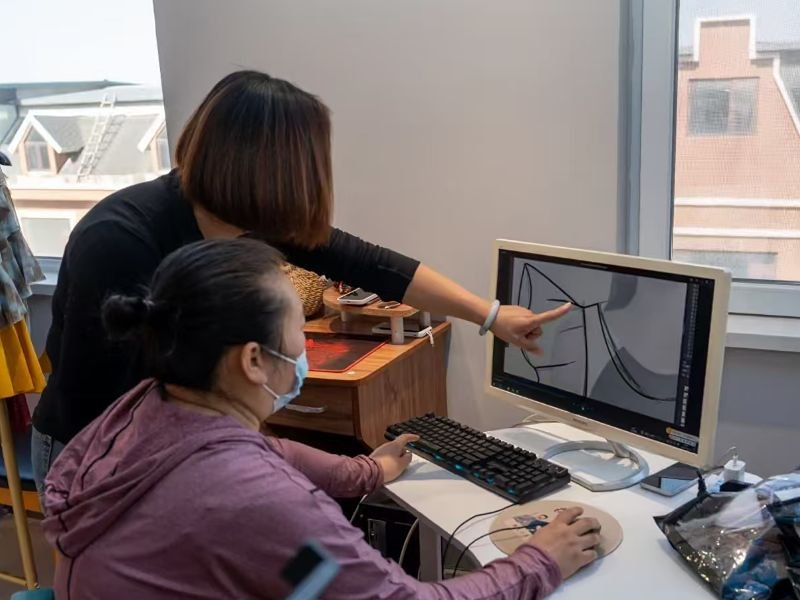
However, the first sample is rarely just a visual preview. It exposes open design decisions and manufacturing constraints. Understanding each stage helps a buyer provide better input, review samples objectively, and create a clear handoff to production.
What Is the Purpose of Swimwear Sampling?
A beautiful sketch can still leave important questions unanswered. Coverage, stretch recovery, lining, seam construction, and support may not become clear until a physical garment exists. If these issues remain unresolved, the uncertainty can carry into grading and bulk production.
Swimwear sampling allows a brand and manufacturer to test whether a design can meet its intended appearance, fit, function, and commercial requirements. The process creates a documented reference for measurements, materials, construction, artwork, trims, and workmanship rather than relying only on drawings, photographs, or verbal instructions.2
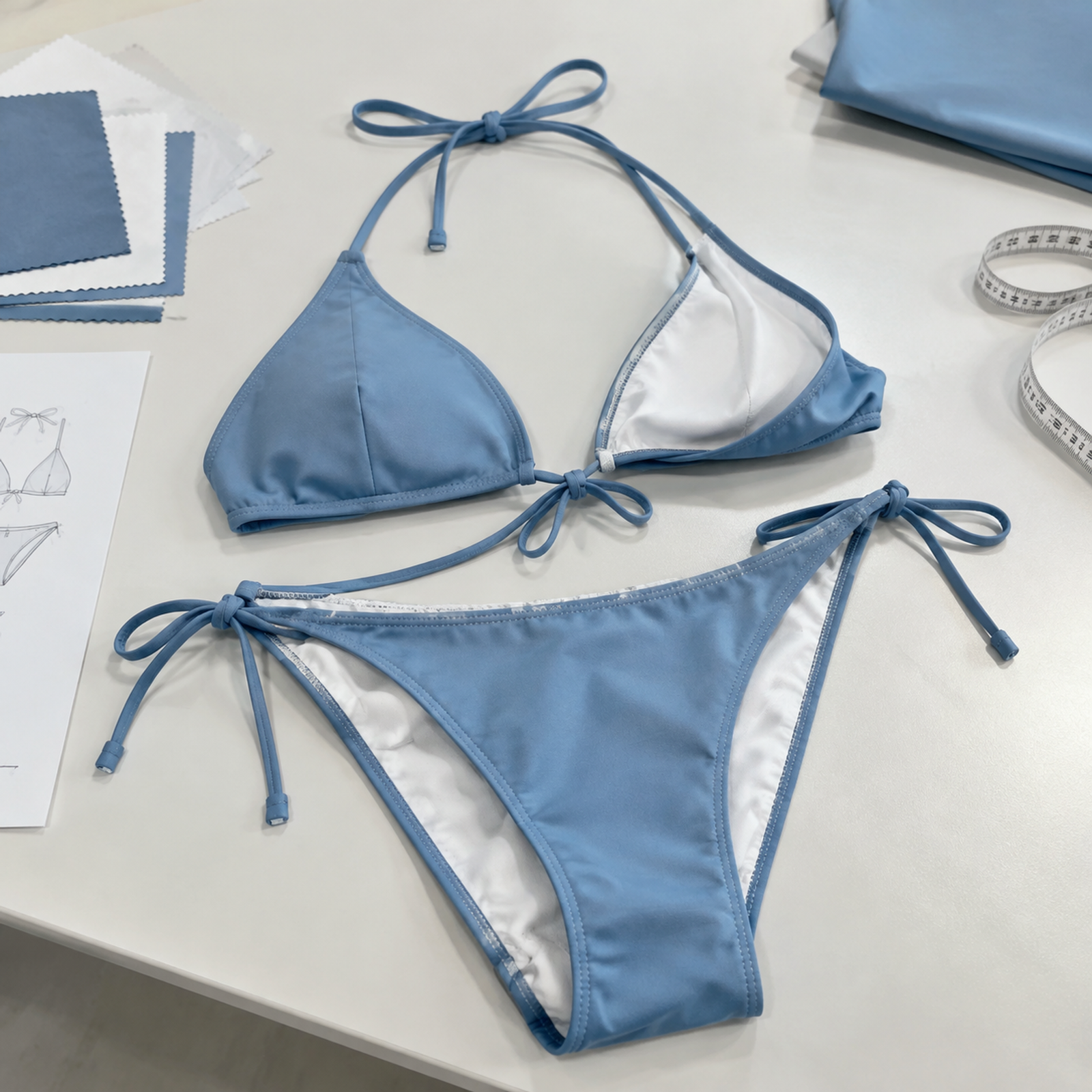
Sampling Is a Risk-Control Process
Sampling should not be treated as a casual preview of the collection. It is a controlled development process that helps lock decisions before significant fabric is cut.
A sample can help evaluate:
- Silhouette and proportions
- Body coverage
- Fit in the target size
- Fabric stretch and recovery
- Lining behavior
- Elastic tension
- Support and shaping
- Seam placement
- Trim position
- Print or color appearance
- Construction feasibility
- Potential production consistency
Swimwear presents specific development challenges because a small measurement change can affect coverage, compression, or comfort. Fabric elasticity also affects how a pattern behaves on the body. Two fabrics with similar fiber compositions may not perform identically because their weight, knit structure, stretch direction, recovery, and finish can differ.3
An attractive sample does not automatically prove that the style is ready for repeat production.
The manufacturer must also determine whether the approved design can be graded into other sizes and produced within practical tolerances.4 Grading is especially important for one-piece swimsuits, underbust structures, plus-size styles, and designs with cups, wires, or adjustable components.
A common misconception is that the first sample should be final. In practice, initial sampling often reveals details that need further development, such as fit, edge finishing, strap construction, support, and hardware compatibility. It may also clarify construction choices that the original sketch did not specify, such as hidden elastic, binding, or turned edges.
A productive first round does not need to be perfect. It needs to reveal the right questions and create a reliable basis for the next decision.
How Does Swimwear Sampling Work?
Sampling can become confusing when stage names are treated as universal. One supplier may use “fit sample,” while another may use “development sample” for a similar purpose. Without an agreed workflow, buyers may misunderstand what each sample is meant to confirm.
A common swimwear sampling workflow moves from the design brief and technical specifications to material review, quotation, pattern development, first sampling, inspection, buyer feedback, revisions, confirmation, and signed approval. The exact sample types and number of stages depend on the design, supplier, target market, and production requirements.
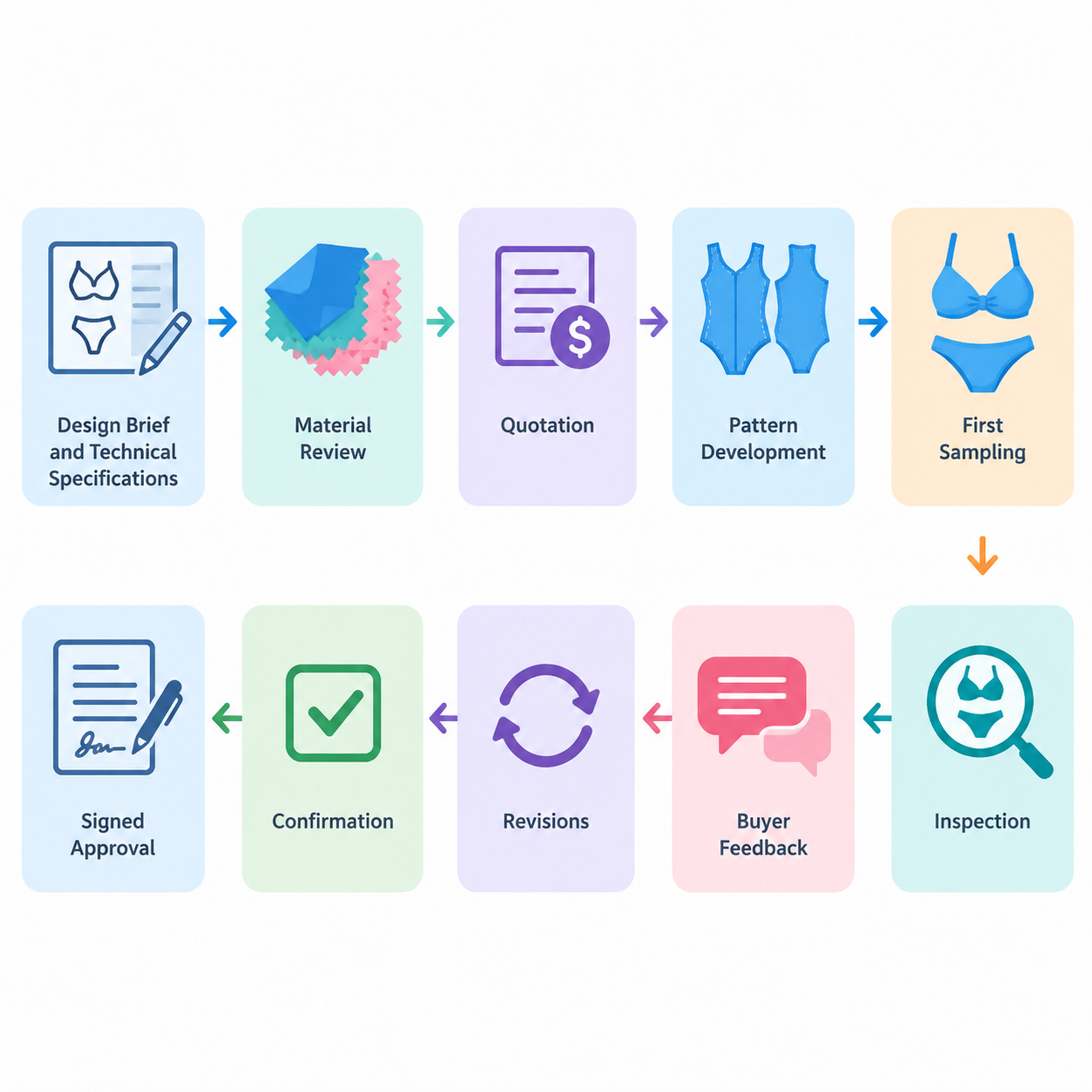
A Typical Development Sequence
The following sequence provides a practical planning model. It should be confirmed with the selected manufacturer because terminology and requirements vary.
- Submit the design brief or reference garment.
- Confirm the target customer, market, and size range.
- Review the tech pack and identify open decisions.
- Select or source fabrics, linings, trims, and components.
- Review construction feasibility and estimated pricing.
- Confirm sample charges and payment terms.
- Develop the base pattern.
- Produce the first sample.
- Complete the manufacturer’s internal inspection.
- Ship or present the sample for buyer review.
- Record all requested changes in one revision document.
- Produce a revised, fit, size-set, or pre-production sample if required.
- Approve measurements, materials, workmanship, and artwork.
- Transfer the approved standard into bulk-production documents.
Sample Types May Differ
Not every project requires every possible sample stage. The appropriate stages depend on product complexity and buyer requirements.
| Sample type | Common purpose | Typical review focus |
|---|---|---|
| Development sample | Translate the initial concept into a garment | Shape, construction, feasibility |
| Fit sample | Evaluate fit on the intended body or form | Measurements, coverage, balance |
| Revised sample | Confirm requested corrections | Change accuracy and unresolved issues |
| Size-set sample | Review grading across selected sizes | Size progression and fit consistency |
| Print or color sample | Confirm visual execution | Scale, placement, color, technique |
| Sales sample | Support presentation or selling activity | Appearance and representative quality |
| Pre-production sample | Confirm the standard before bulk cutting | Final materials, trims, labels, workmanship |
| Shipment sample | Represent completed production | Comparison against approved requirements |
A simple bikini may need fewer development stages than a structured one-piece with molded cups, underwire, custom hardware, and engineered artwork. A ready-to-brand ODM style may also move differently from a full custom OEM design because an existing pattern and construction method may already be available.
Before payment, the buyer should ask the supplier to define:
- Which sample is being quoted
- What the sample is intended to approve
- Which materials will be used
- Whether substitute development materials may be necessary
- What is included in the sample charge
- Whether courier costs are separate
- How revisions will be handled
- What approval is needed before production
This clarification prevents a buyer from expecting a pre-production standard when the supplier is only producing an initial development sample.
What Should Buyers Prepare Before Swimwear Sampling?
A vague request such as “make this bikini in premium fabric” does not provide enough information for controlled development. The supplier must then interpret fit, construction, support, materials, and market positioning. Each unrecorded assumption can create an avoidable revision.
Before swimwear sampling begins, buyers should prepare technical drawings or references, measurement specifications, target sizes, fabric preferences, colors, artwork, trims, labels, construction details, expected order quantities, and the launch deadline. Any missing information should be recorded as an open decision instead of being left to verbal interpretation.
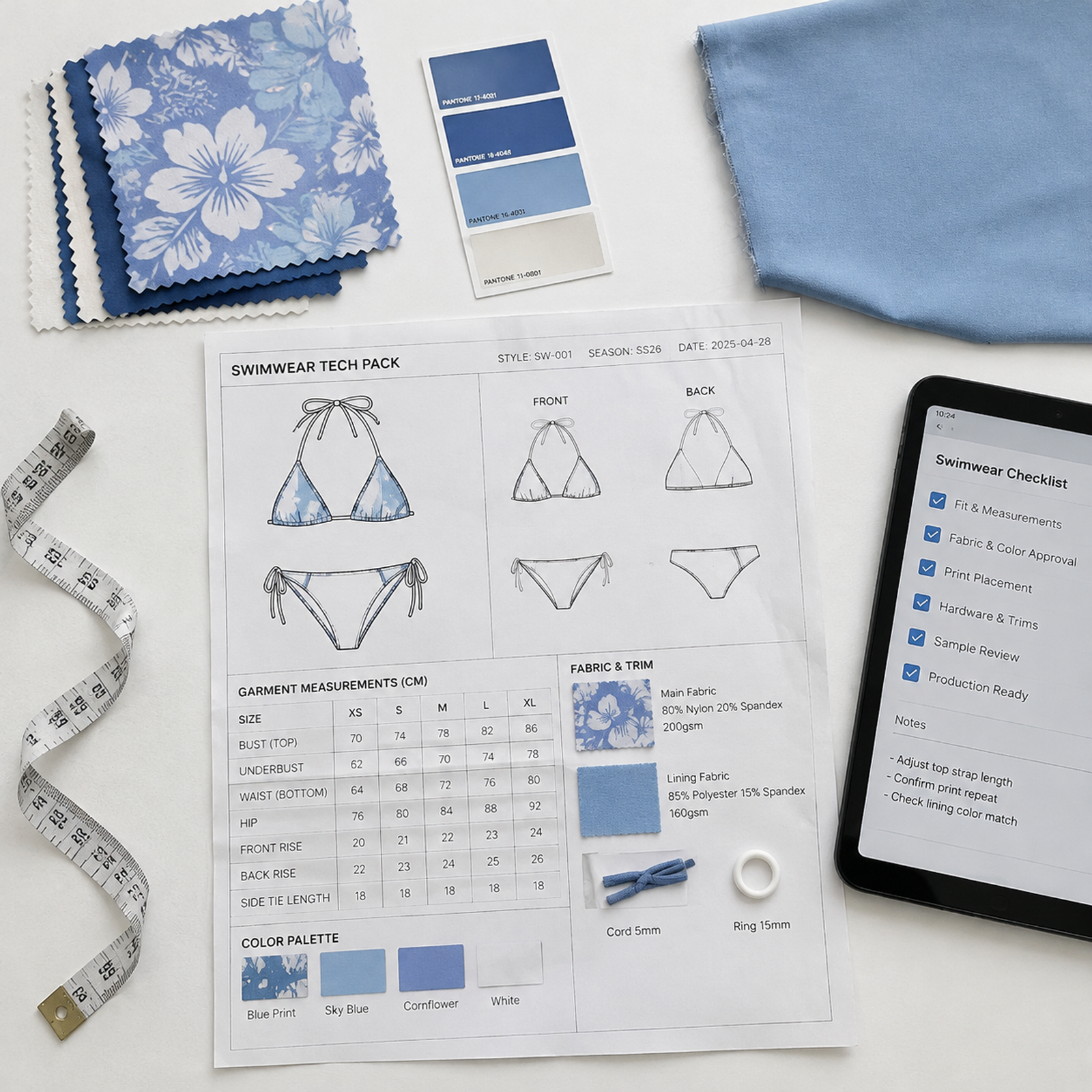
The Core Development Package
A complete technical package does not need to use complicated language. It does need to communicate the design consistently.
Useful inputs include:
- Front and back technical drawings
- Reference photographs or garments
- Point-of-measurement specifications
- Measurement tolerances
- Base size and intended size range
- Target country or regional market
- Preferred fabric composition and performance
- Lining requirements
- Pantone references or approved color standards
- Repeat artwork and placement artwork
- Elastic, cup, wire, hook, ring, slider, and closure details
- Label and packaging requirements
- Seam and edge-finishing instructions
- Estimated order quantity by style or color
- Required delivery window
Reference garments can be useful, but they should not replace written instructions. The buyer should identify which features are being referenced. A garment may be supplied for its neckline, while its leg opening, fabric, or construction may be unsuitable for the new design.
Separate Fixed Requirements From Open Decisions
A decision log makes unclear points visible. It also prevents different messages from becoming competing instructions.
| Requirement | Status | Example |
|---|---|---|
| Silhouette | Confirmed | High-waisted bikini bottom |
| Base size | Confirmed | Buyer’s selected development size |
| Main fabric | Open | Recycled nylon blend under review |
| Coverage | Open | Moderate or full back coverage |
| Hardware color | Confirmed | Matte gold |
| Strap width | Open | Final width after fit test |
| Artwork scale | Confirmed | Approved digital file |
| Launch deadline | Confirmed | Target Southern Hemisphere season |
A sketch or inspiration image can communicate the intended appearance, but it may not explain how the garment should be constructed. Details such as lining coverage, elastic application, strap attachment, seam finishing, and hardware specifications may still need to be defined before sampling begins. A narrow strap, for example, may appear simple on paper but require decisions about elastic, adjustability, support, hardware compatibility, and attachment strength.
Scattered feedback creates another common problem. One correction may appear in an email, another in a messaging application, and a third on an annotated photograph. The safest approach is to consolidate every instruction into one numbered revision list.
Each comment should ideally contain:
- The sample version being reviewed
- The exact garment area
- The current condition
- The requested change
- A target measurement when relevant
- An annotated image
- The date and responsible approver
This preparation does not eliminate every revision. It makes each revision easier to execute and verify.
What Determines Swimwear Sampling Time and Cost?
Buyers often want one fixed development price and completion date. However, sampling depends on materials, pattern complexity, special processes, feedback speed, and shipping. A simple estimate can become misleading if these variables are not defined.
Swimwear sampling time and cost depend on design complexity, fabric availability, custom trims, printing methods, pattern development, revision rounds, buyer response time, and international delivery.5 Sample charges may cover development labor, materials, special processes, and courier costs. Any quoted amount or timeline should be verified for the specific project.
Main Cost Drivers
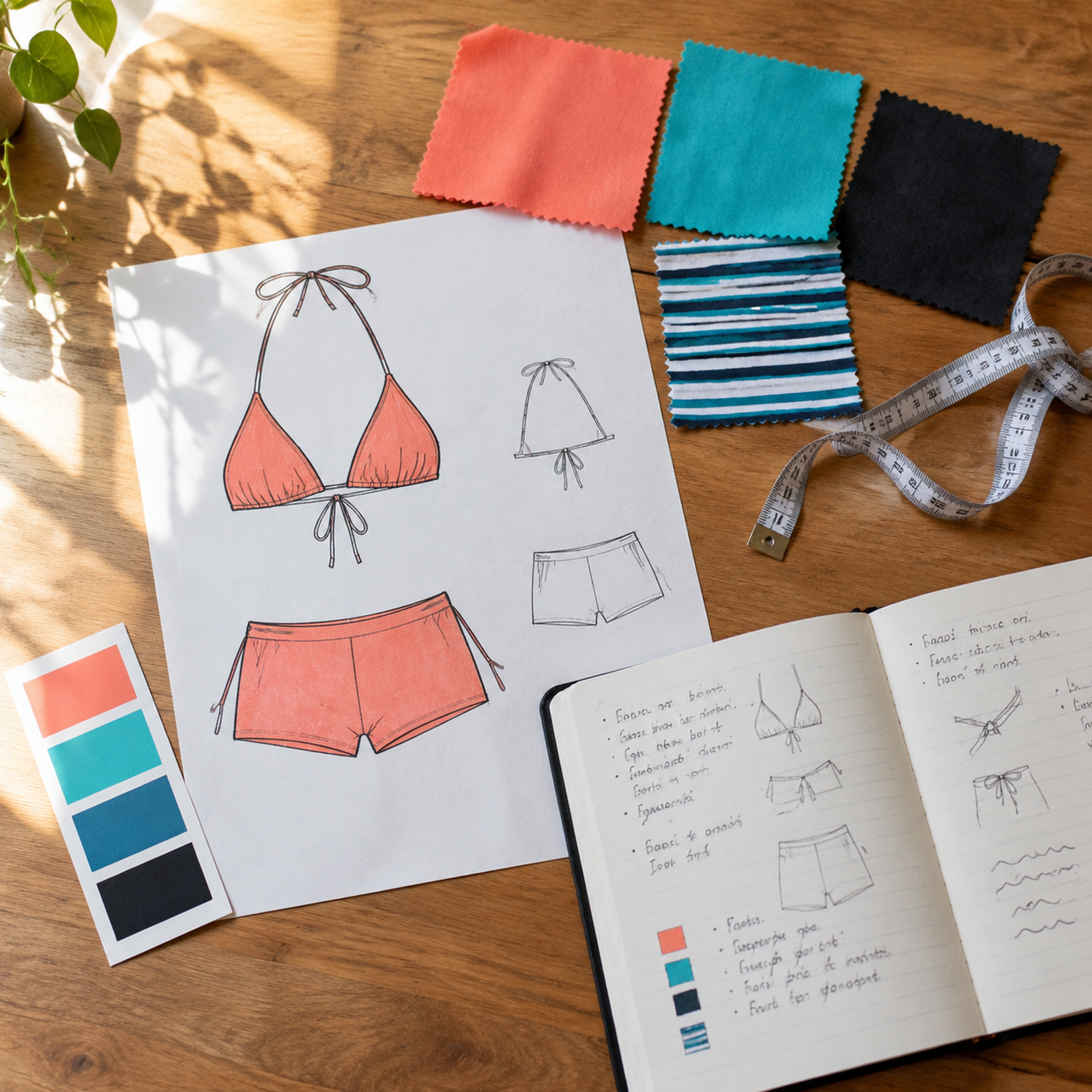
Sample production uses more than a small amount of fabric. A supplier may need to source materials, draft or adjust patterns, set up printing, prepare components, sew a single garment, inspect it, and document changes. Single-piece development does not benefit from the same workflow efficiency as bulk manufacturing.6
Key cost variables include:
- New pattern development: A fully original shape generally requires more work than a modification to an existing ODM pattern.
- Construction complexity: Underwire, cups, boning, ruching, binding, reversible construction, and multi-panel designs can increase development work.
- Material sourcing: Custom or low-availability fabrics may require special purchasing arrangements.
- Artwork preparation: Placement prints and engineered layouts need more coordination than standard solid colors.
- Special processing: Embroidery, heat transfer, laser cutting, custom dyeing, or hardware development may add setup costs.
- Revision scope: A color correction differs from a major silhouette or pattern change.
- Courier service: International sample shipment is often a separate expense.
Main Schedule Drivers
A supplier’s sewing time is only one part of the schedule. The complete development calendar may include material confirmation, pattern work, sample assembly, internal checking, buyer evaluation, revision, and transportation.
| Variable | Possible schedule effect | Buyer control |
|---|---|---|
| Stock fabric availability | Reduces sourcing time | Select from available options |
| Custom-dyed color | Adds approval and processing steps | Approve standards promptly |
| Complex pattern | Requires more development work | Submit complete measurements |
| Custom hardware | May require sourcing or tooling | Choose an existing option if suitable |
| Multiple revisions | Extends development | Consolidate feedback |
| Slow buyer review | Delays the next round | Set an internal review deadline |
| International shipping | Adds transit and customs time | Budget for physical review |
| Peak production season | May affect capacity | Start development earlier |
No responsible estimate should be treated as fixed until the supplier has reviewed the complete brief. Buyers should also ask whether the quoted schedule begins at inquiry, payment, material confirmation, or receipt of complete specifications. These starting points can produce very different expectations.
For seasonal collections, work backward from the required warehouse or retail date. Allow sufficient time for sampling, revisions, bulk production, inspection, international shipping, customs clearance, and local distribution. A realistic schedule should also include a buffer for material delays and additional sample rounds.
How Should a Swimwear Sample Be Reviewed?
A sample can look strong in a photograph while still having fit, elasticity, coverage, or texture issues. If review comments focus only on appearance, important functional problems may remain hidden until customers wear the finished product.
A swimwear sample should be reviewed against the approved tech pack, measurements, intended fit, fabric performance, construction details, and visual standards. The buyer should inspect the physical garment whenever stretch, hand feel, coverage, support, or precise color matters, then submit consolidated and measurable revision comments.
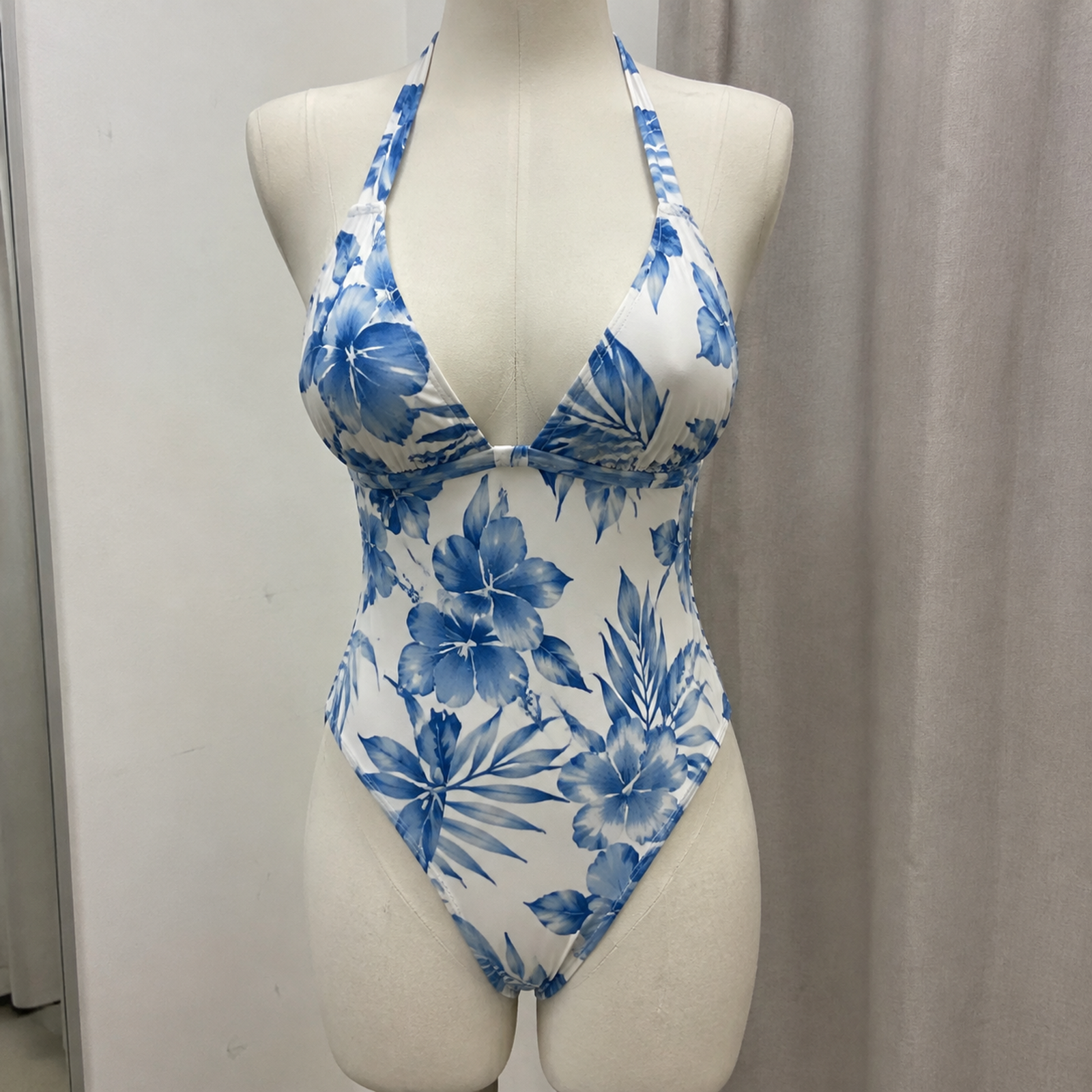
Use a Repeatable Review Order
A consistent inspection sequence reduces the risk of overlooking details.
1. Verify the Sample Identity
The sample should be matched to its style number, color, size, version, and date. This step is especially important when several similar styles are under development.
2. Compare Measurements
The garment should be measured using the agreed points of measurement and method. A measurement difference should be assessed against the stated tolerance rather than judged only by appearance.
Relevant points may include:
- Underbust width
- Cup or neckline dimensions
- Strap length
- Body length
- Waist width
- Front and back rise
- Leg opening
- Side-seam length
- Gusset width
- Back coverage
Measurement methods should be explicit. Stretch garments can produce different results depending on whether they are measured relaxed, extended, flat, or along a curve.7
3. Evaluate Fit and Function
The sample should be tested on the intended fit model or another approved evaluation basis. Reviewers should examine:
- Whether the garment sits in the correct position
- Whether coverage matches the design intent
- Whether elastic feels too tight or too loose
- Whether straps remain stable
- Whether cups and support elements align correctly
- Whether seams twist, gape, or dig into the body
- Whether the lining rolls or becomes visible
- Whether movement changes the fit
Fit approval is application-specific. A qualified pattern or fit professional should evaluate complex sizing, support, compression, or compliance requirements when necessary.
4. Inspect Materials and Workmanship
The physical sample helps the buyer assess hand feel, thickness, texture, recovery, lining compatibility, and hardware weight. Photographs and videos can support communication, but they cannot fully replace physical review for these characteristics.8
Construction inspection should cover:
- Stitch consistency
- Skipped or broken stitches
- Seam security
- Elastic insertion
- Symmetry
- Print alignment
- Trim attachment
- Label placement
- Clean finishing
Submit One Controlled Revision List
Comments such as “make it fit better” are difficult to execute. A useful instruction states the problem and the expected result.
For example:
- Increase front rise by the agreed amount.
- Move the strap attachment outward according to the annotated image.
- Reduce back coverage while keeping the side seam unchanged.
- Replace the temporary ring with the approved production hardware.
- Correct the artwork placement using the attached dimensions.
Every revision round should receive a version number. Completed changes, rejected changes, and open questions should remain visible. This method gives both parties a shared record and reduces the chance that an older instruction returns later.
How Does Swimwear Sampling Become a Production Standard?
Approval can become risky when it consists only of a brief message saying that the sample looks good. That response may not identify which measurements, materials, or temporary components were accepted. Bulk teams then lack a complete production reference.
Swimwear sampling becomes a production standard when the buyer and supplier lock the approved measurements, tolerances, materials, colors, artwork, trims, labels, construction, and workmanship in version-controlled documents. Before bulk cutting, production inputs should be checked against that standard, with defined in-line and final quality-control requirements.
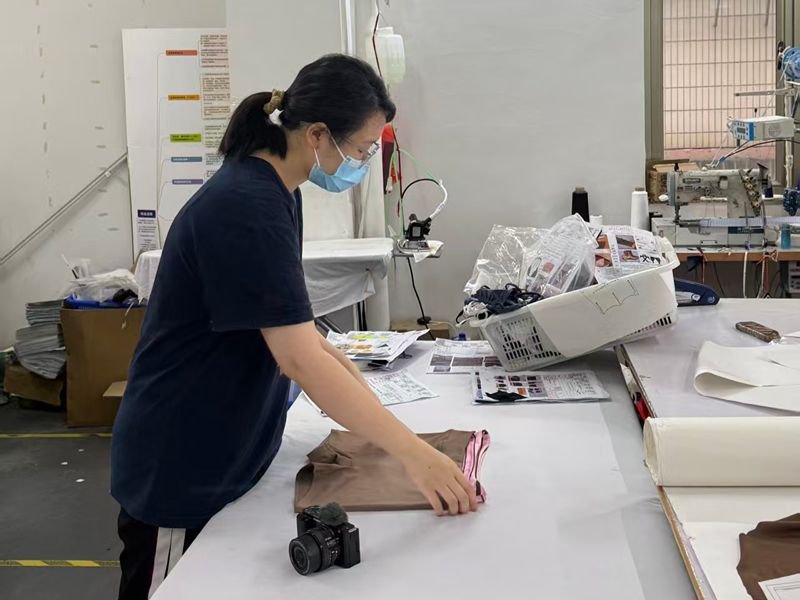
Approval Should Be Specific
The final approval package may include:
- Signed or digitally approved sample record
- Final tech pack version
- Approved measurement chart
- Defined tolerances
- Approved fabric and lining references
- Confirmed color standards
- Final artwork files
- Approved trim and hardware details
- Label and packaging instructions
- Construction notes
- Photographs of critical details
- Recorded exceptions or conditional approvals
If a development sample used substitute fabric or temporary hardware, those substitutions should be clearly marked. The production material should then be confirmed before bulk cutting. A visually similar replacement may behave differently in stretch, recovery, weight, or sewing performance.
Bulk Production Is Controlled by Tolerances
Bulk garments should not be described as literal “1:1 copies” of a single sample. Apparel production involves grading, material behavior, operator processes, and permitted manufacturing variation.9 The correct goal is conformance to approved specifications and tolerances.
A practical handoff defines:
| Control point | Approval record | Production check |
|---|---|---|
| Measurements | Final specification chart | In-line measurement audit |
| Fabric | Approved quality and color reference | Incoming material inspection |
| Artwork | Approved file and placement | Print or panel verification |
| Trims | Approved component details | Incoming trim check |
| Construction | Tech pack and sample reference | Sewing-line inspection |
| Workmanship | Defined acceptance criteria | Final inspection |
| Packaging | Approved packing instructions | Packing audit |
Quality control should begin before final inspection. Material inspection can identify color or quality discrepancies before cutting. In-line checks can identify construction or measurement drift while corrections remain manageable. Final inspection can then evaluate completed goods against the agreed requirements.10
At Aura Intimates Global, quality requirements focus on material consistency, stitching accuracy, and color matching. Project-specific inspection criteria should be agreed upon before bulk production, with independent inspection considered when appropriate.
Buyers should also verify any certification or test document directly and confirm that it applies to the relevant facility, material, product, and validity period.11
A signed sample is therefore not the end of product development. It is the controlled bridge between product development and repeatable manufacturing.
Frequently Asked Questions
Is the First Swimwear Sample Usually Final?
The first sample is not automatically final. It often reveals unresolved questions involving fit, coverage, construction, fabric behavior, or trim placement. Some straightforward ODM modifications may need fewer changes, while original or technically complex styles may require additional rounds. The required process depends on the project.
Can a Swimwear Sample Be Approved From Photos or Videos?
Photos and videos can confirm general appearance and support fast communication. However, they may not be sufficient when fit, stretch, recovery, texture, support, coverage, or exact color is important. A physical review is usually more appropriate for decision-critical characteristics.
What Is the Difference Between an ODM Sample and an OEM Sample?
An ODM sample usually begins with an existing supplier design that a brand can adapt through fabrics, colors, prints, trims, or limited styling changes. An OEM sample usually follows the buyer’s original specifications and may require new pattern development, construction decisions, and more extensive technical review.12
Who Pays for Swimwear Sampling and Shipping?
Payment arrangements vary by supplier and project. Sample charges may cover pattern work, development labor, materials, special processes, and sample sewing. Courier costs may be included or charged separately. Buyers should request a written breakdown and confirm whether any fees can be credited under stated order conditions.
What Happens After a Swimwear Sample Is Approved?
After approval, the final specifications, materials, artwork, trims, measurements, tolerances, and workmanship requirements should be transferred to bulk-production documents. The supplier should verify production materials before cutting and follow defined incoming, in-line, and final quality checks throughout manufacturing.
Conclusion
Swimwear sampling is a structured method for converting a design into an approved and reproducible production standard. Strong results depend on complete inputs, visible open decisions, physical evaluation, consolidated feedback, and version-controlled approval. Buyers should confirm each supplier’s stages, costs, terminology, and quality procedures instead of assuming that every factory works in the same way.
Whether you are adapting a ready-to-brand ODM design or developing a custom OEM collection, Aura Intimates Global can help you review your requirements and plan the sampling process before bulk production.
"Cutting Edge:Product Development", https://courses.cit.cornell.edu/cuttingedge/productDev/12prodDev.htm. Apparel product-development research describes iterative prototyping and fit sampling as methods for identifying design and manufacturability problems before production; this supports the risk-control rationale, although it does not by itself quantify reductions in revisions, costs, or launch delays for swimwear. Evidence role: general_support; source type: research. Supports: Apparel product-development research should establish that iterative sampling and documented evaluation help identify design, fit, and manufacturability problems before production.. Scope note: The evidence is likely to concern apparel development generally rather than provide swimwear-specific estimates. ↩
"(PDF) Effectiveness of Technical Packages for the Apparel ...", https://www.academia.edu/56373178/Effectiveness_of_Technical_Packages_for_the_Apparel_Production_Process_in_the_Global_Apparel_Industry. Apparel production references describe the technical package as the principal record for communicating measurements, materials, component specifications, construction methods, and other production requirements; this supports documented control but does not establish that documentation eliminates all interpretation or error. Evidence role: general_support; source type: education. Supports: Apparel design and production sources should describe technical packages as controlled records of measurements, materials, construction, components, and presentation requirements.. Scope note: A complete technical package reduces ambiguity but cannot prevent every development or manufacturing discrepancy. ↩
"Effects of knitted structures on the performance of cotton ...", https://medcraveonline.com/JTEFT/effects-of-knitted-structures-on-the-performance-of-cotton-knitted-fabrics.html. Textile studies show that stretch and recovery are affected not only by fiber content but also by knit construction, fabric mass, yarn arrangement, test direction, and finishing conditions. Evidence role: mechanism; source type: paper. Supports: Textile research should show that fabric construction and finishing variables influence stretch, recovery, and mechanical performance independently of nominal fiber composition.. ↩
"Optimized pattern grading - Experts@Minnesota", https://experts.umn.edu/en/publications/optimized-pattern-grading-2/. Apparel sizing and pattern-grading literature explains that a base pattern is systematically increased or decreased for other sizes and that acceptable fit and measurement variation must be assessed across the intended range; this supports the need for grading review, although it does not prescribe universal tolerances for swimwear. Evidence role: general_support; source type: education. Supports: Apparel sizing literature should explain that grading systematically changes patterns between sizes and that fit and measurement conformance must be assessed across the intended size range.. Scope note: Specific grading rules and tolerances depend on the garment, material, size system, and intended market. ↩
"How Long Does Apparel Product Development Really Take?", https://ajgfashionconsulting.com/blog/how-long-does-product-development-really-take-for-apparel-brands. Apparel product-development and supply-chain studies identify product complexity, material procurement, iterative approvals, and transportation as contributors to development lead time and cost; the relative effect of each factor varies by product and supply chain. Evidence role: general_support; source type: research. Supports: Apparel supply-chain research should associate product complexity, material procurement, iterative approvals, and logistics with development lead time and cost.. Scope note: General apparel evidence cannot provide a fixed timeline or cost for an individual swimwear project. ↩
"Economies of Scale: What Are They and How Are ...", https://www.investopedia.com/terms/e/economiesofscale.asp. Operations-management research shows that setup activities and other fixed production inputs are distributed across fewer units in one-off or small-batch work, resulting in less favorable per-unit efficiency than larger runs; this is a general manufacturing mechanism rather than a swimwear-specific cost estimate. Evidence role: mechanism; source type: research. Supports: Operations research should explain how setup work and fixed production activities increase per-unit effort in one-off or very small-batch manufacturing.. Scope note: The principle explains relative workflow efficiency but does not determine the actual sample charge for a particular supplier. ↩
"Understanding Garment Points of Measure (POMs)", https://alisonhoenes.com/2019/10/understanding-garment-points-of-measure-poms/. Standardized textile and garment measurement methods control conditioning, applied tension, orientation, and measurement procedure because extensible materials can yield different dimensions when measured relaxed, extended, flat, or along a curved path. Evidence role: mechanism; source type: paper. Supports: Standards or measurement studies should establish that specimen conditioning, applied tension, measurement path, and relaxed versus extended state affect dimensional results for extensible textiles.. ↩
"(PDF) Can you see the feel? The absence of tactile cues in ...", https://www.researchgate.net/publication/366147163_Can_you_see_the_feel_The_absence_of_tactile_cues_in_clothing_e-commerce_impairs_consumer_decision_making. Textile-evaluation research treats hand and tactile response as physical properties, while color-science research shows that displayed appearance depends on capture, display calibration, and viewing conditions; photographs and video are therefore useful communication aids but not complete substitutes for physical assessment. Evidence role: mechanism; source type: research. Supports: Research should show that tactile textile properties require physical or instrumented assessment and that displayed color varies with capture, display, calibration, and viewing conditions.. Scope note: High-quality calibrated imaging and virtual-fit tools may improve remote review, but they do not reproduce every tactile or wear-related characteristic. ↩
"Clothing Production Tolerances: A Guide for Brands (2026)", https://www.powersweetfashion.com/post/clothing-production-tolerances-a-guide-for-brands-2026. Quality-management practice evaluates manufactured goods against defined specifications, acceptance criteria, and tolerances rather than requiring exact identity with a single reference unit; allowable variation must nevertheless be explicitly agreed and controlled. Evidence role: expert_consensus; source type: institution. Supports: Quality-management and apparel-production guidance should explain that conformity is assessed against specified requirements and allowed tolerances rather than exact duplication of a reference unit.. ↩
"Textile and Apparel Inspection", https://www.intertek.com/textiles-apparel/inspection/. Established quality-control frameworks distinguish incoming inspection, in-process monitoring, and final inspection as complementary controls, allowing material or process nonconformities to be detected before reliance on finished-goods inspection alone. Evidence role: expert_consensus; source type: institution. Supports: Quality-management sources should recognize incoming, in-process, and final inspection as complementary controls for materials, process conformity, and finished goods.. ↩
"ISO - Certification", https://www.iso.org/certification.html. Conformity-assessment guidance requires certificates and test reports to be evaluated according to their issuing body, stated scope, identified organization or facility, covered product or material, and validity status; a genuine document does not establish compliance beyond that defined scope. Evidence role: general_support; source type: institution. Supports: Accreditation and conformity-assessment guidance should state that certificates and reports must be checked for authenticity, scope, named organization or site, covered product or process, and current validity.. ↩
"OEM vs ODM explained – what's best for manufacturers?", https://www.unleashedsoftware.com/blog/oem-vs-odm-explained-whats-best-for-manufacturers/. Manufacturing literature commonly distinguishes OEM arrangements, in which production follows a customer's design or specification, from ODM arrangements, in which the supplier also provides an existing or supplier-developed design; the exact division of design responsibility remains contract-specific. Evidence role: definition; source type: research. Supports: A neutral manufacturing or supply-chain source should distinguish OEM production to customer specifications from ODM activity that includes supplier-led product design.. Scope note: OEM and ODM terminology is not applied identically across all industries or supplier contracts. ↩