

The materials used for swimwear can affect fit, comfort, color retention, durability, and the overall performance of a finished garment. However, comparing fabrics by fiber name or thickness alone can lead to expensive sourcing mistakes.
From an OEM/ODM manufacturing perspective, we evaluate each fabric as part of a complete system that includes its fiber composition, knit construction, lining, finishes, elastics, pattern, and intended use.
The most common swimwear materials are nylon or polyester blended with elastane.1 Nylon blends usually provide a soft hand and smooth fit, while polyester-based fabrics generally offer stronger resistance to chlorine and color fading. PBT and Sorona-based constructions can support specialized performance needs, but no single material is best for every collection.
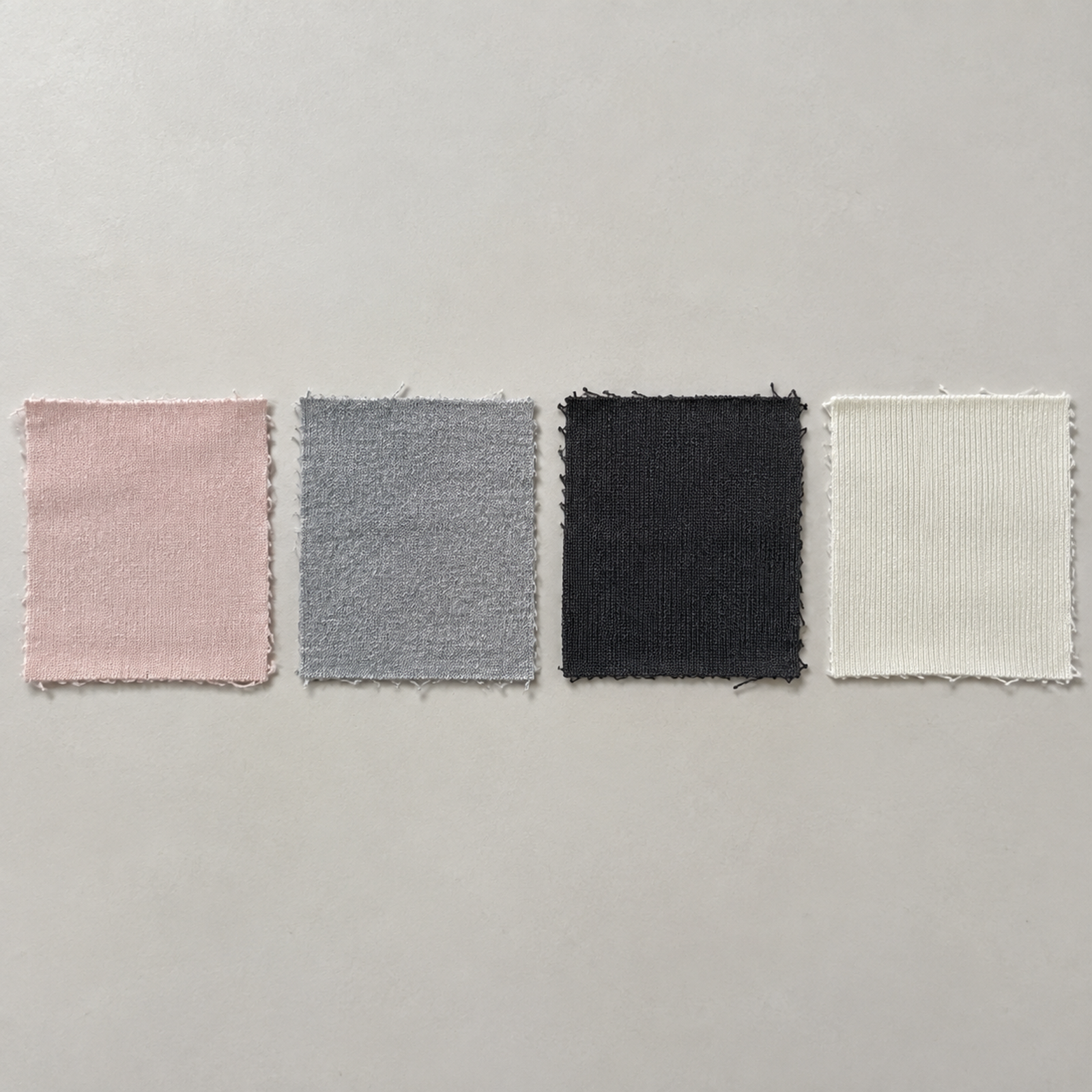
In our factory work, we start with one practical question: Where and how will the customer wear this garment? A resort bikini, a children’s swimsuit, and a training suit face very different conditions. The following comparisons show how we match fabric systems to each commercial purpose.
Which materials are used for recreational swimwear?
Recreational swimwear needs to balance appearance, comfort, stretch, recovery, and durability. These requirements do not always point toward the same fabric.
A fabric that feels exceptionally soft may not provide enough coverage when stretched. A heavier fabric may improve opacity but feel warmer or more restrictive. A fabric with strong color performance may not provide the hand feel expected from a premium fashion collection.
Most recreational swimwear materials combine nylon or polyester with elastane.A typical fabric may contain approximately 75–90% nylon or polyester and 10–25% elastane, although actual ratios vary.2 We usually choose nylon blends for soft fashion-led products and polyester blends when colorfastness, printed designs, or chlorine exposure deserve greater priority.
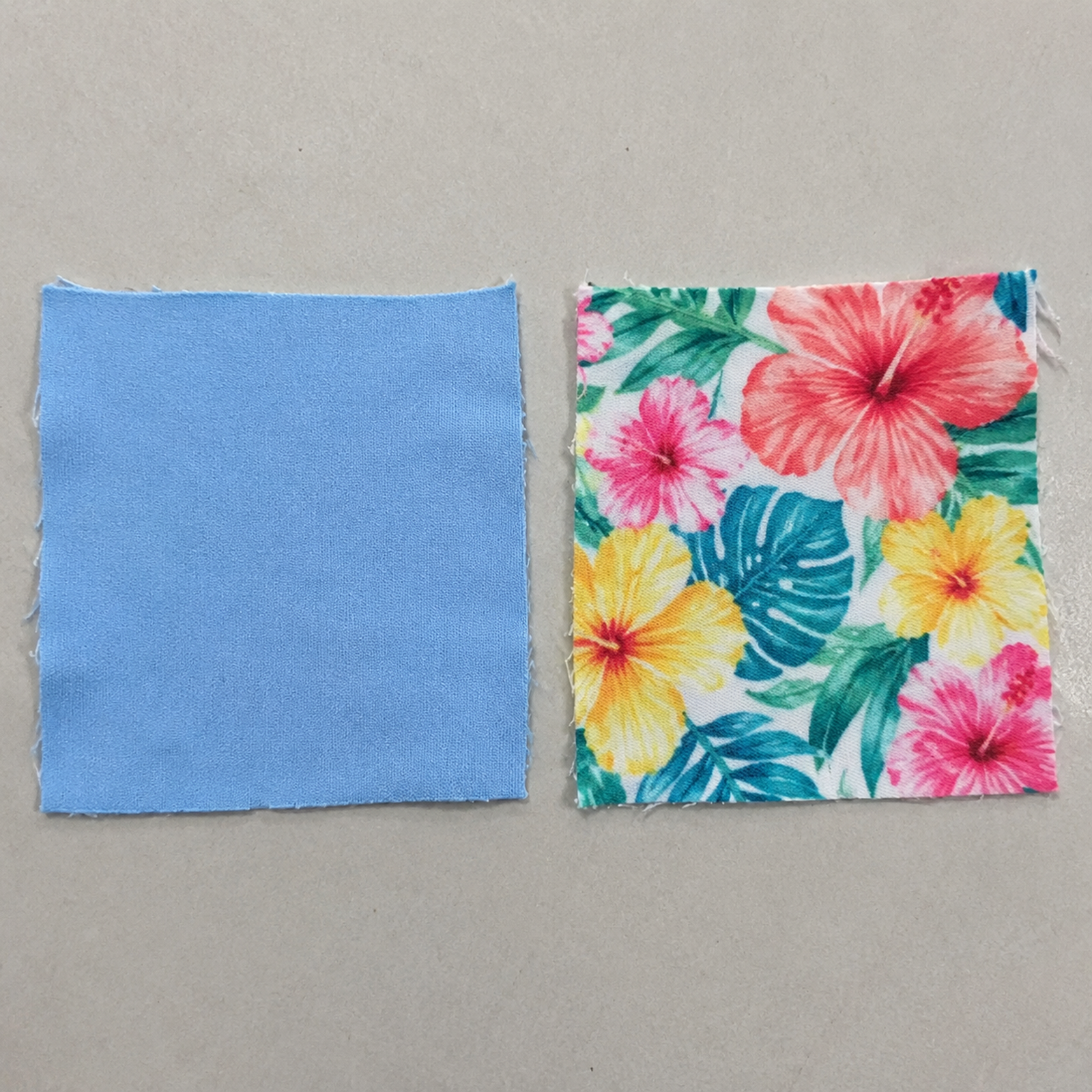
Nylon and elastane blends
Nylon, also known as polyamide, is widely used in fashion swimwear. It is often considered for bikinis, resort one-pieces, tankinis, and collections where a soft hand and smooth appearance are important.
Nylon-elastane fabrics can provide:
- A smooth and soft hand feel
- Good stretch and body conformity
- Rich-looking solid colors
- A clean surface for fashion silhouettes
- Comfortable recovery when paired with suitable elastane
However, the fiber name alone does not tell us enough.
Two fabrics with the same fiber percentages can perform differently because of yarn quality, knitting density, heat setting, dyeing, finishing, and fabric construction.
For example, a lightweight nylon-elastane fabric may feel exceptionally soft on a hanger but become too transparent when stretched over the body. A denser knit may provide better coverage but feel warmer or more compressive.
That is why fabric selection should continue beyond the swatch stage.
Polyester and elastane blends
Polyester blends are also widely used in swimwear. They are often considered when a collection involves frequent pool exposure, sublimation printing, bright patterns, or a stronger focus on color retention.
Polyester should not automatically be described as chlorine-proof. Actual chlorine resistance depends on the fiber, elastane grade, fabric construction, finishing, and testing conditions.
Polyester-based fabrics can offer several useful characteristics:
- Good resistance to color fading
- Strong print definition
- Lower moisture absorption than nylon3
- Better suitability for some repeated-use applications
- Competitive cost options across several fabric weights
The table below gives a practical starting point rather than a universal ranking.
| Fabric system | Typical commercial strengths | What should be verified |
|---|---|---|
| Nylon + elastane | Softness, smooth fit, premium hand feel | Chlorine resistance, pilling, opacity, colorfastness |
| Polyester + elastane | Prints, color retention, repeated-use potential | Surface feel, stretch recovery, abrasion |
| Textured nylon or polyester + elastane | Fashion value, tactile appearance | Snagging, water retention, sewing behavior |
| Recycled nylon or polyester + elastane | Sustainability positioning, familiar performance options | Fiber source, certification, traceability, consistency |
A fabric specification sheet can provide useful information, but the approved fabric sample and finished garment reveal much more than fiber percentages alone.
For shortlisted fabrics, we recommend evaluating the shell and lining together, particularly for light-colored swimwear. Supplier test reports can also be useful when the test method, conditions, and production lot are clearly identified.
How should you compare elastane swimwear materials?
Elastane gives swimwear its familiar stretch, but a high elastane percentage does not guarantee superior quality.
You may encounter branded elastane such as LYCRA fiber or Hyosung's creora. These brands can be relevant when a product has specific technical or marketing requirements, but the brand name should not replace evaluation of the finished fabric.
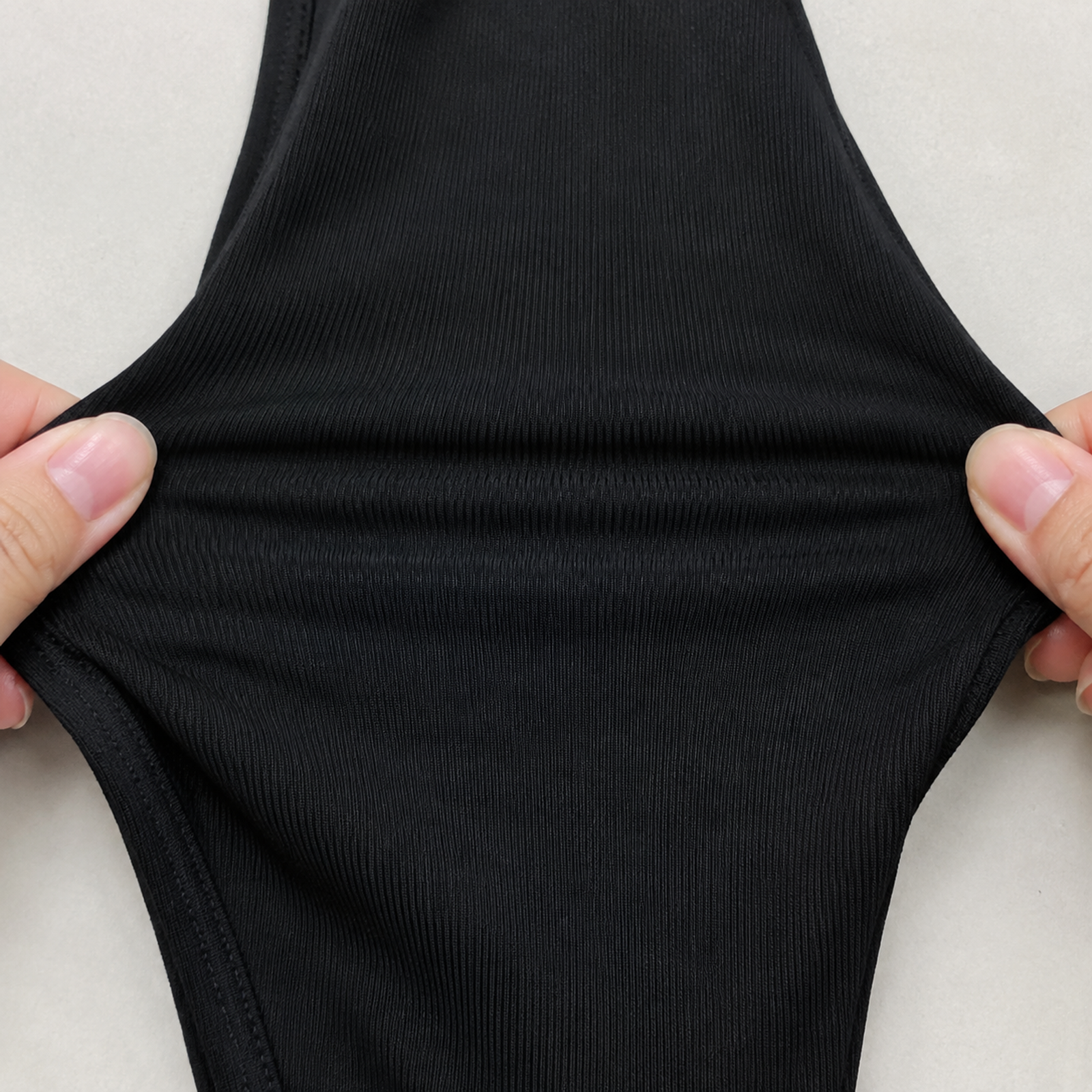
We compare elastane-containing swimwear materials using factors such as:
- Stretch and recovery
- Resistance to the intended exposure
- Heat stability
- Hand feel
- Fabric weight
- Cost
- Supply consistency
- Finished-garment performance
Branded fiber is one part of a fabric specification, not a substitute for fabric testing.
What does elastane contribute?
Elastane, also known as spandex, is designed tostretch substantially and recover toward its original length.4 This property makes it useful for close-fitting garments that need stretch and shape recovery.
In swimwear, the required amount and type of stretch depend on the garment.
A high-support one-piece may require different stretch and recovery from a relaxed resort bikini. Pattern dimensions also need to correspond with the selected fabric's stretch characteristics5
We therefore pay attention to:
- Usable fabric width
- Fabric weight
- Stretch in both directions
- Recovery
- Pattern dimensions
- Negative ease
- Lining behavior
- Intended level of support
Fiber percentages alone cannot show whether a fabric stretches mainly across the width or performs consistently in both directions.
LYCRA, creora, and unbranded elastane
LYCRA is a recognized fiber brand, while creora is Hyosung’s elastane brand. Both companies offer different product grades, so neither name should be treated as a single performance specification.
Some elastane products are designed for specific performance requirements, including improved resistance to chlorine or other environmental conditions. When suppliers provide test figures, we do not treat those numbers as guaranteed garment life.
Before relying on a performance claim, buyers should ask:
- Which test method was used?
- What chlorine concentration and water temperature applied?
- Was the test continuous or cyclic?
- What constituted failure?
- Was the fiber, fabric, or finished garment tested?
- Does the report cover the current production lot?
Supplier data can help compare options when the test conditions are transparent. It should not replace application-specific testing when a brand plans to make a performance claim.
| Evaluation factor | Why it matters | Useful Procurement evidence |
|---|---|---|
| Stretch recovery | Helps the garment retain fit | Fabric test report and approved sample |
| Chlorine resistance | Matters for pool-oriented products | Test method, conditions, and laboratory report |
| Hand feel | Influences perceived comfort and positioning | Physical swatches and wear samples |
| Cost | Affects target margin and retail pricing | Production quotation at confirmed MOQ |
| Buyer recognition | May support product communication | Authorized branding terms and documentation |
| Supply stability | Protects repeat-order consistency | Lot controls, lead time, and shade management |
For some collections, standard elastane may be sufficient. The best choice depends on measurable performance, customer requirements, and total product cost rather than fiber branding alone.
When are elastane-free swimwear materials suitable?
Not all performance swimwear requires conventional elastane.
Elastane-free constructions based on materials such as PBT can provide alternatives for pool-oriented applications. Some Sorona-related constructions can also provide stretch and recovery through their fiber or yarn structure.
However, these materials should not simply replace a nylon-elastane fabric without reviewing the pattern and intended use.
Elastane-free swimwear materials can be suitable for some training, frequent-pool-use, or durability-focused applications, but their stretch, recovery, compression, and care behavior must be evaluated on the actual fabric.
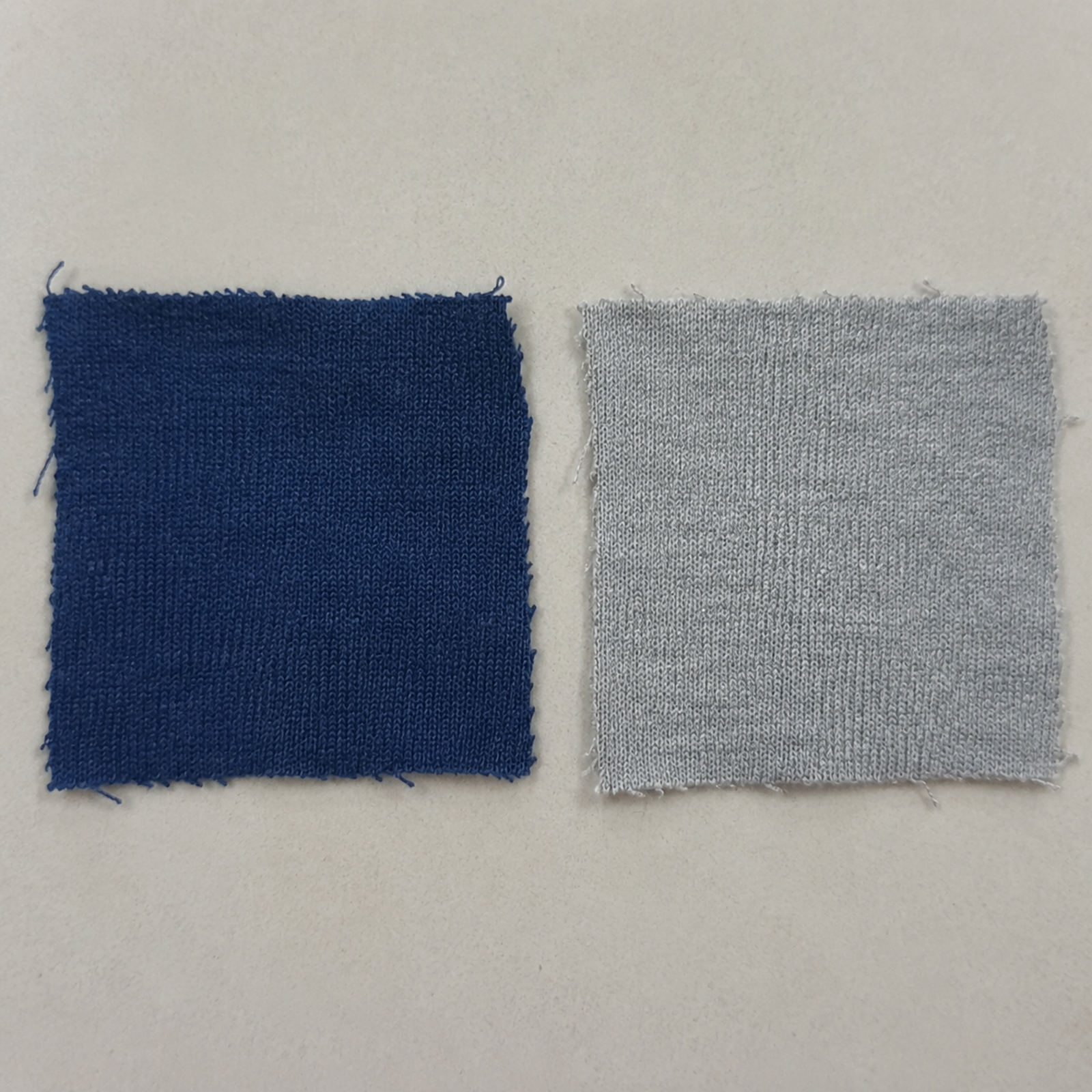
PBT-based swimwear fabric
PBT, or polybutylene terephthalate, belongs to the polyester family.6 It is often used in fabrics designed for repeated pool exposure. Many training and performance swimsuits use polyester/PBT constructions without conventional elastane.7
PBT-based fabrics are commonly considered for:
- Chlorine-resistant applications
- Repeated pool exposure
- Stable shape
- Lower reliance on conventional elastane
- Training and performance products
However, PBT is not a single finished-fabric specification.
The PBT percentage, companion fibers, yarn structure, knitting method, fabric weight, and finishing process can all affect the final result.
Some PBT constructions can feel firmer or less forgiving than fashion-oriented nylon-elastane fabrics. Consequently, a pattern developed for one fabric system may require adjustment when switching to another.
Sorona-based constructions
Sorona is a branded polymer platform associated with DuPont. Suppliers may offer different fabrics containing Sorona-related fibers or yarn constructions.
Research on PTT-based fibers indicates that they can contribute to stretch and recovery in textile constructions without relying on conventional elastane.8 However, this evidence should not be interpreted as proof that every fabric marketed as "Sorona" will perform the same way.
Before approving a Sorona-related fabric, buyers should request:
- Exact fiber composition
- Percentage of each component
- Knitting structure
- Fabric weight
- Usable width
- Stretch and recovery data
- Care instructions
- Relevant certification or trademark documentation
"Sorona fabric" is not enough information to evaluate a finished swimwear material.
| Requirement | PBT-based construction | Sorona-related construction | Elastane blend |
|---|---|---|---|
| Frequent pool exposure | Often considered | Depends on exact construction | Depends on elastane and fabric system |
| Soft fashion hand feel | May feel firmer | May feel more forgiving | Widely available in soft constructions |
| Pattern compatibility | May require adjustment | Requires stretch verification | Familiar to many pattern teams |
| Chlorine resistance | Common reason for selection | Must be verified for the actual fabric | Varies by fabric system |
| Buyer familiarity | Strong in training swim | Growing but variable | High |
| Composition clarity | Must be verified | Must be verified | Must be verified |
When a customer asks for a "chlorine-resistant swimsuit," the first step should be to clarify the actual application.
A swimsuit for occasional hotel-pool use is not necessarily facing the same conditions as a suit worn several times a week for training.
The intended use determines which performance requirements should be tested.
How do we evaluate the quality of materials used for swimwear?
Terms such as "luxury fabric," "Italian quality," "eco fabric," or "factory-developed material" can be useful marketing descriptions, but they are not sufficient technical specifications.
A fabric should be evaluated using measurable characteristics and the requirements of the finished garment.
We assess materials used for swimwear through factors such as:
- Fiber composition
- Yarn and knit construction
- Fabric weight
- Stretch and recovery
- Opacity
- Lining compatibility
- Surface stability
- Finishing
- Color consistency
- Lot control
- Sewing behavior
- Intended use
Fabric weight does not equal quality
Fabric weight, usually stated in grams per square meter, affects coverage, drape, compression, and drying behavior.9 Yet heavier does not always mean better.
A lighter fabric may suit a soft resort bikini or a garment with carefully designed lining. A heavier fabric may provide more coverage or compression but feel warmer or restrict movement.
During sampling, we recommend checking:
- GSM and usable width: Confirm actual measurements rather than relying only on a specification sheet.
- Stretch in both directions: Compare extension and recovery across the fabric.
- Opacity: Inspect dry and wet samples under realistic lighting.
- Surface stability: Check pilling, snagging, and abrasion risk.
- Color consistency: Compare approved standards with bulk lots.
- Sewing response: Look for skipped stitches, seam waving, and needle damage.
- Hand feel: Compare the approved sample with production-intent material.
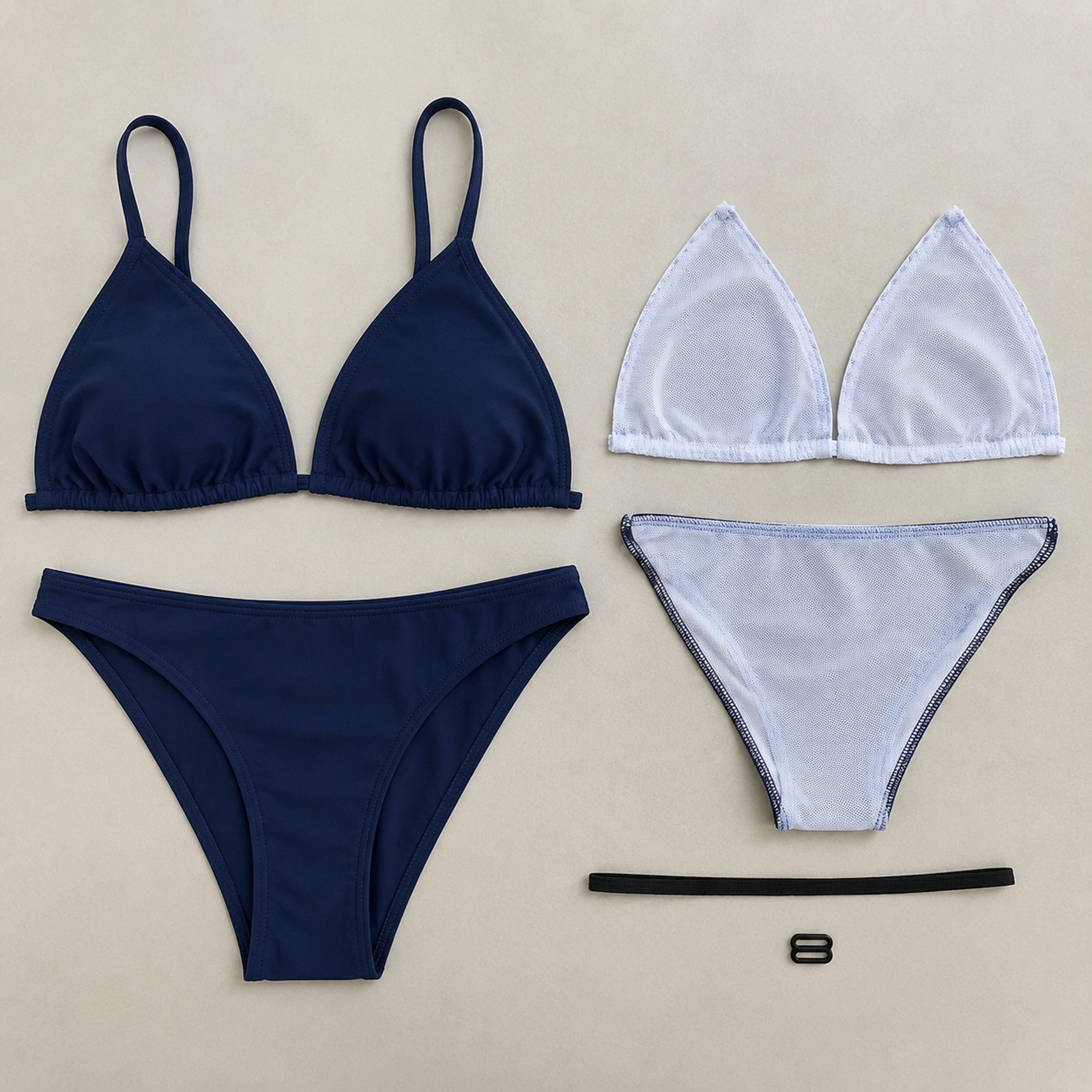
Lining changes the finished garment
Lining is not simply an additional layer.
It can influence coverage, support, stretch, drying behavior, and comfort. A lining with substantially different stretch can restrict the outer fabric or distort the fit.10
This is particularly important for light-colored swimwear.
We inspect the complete shell-and-lining system both dry and wet, including areas around leg openings, bust areas, seams, and high-stretch zones.
The weakest component can determine garment life
A highly durable shell fabric cannot compensate for an elastic that loses recovery too quickly.
Swimwear is a complete system that can include:
- Shell fabric
- Lining
- Elastic and binding
- Sewing thread
- Cups or padding
- Rings, sliders, clasps, and decorative hardware
- Prints, heat transfers, and labels
We judge durability by the complete garment system, not by the strongest material in it.
This is why material selection should continue through sample development and garment testing rather than ending when the fabric is approved.
Are recycled swimwear materials automatically more sustainable?
No.
Recycled content can be part of a more sustainable product strategy, but recycled fiber alone does not establish the environmental performance of the finished garment.
Life-cycle assessments consider multiple stages, including raw materials, processing, energy use, durability, transportation, use, waste, and end-of-life. Recycled content is therefore only one part of the overall picture. European Environment Agency analysis of textiles and environmental impact11
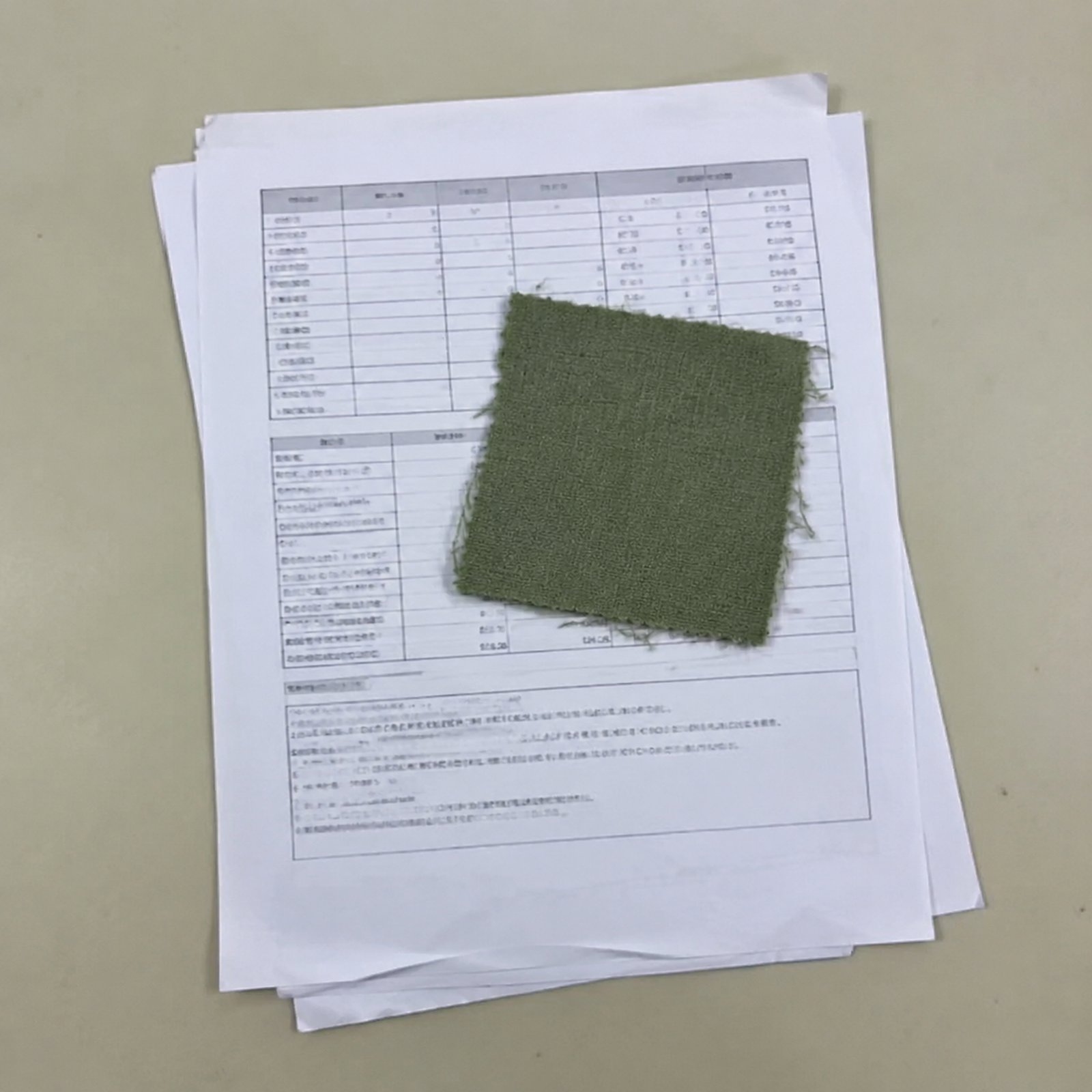
Recycled nylon and recycled polyester can support a brand's sustainability objectives when their source, composition, chain of custody, and relevant certifications can be verified.
However, brands should continue evaluating:
- Fabric quality
- Durability
- Colorfastness
- Production consistency
- Restricted substances
- Traceability
- Whole-garment construction
What documentation should buyers request?
ECONYL regenerated nylon is one recognized recycled nylon option, but a branded fiber name does not automatically establish the performance of every finished fabric containing that fiber.
Depending on the product and market, buyers may request:
- Fiber composition declarations
- Relevant transaction or scope certificates
- Chain-of-custody documentation
- Supplier documentation identifying the fiber
- Restricted-substance test reports
- Fabric performance reports
- Authorized trademark guidance
- Lot or batch references
Certification documents should be checked for their scope, issuing organization, validity, named facility, and covered products.
This becomes particularly important when a brand needs to meet retailer requirements or make environmental claims in a regulated market.
Durability belongs in the sustainability discussion
A durable product may remain usable for longer, but durability alone should not be converted into a specific environmental benefit without appropriate life-cycle evidence.
From a product-development perspective, brands can still make practical choices that support longer use:
- Match shell, lining, and elastic performance
- Avoid fragile decorations on high-use products
- Select materials appropriate for the intended exposure
- Provide realistic care instructions
- Reduce unnecessary component complexity
- Control cutting and production waste
- Maintain repeatable colors and constructions
For emerging D2C brands, sustainability also needs to remain commercially realistic.
A material that significantly increases product cost may affect the final retail price and market positioning. A focused sustainable capsule or small initial collection can sometimes be a more manageable way to validate demand before expanding the entire range.
The most useful sourcing brief connects the environmental objective with measurable requirements.
For example, instead of simply requesting "premium eco swimwear," a buyer could specify:
- Verified recycled nylon content
- Target fabric-weight range
- Wet-opacity requirements
- Colorfastness requirements
- Required certifications
- Compatible lining
- Suitable elastic performance
This gives the manufacturer clearer requirements for development and sampling.
Frequently Asked Questions
What Is the Most Common Material for Swimsuits?
Common swimsuit materials include nylon-elastane and polyester-elastane blends.
Nylon blends are often selected for their soft hand and smooth appearance, while polyester blends can be useful for color retention, printing, and some repeated-use applications.
The appropriate choice depends on the garment's construction, intended use, target price, and performance requirements.
Is Nylon or Polyester Better for Swimwear?
Neither fiber is universally better for swimwear.
Nylon is often considered for soft hand feel and fashion-focused styles. Polyester can be considered for printing, color retention, and some pool-oriented applications.
However, the finished fabric matters more than the base-fiber name alone.
Knit construction, elastane grade, fabric weight, finishing, lining, and pattern all influence the finished garment.
What Percentage of Elastane Is Good for Swimwear?
There is no single elastane percentage that guarantees good swimwear performance.
Many commercial swim fabrics use elastane in varying proportions, but the appropriate ratio depends on the fabric construction and garment requirements.
We evaluate elastane percentage together with:
- Fabric weight
- Stretch direction
- Recovery
- Pattern dimensions
- Support requirements
- Intended use
The approved garment sample is more useful than the composition number alone.
Is Thicker Swimsuit Fabric Higher Quality?
No. A thicker swimsuit fabric is not automatically higher quality.
Higher fabric weight may improve coverage or compression, but it can also affect weight, drying, warmth, and movement.
The right evaluation should consider GSM together with opacity, recovery, hand feel, lining, seam behavior, and intended use.
How Do You Test Swimwear Fabric Before Bulk Production?
A proper evaluation should combine fabric documentation, material testing, and an actual garment sample.
Depending on the application, buyers may evaluate:
- Fiber composition
- Fabric weight
- Stretch and recovery
- Wet opacity
- Colorfastness
- Pilling
- Abrasion
- Chlorine resistance
- Lining compatibility
- Sewing performance
The fitted sample should use production-intent materials wherever possible.
For application-specific performance claims, qualified textile laboratories or specialists should conduct the appropriate testing.
Conclusion
The materials used for swimwear commonly include nylon, polyester, elastane, PBT-based constructions, Sorona-related fibers, and recycled alternatives.
But choosing a swimwear material is not simply a matter of asking which fiber is "best."
The right material is the one that works with the garment's pattern, construction, lining, intended use, target customer, performance requirements, and production conditions.
For brands developing a new collection, the process should therefore move from:
Material selection → Fabric evaluation → Pattern development → Sampling → Fit testing → Quality verification → Bulk production
At Aura Intimates Global, we combine more than 10 years of OEM/ODM manufacturing experience with product development, sampling, and production quality management to help brands turn material requirements into finished swimwear.
If you are developing a new swimwear collection, contact Aura to discuss your target market, collection concept, MOQ, fabric requirements, and production needs before approving bulk production.
"Do I have to rinse out my swimsuit after the pool? A textile ...", https://phys.org/news/2026-01-swimsuit-pool-textile-scientist.html. Textile references identify nylon- or polyester-based knits combined with elastane as common constructions for close-fitting swimwear, although their relative prevalence varies by product category and market. Evidence role: expert_consensus; source type: education. Supports: A textile reference should identify nylon-elastane and polyester-elastane blends as widely used swimwear constructions.. Scope note: General textile references may establish common usage without quantifying global market share. ↩
"Swimwear Fabric Guide: Chlorine Resistance, UV & Stretch", https://spandexbyyard.com/blogs/spandex-vs-other-stretch-fabrics-type-explained/best-fabric-for-swimwear?srsltid=AU7gw4VEKvEW0g-LYEYHAGp_UJDqRCcLBKuC4yET91UmNyPpRVrr18Rw. Published analyses and compositional surveys of commercial stretch swim fabrics report base-fiber and elastane ratios within broadly similar ranges; these observations describe sampled products rather than a binding industry specification. Evidence role: statistic; source type: research. Supports: A compositional survey or textile study should show that many commercial swim fabrics fall within the stated elastane and base-fiber ranges.. Scope note: A sample of fabrics may not represent every market, garment type, or supplier. ↩
"Mid-infrared emissivity of nylon, cotton, acrylic, and ...", https://research.cec.sc.edu/files/asc/files/documents/belliveau-et-al-2019-mid-infrared-emissivity-of-nylon-cotton-acrylic-and-polyester-fabrics-as-a-function-of-moisture.pdf. Standard textile-property references report a lower equilibrium moisture regain for polyester than for nylon under comparable conditions, supporting the relative absorption claim but not directly determining how quickly a complete swimsuit will dry. Evidence role: mechanism; source type: education. Supports: Standard textile-property data should show lower equilibrium moisture regain for polyester than for nylon under comparable atmospheric conditions.. Scope note: Garment drying also depends on knit structure, fabric mass, finishes, lining, and environmental conditions. ↩
"Impact of the Elastane Percentage on the Elastic Properties of ...", https://pmc.ncbi.nlm.nih.gov/articles/PMC9570736/. Elastane, also known as spandex, is defined as a manufactured elastic fiber capable of substantial extension followed by recovery toward its original length. Evidence role: definition; source type: encyclopedia. Supports: An authoritative reference should define elastane or spandex by its high extensibility and elastic recovery.. ↩
"(PDF) Designing with stretch fabrics", https://www.academia.edu/68247631/Designing_with_stretch_fabrics. Stretch-garment patternmaking guidance relates negative ease and pattern reduction to the selected fabric's extensibility and recovery, because identical pattern dimensions can produce different pressure and fit in different knits. Evidence role: mechanism; source type: education. Supports: Patternmaking guidance should explain that negative ease for stretch garments is determined in relation to fabric extensibility and recovery.. Scope note: The appropriate reduction also depends on garment design, body area, support requirements, and seam construction. ↩
"Thermoplastic Polyester (PET/PBT)", https://books.byui.edu/plastics_materials_a/thermoplastic_polyes. Polybutylene terephthalate is a thermoplastic polyester produced through condensation chemistry involving terephthalate and butanediol components. Evidence role: definition; source type: encyclopedia. Supports: A polymer reference should classify polybutylene terephthalate as a member of the polyester family.. ↩
"Chlorine Resistant Swimwear: Why It's Worth the Investment", https://swimweargalore.com/en-us/blogs/the-swim-report/chlorine-resistant-swimwear-why-its-worth-the-investment?srsltid=AU7gw4X9HXHdOf_pbHZ3HaGtqUZBtxPg_9FgAl2_LW04cTCbL0ExpB9G. Textile literature describes polyester/PBT knitted constructions as an elastane-free material option for pool and training swimwear, particularly where dimensional stability under repeated chlorinated-water exposure is prioritized. Evidence role: general_support; source type: research. Supports: Independent textile research should document polyester/PBT constructions as an elastane-free option for pool-oriented swimwear.. Scope note: This application evidence does not show that every polyester/PBT fabric has equivalent chlorine resistance or fit performance. ↩
"Dyeing of Innovative Bicomponent Filament Fabrics (PET ...", https://www.academia.edu/65527331/Dyeing_of_Innovative_Bicomponent_Filament_Fabrics_PET_PTT_by_Disperse_Dyestuffs_Characterization_and_Optimization_Process. Research on polytrimethylene terephthalate fibers reports comparatively favorable elastic recovery and identifies them as a basis for stretch textiles that need not contain conventional elastane; the resulting comfort and extension still depend on yarn formation and fabric construction. Evidence role: mechanism; source type: paper. Supports: Research on polytrimethylene terephthalate fibers should show that their molecular and yarn structure can contribute to elastic recovery in fabrics without elastane.. Scope note: Evidence about PTT fibers does not establish the performance of every fabric marketed under a Sorona-related description. ↩
"Quantitative mode for predicting fabric drape parameters ...", https://journals.sagepub.com/doi/10.1177/15280837261479248. Experimental textile studies associate fabric areal density with changes in cover, drape, mechanical resistance, and moisture-drying behavior, but GSM alone does not determine any of these properties independently. Evidence role: mechanism; source type: paper. Supports: Textile studies should connect fabric areal density with drape, thickness or cover, pressure behavior, and moisture-drying performance.. Scope note: Fiber type, knit geometry, thickness, finishes, stretch, and lining can confound the relationship between GSM and garment performance. ↩
"Analysis of Woven Fabric Mechanical Properties in the ... - PMC", https://pmc.ncbi.nlm.nih.gov/articles/PMC12349057/. Research on layered and close-fitting garments indicates that composite extension is constrained by the mechanical behavior of the component layers, so a less extensible lining can alter garment stretch, pressure, and fit. Evidence role: mechanism; source type: paper. Supports: Research on layered stretch garments should show that the least extensible layer can constrain the composite system and affect fit or pressure.. Scope note: The degree of distortion depends on pattern geometry, seam attachment, grain direction, and the mechanical properties of both fabrics. ↩
"Textiles and the environment: the role of design in Europe's ...", https://www.eea.europa.eu/en/analysis/publications/textiles-and-the-environment-the-role-of-design-in-europes-circular-economy-1. Life-cycle assessment guidance treats recycled content as one input among many: it may reduce demand for virgin feedstock, while the finished garment's environmental profile also depends on processing, energy, durability, transport, use, waste, and end-of-life assumptions. Evidence role: expert_consensus; source type: institution. Supports: Life-cycle guidance should establish that recycled content can reduce reliance on virgin feedstock while overall environmental performance depends on multiple stages of the product system.. Scope note: The direction and magnitude of any benefit must be evaluated for the specific fiber, production system, allocation method, and use scenario. ↩